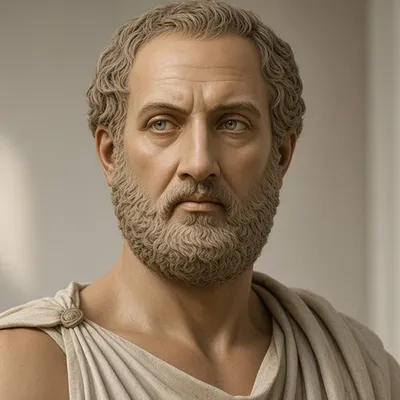
"Power and interests often play a fundamental role in shaping the behavior of states."


Life and Thought
Thucydides was an ancient Greek historian and political thinker, and the author of "History of the Peloponnesian War." He is regarded as one of the founders of critical historiography, emphasizing rational analysis of the causes of events and leaving a lasting influence on political thought and historical methodology.
Thucydides was born around 460 BCE in Athens or its surrounding regions. Little is known about his life, but he came from a wealthy and influential family and served as a military commander during the Peloponnesian War between Athens and Sparta. In 424 BCE, he was appointed as a general, but after failing to defend Amphipolis, he was exiled. This period allowed him to examine the war and the political transformations of his time from a critical distance.
Thucydides' most important work is "History of the Peloponnesian War," which describes the conflict between the Athenian and Spartan alliances from 431 to approximately 404 BCE. Unlike many earlier historians, he attempted to write history based on evidence, source examination, and analysis of human and political causes, avoiding mythological explanations and divine interventions.
In his analysis of war and politics, Thucydides emphasized concepts such as power, political interests, fear, ambition, and the rational calculation of states. His famous Melian Dialogue, which examines the relationship between power and justice, remains one of the important texts in the history of political thought and international relations.
Thucydides' historical method, especially his emphasis on critical inquiry and discovering the real causes of events, influenced modern historiography and political theory. He is often mentioned alongside Herodotus as one of the greatest historians of ancient Greece, though his approach was more analytical and political.