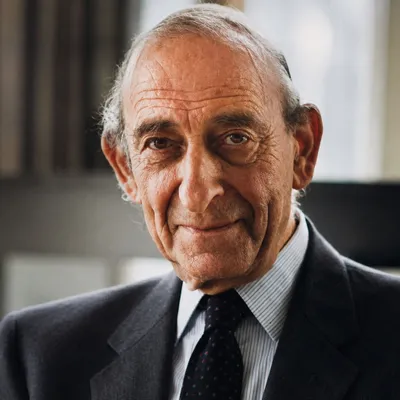
Foreign thinker
Raymond Aron
Raymond AronPolitical Philosophy, Sociology, and International RelationsFrench1905–1983
"A man who no longer expects miraculous changes from a revolution or an economic plan is not obliged to resign himself to the unjustifiable."


Life and Thought
Raymond Aron was a French philosopher, sociologist, political scientist, and journalist, and one of the most important political thinkers of twentieth-century France. Through his critique of Marxism and political ideologies, and his works on sociology, history, war, and international relations, he is considered a prominent defender of the liberal tradition and political realism in France.
Raymond Claude Ferdinand Aron was born on March 14, 1905, in Paris and died in the same city on October 17, 1983. He studied at the École Normale Supérieure and the University of Paris, and later taught at major academic institutions, including the Collège de France. Throughout his professional career, Aron was simultaneously active in philosophy, sociology, political science, history, and journalism, becoming one of the most influential figures in French intellectual life of the twentieth century.
His first major philosophical work, *Introduction to the Philosophy of History*, was published in 1938. In this work, Aron emphasized the complexity and polysemy of historical reality and opposed deterministic conceptions of history. In his view, historical knowledge cannot be reduced to the definitive prediction of the future or the discovery of inevitable laws of historical development.
Aron is best known for his serious critique of communism and political ideologies. The book *The Opium of the Intellectuals*, published in 1955, is one of his most famous works. By inverting Marx's famous phrase about the "opium of the masses," Aron argued that Marxism had become a kind of political faith for a segment of post-World War II intellectuals. In this book, he warned against the sanctification of revolution and the justification of political violence, and defended freedom and democracy.
In the field of sociology, Aron paid special attention to the classical sociological tradition and thinkers such as Montesquieu, Comte, Marx, Tocqueville, Durkheim, Pareto, and Max Weber. His book *Main Currents in Sociological Thought* offers an important critical examination of the legacy of these thinkers.
Aron was also a major figure in the study of war and international relations. The book *Peace and War: A Theory of International Relations* is one of his well-known works in this area. His approach to analyzing international politics was based on attention to power, interests, the constraints of human decision-making, and historical conditions.
Throughout his intellectual life, Aron had a long yet tense relationship with Jean-Paul Sartre and became a serious opponent of ideological leftism and communism. Against the belief in deterministic laws of history, he emphasized uncertainty, political responsibility, and the possibility of human choice; from this perspective, one of the enduring themes of his thought was the defense of critical rationality against political dogmatism.