Everything that exists is either necessary of existence or possible of existence. The necessary of existence is that whose existence is from itself, and the possible of existence is that whose existence is from another.


Life and Thought
Ibn Sina (Avicenna), the Persian philosopher, physician, and scientist (370–428 AH), was one of the most influential pre-modern thinkers in the Islamic world and Europe. By authoring works such as The Book of Healing and The Canon of Medicine, he synthesized Greek and Islamic philosophical and medical traditions into a coherent system.
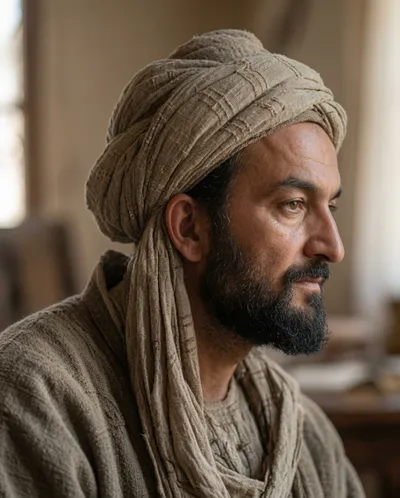
Ibn Sina, born around 370 AH / 980 CE and died in 428 AH / 1037 CE, was a Persian philosopher, physician, logician, scientist, and author. He is one of the greatest figures in the history of philosophy and medicine in the Islamic world and is considered among the most influential pre-modern thinkers in both East and West. In the Islamic tradition, he was called "al-Shaykh al-Raʾis" (the Master and Head), and in the medieval Latin tradition, his name was also one of the foundational names of philosophy and medicine.
The primary source for Ibn Sina's biography is his own account, followed by a supplement added by his student and companion, Abu Ubayd al-Juzjani. The Encyclopædia Iranica emphasizes that almost all later narratives of Ibn Sina's life trace back to this autobiography and al-Juzjani's report, and must be carefully separated from later legends and accretions.
Ibn Sina was born near Bukhara, in Samanid territory. From childhood, he displayed a rare genius; he learned the Quran, literature, logic, mathematics, and medicine at an early age, and according to biographical reports, by around the age of eighteen, he had reached a high level in many of the sciences of his time. His access to the Samanid library in Bukhara, especially after treating the Samanid Amir Nuh, was highly influential in his scholarly development.
With the decline of Samanid power, Ibn Sina's life took on a restless character. He traveled from Bukhara to Khwarazm, Gorgan, Ray, Hamadan, and finally Isfahan. In Ray and Hamadan, he became connected with the Buyid court and even served for a time as vizier to Shams al-Dawla. After political conflicts and imprisonment, he went to Isfahan and entered the service of Ala al-Dawla Kakuya. This period was one of the calmest and most productive of his life. Ibn Sina eventually fell ill during a journey to Hamadan and died there.
Ibn Sina's philosophy is not a simple continuation of Aristotle; he reconstructed the Aristotelian, Neoplatonic, Farabian, Islamic theological (kalam), and scientific traditions of his time into a coherent system. The Stanford Encyclopedia of Philosophy considers him a thinker who combined various branches of Greek and Islamic philosophy into a rational and self-sufficient system.
In metaphysics, Ibn Sina's most important innovation is the distinction between "essence" and "existence" and the analysis of beings based on possibility and necessity. Through this path, he arrives at the concept of the "Necessary Existent" (Wajib al-Wujud); a being whose existence is inseparable from its essence and is the ultimate cause of all possible beings. In his system, metaphysics is the science of "being qua being," and God, as the First Principle, is proven within this very science.
In logic, Ibn Sina went beyond Aristotelian logic and created a system that later became renowned in the Islamic world as "Avicennan logic." His discussions on syllogism, conditional propositions, modal logic, definition, demonstration, and the relationship between logic and science remained influential for centuries in the Islamic philosophical and theological tradition.
In philosophical psychology, he considered the human soul to be an immaterial substance and, to demonstrate the soul's independence from the body, devised the famous argument of the "Suspended Man" or "Flying Man." This idea later gained importance in Islamic philosophy and even in comparison with certain discussions in modern philosophy concerning self-consciousness.
Ibn Sina's medical fame rests above all on the book The Canon of Medicine. This work is a vast encyclopedia of theoretical and practical medicine and served as the standard reference text for medical education in the Islamic world and Europe for centuries. The Canon is not merely a collection of prescriptions but a coherent system of diagnosis, humoral theory, pharmacology, pathology, and treatment.
Ibn Sina's importance in medicine lies in his gathering of scattered Greek, Islamic, and empirical knowledge into an organized and pedagogical format. His medical works were taught in medieval European universities and retained their authority until the beginning of the modern era.
Ibn Sina influenced many philosophers and theologians; from Nasir al-Din al-Tusi, Suhrawardi, and Mulla Sadra in the Islamic tradition to Albertus Magnus and Thomas Aquinas in the Latin tradition. Much of the philosophical discussion in Islam after him is either a continuation of Ibn Sina or a critique of him. Al-Ghazali and Fakhr al-Din al-Razi were among his most important critics, and Ibn Rushd (Averroes) also objected to parts of his system from an Aristotelian standpoint.
Despite these critiques, the Avicennan tradition did not disappear; rather, it became one of the main pillars of Islamic thought in logic, metaphysics, theology, philosophical psychology, and medicine. In Iran, his birthday, the first of Shahrivar, is recognized as Doctor's Day, and his mausoleum in Hamadan is one of the important symbols of the history of science and philosophy in Iran.