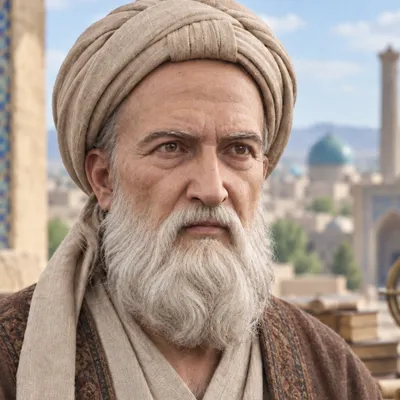
Iranian thinker
Abu Rayhan al-Biruni
Abu Rayhan al-BiruniAstronomy, Mathematics, and Cultural AnthropologyIranian973–1048



Life and Thought
Abu Rayhan Muhammad ibn Ahmad al-Biruni (973–1048 CE) was an Iranian polymath of the Islamic Golden Age and one of the greatest astronomers, mathematicians, and historians of the medieval period. Through his book Tahqiq ma li'l-Hind, the first scholarly and impartial study of Indian culture and religions by an outside author, he is regarded as a founder of comparative religious studies and cultural anthropology.
Abu Rayhan Muhammad ibn Ahmad al-Biruni was born on 3 Dhu al-Hijjah 362 AH (4 September 973 CE) on the outskirts of Kath, the capital of Khwarazm. He spent the first twenty-five years of his life there, studying mathematics, astronomy, and Greek and Islamic sciences under scholars such as Abu Nasr Mansur ibn Iraq. Biruni was fluent in several languages, including Khwarazmian, Persian, Arabic, and Sanskrit, and was familiar with ancient Greek, Hebrew, and Syriac.
In his youth, Biruni dedicated his first major work, al-Athar al-Baqiya an al-Qurun al-Khaliya (The Chronology of Ancient Nations), to Qabus ibn Wushmagir, the Ziyarid ruler of Gorgan, around 390 AH; in it he examined the calendars and festivals of various peoples and religions from a comparative perspective. During this period he also observed lunar eclipses in Gorgan before eventually returning to the Khwarazmshahid court. After the fall of the Khwarazmshahs to Sultan Mahmud of Ghazni in 408 AH, Biruni moved to the Ghaznavid court, where he spent the rest of his life, despite a difficult relationship with Mahmud, serving that dynasty and its successors.
Biruni's most significant achievement resulted from his participation in Mahmud of Ghazni's campaigns into India: having learned Sanskrit and studied Hindu texts and practices firsthand, he wrote Tahqiq ma li'l-Hind (Verifying All That Concerns India), the first systematic, observation-based study of a foreign culture by a Muslim scholar, earning him the titles "father of anthropology" and "father of Indology." In the book's introduction, he explicitly states his method of relaying the Hindus' own views impartially rather than judging them from the standpoint of his own religious beliefs.
In astronomy and mathematics, Biruni's al-Qanun al-Mas'udi (dedicated to Mas'ud of Ghazni) addressed spherical trigonometry, a method for calculating the Earth's radius through observation from a mountain peak, and mathematical astronomy; his al-Tafhim li-Awa'il Sina'at al-Tanjim, his only known work in Persian, explained the principles of mathematics, geometry, and astronomy in question-and-answer form for a young audience (according to some sources, a girl named Rayhana); and his al-Jamahir fi Ma'rifat al-Jawahir classified minerals and gems and measured their specific gravities, making it one of the earliest works of experimental mineralogy.
Biruni was a contemporary of Avicenna, and the two exchanged a scientific correspondence on questions of Aristotelian physics and cosmology — including the nature of the vacuum, the motion of the celestial spheres, and the four elements — preserved in the treatise al-As'ila wa'l-Ajwiba (Questions and Answers), which reveals both the depth and the sharpness of their disagreements. Biruni also wrote a dedicated treatise, Risala fi Fihrist Kutub al-Razi (Catalogue of Razi's Books), which remains the most important historical source on the birth, death, and works of the physician-philosopher Muhammad ibn Zakariya al-Razi.
Throughout his work, Biruni consistently relied on direct observation, measurement, and experiment, and resisted the uncritical acceptance of prevailing views — even those from authoritative Greek sources. He died in Ghazni at around eighty years of age.