The virtuous city is like a healthy body, all of whose organs assist one another for the perfection of life and its preservation.
In their times
Open in the Timeline of Thought


Life and Thought
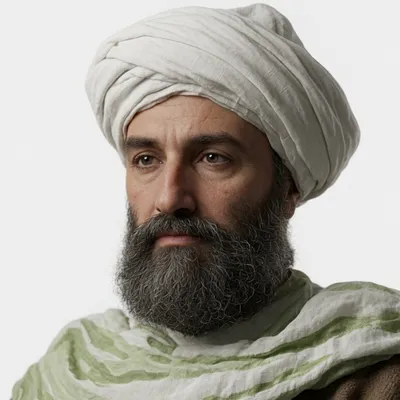
Abu Nasr Muhammad al-Farabi, commonly known as al-Farabi, is a philosopher of the early period of Islamic philosophy. He was born around 870 CE and died in Damascus in 950 or 951 CE.
Abu Nasr Muhammad al-Farabi, commonly known as al-Farabi, is one of the greatest philosophers of the early period of Islamic philosophy. He was born around 870 CE and died in Damascus in 950 or 951 CE. We lack definitive and consistent details about his life, but we know that he attained a very high status in the Islamic philosophical tradition; so much so that he was called the "Second Teacher" after Aristotle.
Al-Farabi studied and taught in Baghdad, where he became acquainted with the Aristotelian logical and philosophical tradition, particularly through Syriac and Christian schools. He then went to the Levant and lived for a time in Damascus and Aleppo. It is said that he also had connections with the court of Sayf al-Dawla al-Hamdani, although many accounts of his life are mixed with legend and later reports.
Al-Farabi is the first major philosopher of the Islamic world who attempted to present philosophy as a coherent system. His importance lies not only in his commentaries on Greek works; he formulated logic, metaphysics, ethics, politics, language, religion, and music within a relatively harmonious framework.
In political philosophy, al-Farabi is the founder of one of the most important traditions of political thought in the Islamic world. His famous work, <i>The Principles of the Opinions of the People of the Virtuous City</i> (<i>Ārā' Ahl al-Madīna al-Fāḍila</i>), presents an image of an ideal society in which the head of the city must be wise, ethical, and a spiritual leader. In this view, politics is inseparable from human happiness.
In logic, al-Farabi played a significant role in transmitting and adapting Aristotelian logic into the Arabic language. He established a link between language, thought, and demonstration, and sought to show that logic is the tool for attaining certain knowledge.
One of the less examined aspects of al-Farabi is his theory of music. The <i>Great Book of Music</i> (<i>Kitāb al-Mūsīqā al-Kabīr</i>) is one of the most important works of musicology in the Islamic world. In this work, al-Farabi did not only address the abstract theory of music but also examined the practical experience of music, mathematics, acoustic ratios, rhythms, and the musical modes of his time.
Bibliography
Writings and transcribed lectures10 titles
The Opinions of the People of the Virtuous City
al-Siyāsa al-madaniyya
Tahsil al-Sa'ada (The Attainment of Happiness)
The Enumeration of the Sciences
The Reconciliation of the Opinions of the Two Sages, Plato and Aristotle
Treatise on the Intellect
The Intentions of Metaphysics
Kitab al-Huruf (Book of Letters)
Kitab al-Musiqa al-Kabir (The Great Book of Music)
What One Should Know Before Philosophy
Sedanet articles about Farabi