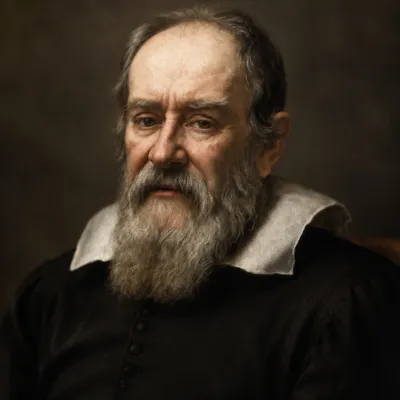
Foreign thinker
Galileo Galilei
Galileo GalileiAstronomy, physics, and natural philosophyItalian1564–1642
In their times
Open in the Timeline of Thought


Life and Thought
Galileo Galilei was an Italian astronomer, physicist, and natural philosopher, and a pivotal figure in the Scientific Revolution. Through telescopic observations and studies of motion, he defended the heliocentric model and played a major role in the emergence of modern science.
Galileo Galilei was born in Pisa and studied at the University of Pisa. After teaching at the universities of Pisa and Padua, he improved the telescope and used it for astronomical observation. He made important discoveries, including the uneven surface of the Moon, the moons of Jupiter, sunspots, and the phases of Venus. These observations conflicted with prevailing Aristotelian and geocentric cosmology and supplied empirical support for Copernican heliocentrism.
His major works include The Starry Messenger, Dialogue Concerning the Two Chief World Systems, and Discourses and Mathematical Demonstrations Relating to Two New Sciences. Galileo made foundational contributions to the study of falling bodies, motion, and experimental method, emphasizing the connection between observation, experiment, and mathematics. His defense of heliocentrism led to his trial by the Inquisition and to house arrest for the remainder of his life.