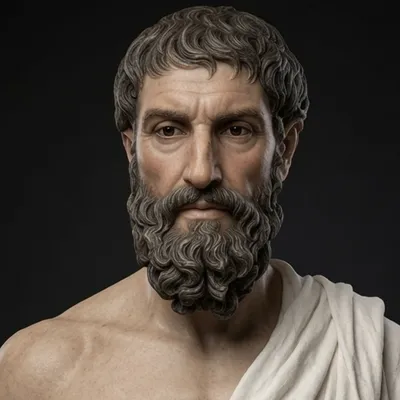
Death is nothing to us; for that which is dispersed has no sensation, and that which has no sensation is nothing to us.


Life and Thought
Epicurus, the Greek philosopher and founder of Epicureanism, was born in 341 BCE and died in 270 BCE. His teachings centered on the pursuit of tranquility, friendship, and freedom from fear.
Epicurus, born 341 and died 270 BCE, was a Greek philosopher and the founder of the Epicurean school. He was born on the island of Samos and later established his philosophical school in Athens, known as "The Garden"; a place that became a circle for dialogue, teaching, and simple philosophical living.
Epicurus's thought was based on the belief that philosophy should help human beings attain tranquility, wise happiness, and freedom from fear. He saw the good life not in excessive pleasure-seeking, but in simplicity, friendship, self-sufficiency, peace of mind, and avoidance of needless anxieties. For this reason, his school is most often associated in the history of culture and philosophy with the concepts of "tranquil living" and "freedom from fear."
Epicurus held influential views on death, the gods, knowledge, nature, and ethics. He regarded death as the end of human experience and believed that the fear of death is one of the primary sources of human suffering. In epistemology, he emphasized sensory experience, and in explaining the world, he drew upon the atomist tradition of Democritus.
Although many of Epicurus's writings have been lost, his teachings reached later generations through surviving letters, sayings, and the works of his students and followers, particularly Lucretius. His thought influenced many philosophers and writers across various periods, from the ancient world to the Enlightenment.
Bibliography
Writings and transcribed lectures18 titles
Letter to Menoeceus
Letter to Herodotus
Letter to Pythocles
Fundamental Teachings
Vatican Discourses
On Nature, in 37 Books
On Atoms and the Void
On Love
On Choice and Avoidance
On the Criterion or Focus
On the Gods
On Piety
Four Essays on Life
Symposium
On Perception
On Justice and Other Merits
On Gifts and Gratitude
Letters