Philosophy
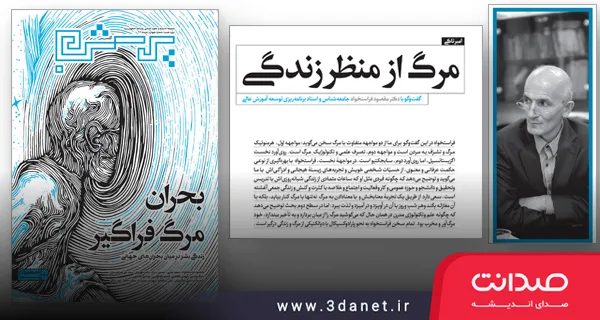
Why Do I Fear Death? A Talk by Arash Naraghi on the Fear of Death from an Epicurean Perspective
The fear of death stems from the belief that non-existence is a harm, yet the Epicureans consider this irrational. Arash Naraghi examines Lucretius's symmetry argument, which equates the non-existence before birth with that after death.

Why Do I Fear Death?
(A Talk on the Fear of Death from an Epicurean Perspective)[1]
Arash Naraghi
Death has been one of the most significant sources of fear in human life. But what is the root of this deep existential dread? Why do humans find their own death and that of their loved ones sorrowful and terrifying? The answer to this question seems clear: death targets the very foundation of our existence and that of our loved ones. The arrival of death means losing our most beloved object, namely our own life and that of our loved ones. It is as if death is a source of immense and irremediable harm, and it is this immense harm that makes death dreadful. This doctrine is sometimes called the "Harm Thesis": the fear of death arises from the harm it inevitably inflicts upon us. But is the "Harm Thesis" true? Is death truly a source of harm and, on that account, a cause of fear in our lives? Is the fear of death a rational matter?
Humans have given different answers to this question. Within the framework of religious thought, the fear of death (insofar as it is death) is often considered unjustified, because within that framework, human life continues after their bodily death, and if death is not the end of the road, then fearing it (at least insofar as it is not the cause of our non-existence and that of our loved ones) would be unjustified. It is for this reason that figures like Freud believed that the secret to the endurance of religion and the persistence of religious belief lies, among other things, in the consolation religion provides against the fear of death and the grief arising from it. The fear of our own death and that of our loved ones sometimes grips us so tightly that it robs us of the desire and courage to live. But religion, with its promise of an afterlife and immortality, dispels our terror and diminishes the volume of our fear and sorrow in this world.
Of course, in addition to religious answers, responses to the "Harm Thesis" have also been given from a non-religious perspective. That is, a group of sages have tried to remedy our fear of death without resorting to religious metaphysics. For example, some, like Bernard Williams, believed that immortality is a cursed yoke upon the human neck, and therefore, death is not only not harmful but can be a source of liberation and meaning-making, and hence, the wise person should welcome it. In addition to the sages of the modern era, in ancient culture, too, some endeavored to refute the "Harm Thesis." Among these individuals were Epicurus (the Greek sage) and his followers. Epicurus and his disciples tried to remedy the human fear of death without resorting to the idea of God or an afterlife, and to demonstrate with the force of argument that our fear of death is fundamentally irrational, and a wise and aware person realizes through the power of reason that death is not a source of harm and, consequently, not a source of fear.
My intention in this essay is to examine the Epicurean response to the phenomenon of the fear of death. In the Epicurean tradition, two important arguments have been put forward to refute the "Harm Thesis" and prove the irrationality of the fear of death: the argument of Epicurus, which can be called "The Timing Puzzle," and the argument of Lucretius, which can be called "The Symmetry Argument."
The Symmetry Argument: Lucretius
Lucretius writes in his treatise On the Nature of Things: "Look back at the eternity that passed before we were born, and mark how utterly it counts to us as nothing. This is a mirror that Nature holds up to us, in which we may see the time that shall be after we are dead."[2]
The core of Lucretius's Symmetry Argument can be traced in several steps:
In the first step, Lucretius argues that our human lives are enclosed between two non-existences: the non-existence before birth and the non-existence after death. Before our birth, millions of years passed and we were not; after our death, millions of years will pass and we will not be.
In the second step, Lucretius invokes the ancient philosophical principle that there is no distinction among non-existences. Distinction is a property of existence. In other words, distinction becomes relevant only when something exists, and that existing reality serves as the substrate for multiplicity and difference. Therefore, distinction cannot be a property of non-existences. On this basis, the statement "the house I do not have is bigger than the house you do not have" or "the car I do not have is faster than the car you do not have" is meaningless, because it entails drawing a distinction between two non-existent things. By virtue of this principle, Lucretius believes that there should also be no distinction between the non-existence before birth and the non-existence after death.
In the third step, Lucretius draws attention to the fact that, emotionally, we have no worry or fear regarding our non-existence before birth. That is, when we think about our non-existence before birth, we do not find it a source of dread and anxiety. And if we accept that there is no distinction between the non-existence before birth and the non-existence after death, then we should have the same emotional attitude toward the second non-existence (i.e., the non-existence after death) as we do toward the first non-existence (i.e., the non-existence before birth). And this means that, emotionally, we should not find the non-existence after death a source of worry and fear either.
Of course, in a fourth step, we can add this point to Lucretius's argument: if the non-existence after death is not a source of anxiety and worry, then the process of death, which carries us toward that non-existence, should also not be a source of worry and anxiety for us. And by this account, one should not fear dying and death.
But what can be said about this argument? The symmetry argument has been a subject of discussion and examination among philosophers from various angles. The main criticisms are primarily directed at the symmetry principle itself. It seems that, contrary to Lucretius's view, there may be important differences between the non-existence before birth and the non-existence after death. Here, I will point to three differences between those two non-existences:
The first difference is that the non-existence before birth is temporary and ultimately leads to "existence," which is a desirable thing. But the non-existence after death is precisely a permanent departure from the realm of existence; that is, beyond the gate of death, an eternal non-existence awaits us. The first non-existence is the beginning of life, which is considered something desirable and sought-after, but the second non-existence is the end of life and an eternal separation from the good things of life. Given this distinction, it becomes clear why we are not terrified of the non-existence before birth, but we find the non-existence after death a source of dread and anxiety.
The Second Difference: Some critics claim that one of the differences between prenatal nonexistence and postmortem nonexistence is that we cannot make the time of our birth earlier or later; therefore, the time of our birth (i.e., the shortness or length of the period of prenatal nonexistence) is beyond our control. For example, if my parents had married ten years earlier or ten years later, their shared child would not have been me but one of my potential siblings. However, we can, to some extent, voluntarily make the time of our death earlier or later, meaning we have relative control over the time of our death. For instance, if we eat healthily, exercise, and observe medical and health care, we can increase our lifespan. Advances in medical technology have also significantly increased our average lifespan. On the other hand, we can voluntarily submit to death (e.g., by suicide) and thus determine the time of our death. Therefore, in this sense, there is indeed a meaningful distinction between prenatal nonexistence and postmortem nonexistence that explains the difference in our emotional approach to these two states: prenatal nonexistence is beyond our control. In practice, we cannot shift the time of our birth, so we do not entertain impossible fancies and are not worried about why we were not born earlier. But postmortem nonexistence is, to some extent, within the realm of our control, meaning we can at least make it earlier or later to some degree, and therefore we feel anxiety and worry in the face of it. In this way, we can conclude that Lucretius's argument, which is based on the alleged symmetry between prenatal nonexistence and postmortem nonexistence, is in fact built on an unstable foundation.
But the truth is that this objection does not seem precise and valid. For it appears that the time of birth can also be changed to some extent, like the time of death. For example, suppose that scientists had separated the germ cells of a male and female couple from them in the year 1340 (Solar Hijri). If they had combined those two cells in the year 1345, individual A (the result of the union of those two cells) would be born in 1345, and if they kept those two cells alive separately and combined them two years later, the same individual, i.e., A, would be born two years later. Therefore, the time of an individual's birth can also be controllable (at least to some extent), just like the time of their death. In that case, the asymmetry claimed by the critics would be nullified.
The third difference, however, seems more important and thought-provoking. Derek Parfit, the English philosopher, argues that our psychological structure is such that we consider the future more important than the past, and therefore, we are more attached to the future than to the past. It is as if we prefer the good things in our life to lie in the future, and the bad things in the past. To clarify his point, Parfit gives an example: Suppose you have gone to the hospital for a surgical operation. This operation is very painful, and to alleviate your suffering, the doctor gives you a drug after the operation that makes you forget the memory of the past few hours (that is, the period during which you underwent the painful surgery). You suddenly regain consciousness in the hospital room and absolutely do not remember whether or not you have undergone surgery. So, you ask your nurse whether the operation has been performed. The nurse replies that she knows a surgery of this type was performed today, which, contrary to expectations, lasted about ten hours, and was one of the longest and most painful surgeries of its kind. But on the other hand, she also knows that another surgery of the same type is scheduled to be performed today, which will last about two hours. Unfortunately, however, she does not know which of these two operations pertains to you; that is, she does not know whether you are the patient who has already endured that long, extremely painful operation, or the patient who is about to undergo a routine two-hour surgery. Parfit asks which of the two patients you would prefer to be: the one who has already undergone that surgery, or the one who has that surgery ahead of them? Parfit's judgment is that most of us would prefer to be the patient who has endured the ten-hour painful surgery rather than the patient who is to undergo a two-hour painful surgery in the future. It seems that human beings prefer their bad experiences to be behind them in the past rather than anticipating their occurrence in the future. But what is the cause of this emotional asymmetry towards the past and the future? One cause of this psychological phenomenon could be that the most important plans and designs of our lives, which constitute and define our identity, lie in our future. We plan for the realization of these ideals in our future life and strive, through this, to give our identity more consistency and durability. But the past is entirely beyond the realm of our will and discretion. What is in the past is necessarily unchangeable. Therefore, if we seek the flourishing and expansion of our identity, we must direct our efforts toward future plans and designs, not toward what has happened in the past and is forever beyond the circle of our will and discretion. This analysis can show why the future holds more importance and sensitivity for us than the past. According to Parfit, this asymmetry in our emotional relationship with the past and the future can serve as a basis for rejecting Lucretius's argument. In his view, if we place greater value on future suffering compared to past suffering, then it is understandable why non-existence after death causes us more worry and anxiety than non-existence before birth. Non-existence before birth, even if it entails some harm, lies in our past, whereas the harm of non-existence after death lies in the future and, for this reason, has more relevance and importance for us.[3]
The Riddle of Time: Epicurus
Epicurus—Lucretius's teacher—analyzed the problem of the fear of death within the context of his philosophy of life. In his view, the goal of philosophy is human happiness and well-being, and philosophizing is an effort to teach people how they can live a blissful life in this world. For him, the goal of a blissful life is the experience of pleasure. To better understand Epicurus's position on the fear of death, it is good to first place it within the context of his philosophy of life.[4]
Epicurus, in the first step, distinguishes between two kinds of pleasure: kinetic pleasure and static pleasure. Kinetic pleasure is an experience that fills our nature with a positive sense of sweetness and satisfaction. It is, therefore, a positive and affirmative experience. Static pleasure, however, has a negative aspect. We humans enjoy static pleasure to the extent that we remove pain from our existence. According to Epicurus, one of the most important differences between these two kinds of pleasure is that, in his view, kinetic pleasure is an endless and insatiable experience; that is, no matter how much we enjoy it, we remain thirsty and eager for it and want to enjoy it more and more. Static pleasure, however, has a limit, meaning it reaches perfection at a certain point. When a person can eliminate all their pains, they ultimately reach a state completely free of pain, and this is the limit of perfection for static pleasure. For Epicurus, the ultimate goal of life is to attain static pleasure. To perceive happiness, a person must strive to remove all pains from the realm of their life. Therefore, the intelligent person is not one who spends their life in pursuit of accumulating kinetic pleasures. These insatiable pleasures have no limit, and a person who drinks from this salt water finds themselves increasingly thirsty. The intelligent person instead strives to find life's perfection in the removal of pains. When a person reaches the station of painlessness, they find within themselves a tranquility and serenity that is the truth of happiness. Thus, according to Epicurus, happiness is the acquisition of static pleasure and reaching the perfection of painlessness in life.
In the second step, Epicurus teaches us that the source of all our pain and suffering is fear, and this fear itself springs from four main sources and finds its way into the heart of our lives: fear of the gods, fear of not attaining happiness, fear of unfortunate and tragic events and calamities, and finally, fear of death.
In the third step, Epicurus teaches us how we must confront these four fundamental fears. In his view, if a person can block these four fear-generating sources, the dark and illusion-creating waters that flow from those sources into our soul and psyche will gradually dry up. And by dispelling these pain-causing factors, the individual can attain the perfection of happiness, that is, the experience of the ultimate static pleasure. Therefore, the whole of Epicurus's philosophy of life is concerned with tracing the roots of destructive fears in human life and treating those fears.
But here, of course, the focus of our discussion is his view on the problem of the fear of death. In his view, the way to overcome the fear of death is not to falsely convince ourselves that we will not die, or to comfort ourselves with the fantasy of an eternal life. The authentic solution from his perspective is to subject the phenomenon of death to rational examination, and based on this analysis, to realize that death is fundamentally not a bad or worrisome thing. He writes in a letter to Menoeceus: "Death should not be considered the worst of evils among us, for when we are, death has not arrived, and when death arrives, we are not. In other words, we and death never meet each other, and therefore, the one who says they fear death speaks nonsense."[5] Of course, for some people, it is not death itself but the anticipation of its arrival that creates fear. But Epicurus considers this fear to be baseless as well. In his view, if something is not itself a cause of pain and suffering, its anticipation should also not be a cause of distress and anxiety. Therefore, according to Epicurus, we should only fear that which causes us pain and suffering, and if we accept that death itself is not a harmful and fear-inducing thing, we should not be terrified by its anticipation either.
اما چرا مرگ زیانبار نیست؟ اپیکور استدلالی فلسفی تر برای زیانبار نبودن مرگ پیشنهاد می کند. از نظر او، امر الف فقط در صورتی به فرد ب زیان می رساند که بتواند تأثیری علّی بر فرد ب داشته باشد. و فرد ب فقط در صورتی می تواند از امر الف تأثیر علّی بپذیرد که از آن تجربه ای حسّی داشته باشد. بنابراین، به اعتقاد او، تجربه حسّی امر الف توسط فرد ب پیش شرط زیانبار بودن امر الف برای فرد ب است. اما از نظر اپیکور، مرگ پایان تجربه حسّی است. بنابراین، اگر با دررسیدن مرگ امکان هرگونه تجربه حسّی توسط فرد مرده منتفی شود، در آن صورت مرگ نمی تواند بر او تأثیری علّی بر جا بگذارد، و به این اعتبار نمی تواند به او زیانی برساند. و این به اعتبار است که اپیکور «آموزه زیان» را کاذب می داند، و معتقد است که فرد خردمند دلیلی برای هراس از مرگ ندارد.[6]
در واقع بنیان استدلال اپیکور همان چیزی است که گاه «معمای زمان» خوانده می شود: برای آنکه ما مرگ را تجربه کنیم باید با آن مقارن شویم، اما به نظر می رسد که تقارن یا همزمانی ما و مرگ هرگز دست نمی دهد. اگر قرار باشد مرگ به فردی که می میرد زیان برساند، ما باید بتوانیم به سه پرسش زیر پاسخ دهیم[7]:
پرسش نخست ناظر به «موضوع» زیان است: با دررسیدن مرگ چه کسی قرار است زیان ببیند؟ اگر من با دررسیدن مرگ رفته ام، «من» ی نمانده است که موضوع و در معرض زیان قرار بگیرد. در آن صورت چه کسی یا چه چیزی موضوع زیان مرگ خواهد بود؟
پرسش دوّم ناظر به «ماهیت» زیان است: فرض کنیم که مرگ بواقع زیانبار است. اما در این صورت مرگ برای فردی که می میرد چه زیانی به بار می آورد؟ فردی که مرده است قابلیت هر نوع تجربه حسّی و تأثیرپذیری علّی را از دست داده است. در این صورت زیان مرگ از چه جنس و گونه ای خواهد بود؟
پرسش سوّم ناظر به «زمان» زیان است: فرض کنیم که مرگ بواقع زیانبار است، و فرض کنیم که موضوعی هم درکار است که بتواند زیان ناشی از مرگ را تجربه کند. اما این فرد در چه زمانی زیان ناشی از مرگ را متحمل می شود؟ پیش از مرگ یا پس از آن؟ فرض کنید که مرگ نقطه پایان زندگی است، یعنی بی درنگ پس از زندگی دست می دهد. آیا مرگ می تواند به قربانی خود پیش از مرگش آسیب بزند؟ چگونه ممکن است مرگی که هنوز نرسیده و با فرد تماس نیافته، به او زیان برساند. آیا مرگ می تواند به قربانی خود پس از مرگ زیان بزند؟ اگر مرگ رسیده و فرد مرده است، در آن صورت چگونه کسی که قابلیت هرگونه تجربه حسّی و تأثیرپذیری علّی را از دست داده است می تواند از مرگ آسیب ببیند؟
همان طور که پیشتر اشاره کردم، استدلال اپیکور در واقع مبتنی بر این پیش فرض مهّم است که یک واقعه (از جمله مرگ) فقط در صورتی می تواند مایه سود یا زیان ما شود که از طریق حّسی بر ما تأثیر علّی مستقیم بگذارد. بنابراین، اگر من با دررسیدن مرگ به عدم می پیوندم، در آن صورت هیچ واقعه ای (از جمله مرگ) نمی تواند بر این امر معدوم (یعنی من مرده) تأثیری علّی برجا بگذارد. و به این اعتبار، مرگ مایه زیان و هراس نیست.
از قضا یکی از مهمترین انتقادات وارد بر استدلال اپیکور ناظر به تلقی او درباره شرایط امکان زیانبار بودن یک واقعه است. مطابق این تلقی اپیکور، همانطور که دیدیم، امر الف فقط در صورتی برای ما زیانبار است که ما از طریق تجربه حسّی تحت تأثیر علّی آن قرار بگیریم. برای مثال، فرض کنید که من در حال قدم زدن هستم و کسی از پشت سر مشتی به سوی من پرتاب می کند، اما مشت اش به من اصابت نمی کند، و من بدون آنکه از آن واقعه باخبر شوم، به راه خود ادامه می دهم. در این صورت دشوار بتوان گفت که آن فرد به من زیان یا آسیبی رسانده است. این تلقی از زیان را می توانیم «تلقی حسّی- علّی» بنامیم.
It seems that, based on this "sensory-causal conception," it is fundamentally impossible to harm or injure individuals after their death. For example, we intuitively believe that if someone tarnishes a person's good name after their death, or fails to execute their will, they have in fact somehow harmed that individual or betrayed their wishes. That is, it seems that most of us believe that one can harm a person after their death.[8] But assuming the "sensory-causal conception," this intuition is incorrect, meaning that harming an individual after their death would be impossible. In everyday life, too, we encounter many cases where we think an individual has been harmed by an event without ever having become aware of that event, or without that event having left any tangible effect on their current life. For example, consider a person whose spouse has been unfaithful to them for years, and whose friends have hypocritically pretended friendship. But this person never becomes aware of the spouse's infidelity and the friends' cruelty. Here, although the spouse's betrayal and the friends' cruelty (as far as they can sense) have no effect on their life, it seems that most of us believe that the unfaithful spouse and the cruel friends have in fact harmed or injured that unaware individual.
Or suppose I have bought a lottery ticket. As it happens, this ticket, unbeknownst to me, is the winning ticket. Now suppose that someone, without my noticing, steals that ticket from me, and I mistakenly think I have lost the ticket, and therefore, I never find out that my ticket has won a huge sum. Under these circumstances, I continue my normal life, and nothing in my material or psychological life has changed perceptibly. Can it be claimed under these circumstances that the thief has in fact harmed me? According to the "sensory-causal conception," the answer is negative. But it seems that the thief has, in an important sense, truly harmed me. If we take this intuition seriously, we must inevitably change our understanding of the conditions under which an event can be harmful. It seems that here, the harm resulting from that theft is not that my level of well-being or peace of mind has, due to that act of theft, become worse than it was before. Rather, the harm results from the fact that my current level of well-being and peace of mind could have been, by virtue of that winning ticket, far better than it actually is, and the thief has in fact deprived me of that better situation that could have occurred for me. Therefore, here the "harm" does not stem from my actual situation having become worse than it was before. Here, the "harm" stems from the thief having deprived me of the potential situation that could have been actualized by that win. Let us call this conception the "deprivation of potential good conception" (or, optionally, the "deprivation conception").[9] If, instead of the "sensory-causal" conception, we substitute the "deprivation" conception in our analysis, then the possibility of sensory experience and causal influence will not be a precondition for being harmed by an event; that is, the condition of simultaneity or contemporaneity, which is the basis of Epicurus's argument regarding the non-harmfulness of death, will prove false. And in this way, it seems that Epicurus has failed to prove the claim that death is not a source of harm and fear for human beings.
.
.
[1] This article was published in Andisheh Pouya Monthly, Issue 62, Aban 1398 (October-November 2019), pp. 90-93.
[2] Lucretius, Lucretius On the Nature of Things, Trans. C. Bailey, (Oxford: Clarendon Press, 1948)p.133-134.
[3] To become familiar with Parfit's views on this matter, see:
Parfit, Derek, Reasons and Persons, (Oxford: Clarendon Press, 1984) pp. 165-185.
The authors of the following article also argue for the asymmetry of our emotional relationship to non-existence before birth and non-existence after death, although their interpretation is somewhat different from Parfit's:
Brueckner, Anthony and Martin Fischer, John, “Why Is Death Bad?”, Philosophical Studies 50 (1986): 213-223.
[4] To become acquainted with Epicurus's views, see the following brief treatise:
Epicurus, Letter to Menoeceus, Trans. C. Bailey, The Stoic and Epicurean Philosophers, edited and with introduction by Whitney J. Oates (New York, N.Y.: The Modern Library, 1940).
[5] Epicurus, Letter to Menoeceus, pp. 30-31.
[6] For a good defense of Epicurus's argument, see:
Rosenbaum, Stephen E., “How to Be Dead and Not Care: A Defense of Epicurus”, Amirican Philosophical Quarterly 23, non. 2 (April 1986): 217-225.
[7] For example, see:
Feldman, Fred, “Some Puzzles About the Evil of Death”, The Philosophical Review 100, no. 2 (April 1991): 205-227, esp. P. 206.
[8] For an illuminating discussion on the problem of death and posthumous harms, see:
Feinberg, Joel, Harm to Others (Oxford: Oxford University Press, 1984): 79-95.
[9] For a good example of this conception of harm, see:
Nagle, Thomas, “Death”, from Mortal Questions (Cambridge, England: Cambridge University Press, 1979): 1-10.
.
.
PDF file of this article
.
.
Why Do I Fear Death?
A Talk on the Fear of Death from an Epicurean Perspective
Arash Naraghi
Moravian College, Pennsylvania
October 26, 2019
.
.



Discussion0 comments
No comments yet; let yours be the first voice.