Sociology
Death from the Perspective of Life: An Interview with Maghsoud Farasatkhah
Maghsoud Farasatkhah discusses two encounters with death: the hermeneutics of death and initiation into dying, versus its scientific and technological appropriation. Drawing on lived experience, he shows how one can court death, while modern technology itself becomes death-dealing.
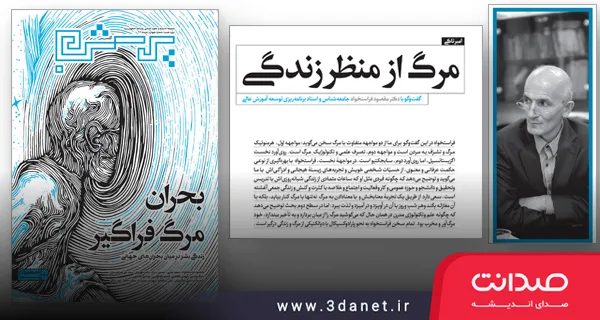
Death from the Perspective of Life
An Interview with Dr. Maghsoud Farasatkhah
In this conversation, Farasatkhah speaks to us of two different encounters with death: the first encounter is the hermeneutics of death and initiation into dying, and the second encounter is the scientific and technological appropriation of death. The first approach is existential, while the second approach is subjective. In the first encounter, drawing upon a kind of mystical and spiritual wisdom, Farasatkhah tells us from his personal sensibilities and his lived emotional and perceptual experiences, and explains how an individual like him, whose daily and nightly life is for many hours saturated with teaching, research, students, the public sphere, work, activity, society, and in short, with multiplicity, action, and collective life, tries, in the background, through a meaning-making experience and by giving meaning to death, not only to come to terms with death but to flirt with it, to grapple and mingle with it every night and day, and to take pleasure in it. But on the second level of discussion, he explains how modern science and technology, while striving to eliminate and postpone death, were themselves death-dealing and destructive. Farasatkhah's entire discourse is paradoxically engaged with a dialectic of death and life.
Amir Taki – In the first step, we were faced with a crisis that, of course, humanity had also encountered in previous centuries; such as widespread international wars, various diseases, or famines; but this time the discussion is about a disease (COVID-19) that has become global and has claimed the lives of many humans. The theme of our special issue is the human encounter with crises following which death spreads globally on a massive scale. Dr. Farasatkhah, what transformations can be expected from this crisis in social discussions or even philosophical circumstances?
Death is a trauma or lesion inflicted upon the living human organism, or a kind of entropy that leads to the end of the life of the body and the living organism. With that very survival instinct and his generative force, the human being has always dueled with his death; that is, he has somehow tried to engage with death: with his own death, with the death of his loved ones, or with the death around him. I will describe the manner of the human encounter with death and his relationship with it on two levels: On the first level, the human being has tried to give meaning to his own death; that is, he has faced death, felt it, and accepted and given meaning to it as part of his own story. I will try to express my personal lived experiences on this level. After that, I will address that second type of human encounter with death, which is the long-standing human endeavor to eliminate death and overcome it. The first encounter is the hermeneutics of death and initiation into dying, and the second encounter is the scientific and technological appropriation of death. The first approach is existential, while the second approach is subjective.
I will begin first with the hermeneutics of death, initiation into death, and the existence of death. The human being has observed death in the situations around him and has seen the death of his loved ones and other persons. Before his eyes, lightning has struck and tribespeople have been swallowed by death, or numerous wars have broken out and many people have been killed. The human being has perhaps experienced death in his life more than anything else. The only thing he has not experienced is his own death; because when the human being experiences death, he is no longer available to us to narrate his experience of death; although, of course, individuals such as Strauss, Corbin (the sociologist), and others conducted studies in the late last century concerning the experiences of those in the throes of dying and on the threshold of death. As it happens, "Grounded Method" or "GT Method" is one of the examples of work that Strauss and others initially carried out in the 60s and 70s in some American hospitals and at the University of Chicago regarding the states of people who are awaiting their own death.
But my point is that humans have experienced the death of others many times and have seen that there is no escape from this reality; therefore, they have tried to change their perspective on it. When a person cannot change a reality at all, the only path left to them is the hermeneutics of death (interpreting and giving meaning to death). Since there is no escape from death and one cannot eliminate or alter the destiny of death, the only thing left is to change one's view of death, to shift one's own state and position, and to look at this reality from another perspective. When a reality overwhelms you and you can do nothing about it and cannot remove it from your path, the only way is to change your position and look at and interpret it from another angle. When your view of death changes, a system of beliefs emerges; what belief you hold about death and how you give meaning to your death.
It is here that humans try to make sense of death, and death becomes a chapter in the story of their life. To better understand the subject, I will first base my discussion on my own lived experiences and personal feelings, and I will describe my coming to terms with the death of my loved ones (my mother and father), how I accepted it, my understanding of my own death, and my inner readiness to die. A question: How is the understanding of these experiences, living with them, and gaining mental and spiritual readiness for one's own death achieved? In fact, how can a person come to terms with death and give it meaning? We feel that we have come from the ambiguity of formlessness into the world of forms. Our life is a form derived from a formlessness. Now, when we witness the death of loved ones or others, we feel that they are returning to that realm of formlessness; that is, we came from formlessness and found a form. After this process, we again resolve to depart, and this time we return to our realm of formlessness; that is, we fix our gaze on eternity: people carry us on their shoulders to bid farewell and entrust us to the earth (the common mother of us all on this planet); then they draw a quilt of nature over us, and we rest again in the depth of the ambiguity of existence, and we call it a resting place or cemetery.
The fact that the grave is called a resting place is not a meaningless allegory; in fact, people, with longing, draw a quilt of nature over the lifeless bodies of their loved ones so they may rest in the depth of the ambiguity of existence: "We are from above and upward we go, We are from the sea and to the sea we go, We are not from there nor from here, We are from no-place and to no-place we go."
From pure indeterminacy, which is wall-to-wall with nothingness, we came and found determinacy, and what was the purpose of Farasatkhah, Amir Taki, and so-and-so becoming? How did we find a material form and the form of a living organism, become a living system, and show existential traces of ourselves? Existential traces that after a while disintegrate, and we return and are dispersed in that nature from which we came and had found form again, and we return once more to our mother nature and to the embrace of existence from which we came, and we settle. From this perspective, the world is a riddle of this very coming and going, being and non-being. Whatever begins, comes to an end. The enduring reality is that in which all beginnings and endings reside, and it has neither beginning nor end.
It is here that the time of our life, the time of the planet Earth's life, the time of a 70-year life, the time of prehistory and modern history, and this tiny piece of the coronavirus era, is a glimmer of a great eternity: "The wall of time has a crevice through which my face is visible." All these places are suspended from a placelessness; a kind of boundless and invisible eternity where all meanings converge; for example, you are in awe of something, and I am in awe of something else. All these states of awe ultimately dissolve into the final pure awe, and all desires end there: "The water of the sea, as it flows to the sea, Goes to the very place from whence it came."
عارفان میگویند معنای معناها، یعنی تمام معناهایی که ما دنبال میکنیم، نهایتاً به معنایی نهایی که در اوج ابهام است، مرجوع میشوند؛ درواقع، گونهای از ابهامِ یک هستی محض، که دیوار به دیوار نیستی است؛ آنچه در کائنات جلوهای می کند و شوری بهپا میکند، امری بیکرانه است که با عدم درهم تنیده است. همه امکانها از این سعه هستی یا نیستی سرازیر میشود؛ همه خیرها و امیدها به آن ابهام ازلی وابدی بازگشت می کند. به حکمت خسروانی ایران که از زبان فردوسی می شنویم : «جهان را بلندی وپستی تویی ، ندانم چه ای هرچه هستی تویی». من تجربه زیسته ام این بود وهست که وقتی مرگ را به این صورت معنا می کنم دیگر با مردن تمام نمیشویم.
انسان واجد نیروی بایوس است و میل به جاودانگی در او هست. اگزیستانسیالیستهایی همچون اونامونو معنای تراژیکی آدر این نیروی حیاتی سراغ می گیرند. او کتابی دارد که جناب بهاءالدین خرمشاهی آن را به درد جاودانگی ترجمه کرده است. اونامونو میگوید که انسان میخواهد جاودانه شود؛ حتی کانت هم که تجربهگرایی در صدر عصر روشنگری است و با نظام متافیزیک و نظام فلسفی سنتی، جاودانگی را توضیح پذیر نمی بیند؛ برای اینکه حیاتی اخلاقی در پیش بگیرد و تجربه بکند ابدیت را همچون اصلی موضوع می پذیرد. کانت در دنیای جدید، هم میخواهد جرئت اندیشیدن داشته باشد و هم جاودانگی را در پیش چشم دل داشته باشد تا زندگی اخلاقی داشته باشد.
انسان با درک جاودانگی احساس میکند که با مردن تمام نمیشود؛ به همین دلیل تلاش میکند تا به معمای مرگ فائق آید. او میخواهد از مرگ عبور کند، و به آن نفوذ کند و احساس کند که با مردن نیز همچنان هست؛ چیزی که حکیم فردوسی شاهنامه اش را با آن آغاز می کند: «به نام خدواندِ جان وخرد ، کزین برتر اندیشه برنگذرد ، خداوندنام و خداوند جای... ». تمام جاها ومکان ها در یک لامکانی مستقرند و تمام نام ها به یک ابدیت بر می گردند . افرادی از قبیله، بزرگان، پدر، مادر و خانواده میروند؛ ولی از آنان همین نام، روح، جاودانگی باقی میماند و نقشی که از آن جاودانگی بر تجربه تمدنی بشر در این سیاره می ماند. درواقع اهمیت حفظ نام برای آدمی، همراه با باورهای مختلف، تفسیری است برای معنابخشیدن به مرگ و تلاشی است برای اینکه انسان بتواند مرگ را تجربه و تحمل کند و به آن معنا ببخشد
ما همه چیزهایی را که میگوییم هستند، در حقیقت سطوح و لایههای سطحی هستی هستند: زمین هست، کوه هست، بدن من هم هست. اما به زبان اصالت وجودی ها بهتر است به جای اینکه بگوییم زمین هست و درخت هست و بدن من هست ، بگوییم: وجود یک بار زمین هست ، بار دیگر درخت هست ، یک بار بدن من هست و یک بار هم با مرگ من رقصی می کند ودوباره به سیر تطور ونَشَآت خود ادامه می دهد، وجود با عدم جلوه می کند «پس عدم گردم عدم چون ارغنون ، گویدم کِانّا الیه راجعون» . نهایتا یک وجود بسیط است که هم هستی و هم نیستی در او بر می آید و به او برمی گردد و گم وناپدید می شود، ما به به درخت و به آسمان وبه خود و زندگی خود ومرگ خود می نگریم اگر همینطور به نگاه خود ادامه بدهیم وبه لایه های عمیق تر وجود چشم بدوزیم می رسیم به یک هستی ونیستی بی پایان. اینجاست که مرگ وزندگی را دو روی یک امر می بینیم و آرام و قرار می گیریم این همان آرامگاه ماست که دیدیم فردوسی هم گفت خداوند نام وخداوند جای: آرامگاه ما یعنی نامی در این گاه آرام گرفته است یک چند جست وخیز کرده وخسته شده ودر اینجا برای همیشه خفته وناپدید شده است حتی سنگ قبری چیزی نیز نمی ماند . وقتی معنای بودن در عمق معرفت ما نفوذ کند، این بودن فقط آن چیزی نیست که مثلاً تنفس میکنیم یا به عناصری دست میزنیم یا لمس و تجربه میکنیم؛ بودن امر وجودی خیلی وسیعتر از این است: سریان دارد، عشق است، معناست، نام است، یاد است، خاطره است وابدیت هست ابدیتی که در یک لحظه ودر یک روز وهر روز وشب می توان آن را تجربه کرد وبعد در او فرورفت وخفت. مرگ به همین راحتی وخوشگواری است. مولانا می گوید: «جوی دیدی کوزه اندر جوی ریز، آب را از جوی کی باشد گریز، آب کوزه چون در آب جو شود، محو گردد در وی و جو او شود»
We endure in the memory of others through our good deeds. We are an immortal spirit; these are all delicate expressions and novel language games, a kind of grammar and syntax, in Wittgenstein's terms, in which death does not mean annihilation; rather, death is a part of life, a part of the modes of being and the stages of existence. We have many such examples in our literature: “I tested it, my death lies in life…” or “I died from mineral and became a plant; / I died from the plant and emerged as animal; / I died from animal and became human; / So why should I fear? When did I diminish by dying? / Another assault, I shall die from humanity…” That is, “Indeed we belong to God, and indeed to Him we return,” which is alluded to in the verses of Rumi’s Masnavi: “Once more I shall be sacrificed from the angelic realm…” up to the point where “Then I shall become non-existence, non-existence like an organon / It tells me that indeed to Him we return.” Here, Rumi pursues his own being right up to the very walls of non-existence and beyond existential determinations, and these are conceived as infinitely vast levels of being.
In Iranian and religious wisdom, traditions, rituals, myths (various allegories and the dead appearing in dreams), and the various rites and rituals socially constructed around death can be traced within the categories of ethnology, anthropology, and folklore. These rituals still exist in various places to this day; indeed, this is an example of giving meaning to death.
Up to this point, I have tried, in expressing my own emotional and perceptual lived feelings and experiences, to explain how an individual like myself, whose daily and nightly life is saturated for many hours with work, activity, social life, and scholarly engagement, and with multiplicity, can, through a meaningful experience and by the act of giving meaning to matters, and through interpretation, hermeneutics, and renewing and deepening one's own perspective, not only come to terms with the category of death but also flirt with it, grapple and mingle with it every night and day, and take pleasure in it.
Now let me touch a little upon that scientific, technical, and technological appropriation of death and the subjective approach to death. Another, different approach to death was the battle against death and the effort to eliminate death or to postpone it as much as possible. This is another face of humanity in relation to death and a different behavior toward death. Here, humanity duels with death; it strives, with science and technology, its scientific endeavor, its system of knowledge and technique, to solve the problem of death for itself or, in a way, to grapple with it.
-What is the relationship between science and technology in the modern era and the category of death?
Up to this point, if the first level of encounter was wonder—an inadequate expression of which was in the statements I made—it is a kind of mental wonder and spiritual initiation into death; that is, Farasatkhah wants to have a kind of spiritual initiation into being, which is a kind of existential initiation into death and non-existence. Death is also a part of life and another facet of our being. Death and life are one; but in another approach, humanity, with a new subjectivity, with human agency, wants to mentally and technically appropriate death. In this situation, we are no longer in a state of wonder and initiation; rather, we are seeking subjective and technical appropriation. A human who sees themselves as the knowing subject and agent of this world, a human who feels that with the new humanistic approach, in the modern system of knowledge, humanity has come to this earth and must bear the burden of responsibility for its own being, grapple with the hardships of being and eliminate its problems, harness the forces of nature and appropriate nature, fight death and control it, capture the energies of nature and, by appropriating them, possess technology, achieve welfare and control its problems, expand its life and change the world, and not merely interpret it.
It is here that we see another chapter of humanity's encounter with death, which is through science and technology. I will give some very small examples of how much, with medical knowledge, humanity has been able to behave toward death and greatly increase hope in its life. If you compare life expectancy with statistical data and abundant historical, archaeological, and ancient historical evidence, and then the evidence, texts, and artifacts of recent human history, for which precise mortality statistics exist, you will realize how humanity has, for example, enhanced its existential security; something that Inglehart refers to as existential security.
Human beings have been able to expand biological security through the development of science and technology, and thereby overcome and contain their fear; they have also found the courage to know and to be technical, and to engage with their problems in an active, proactive, subjective, and technological manner. If you compare life expectancy now with even a few decades ago, you will find that it has now reached over 80 years; but this was not the case in the past—that is, people on average died after a shorter lifespan.
In the past, when a widespread epidemic broke out, everyone assumed that a number of people would die. At the beginning of the twentieth century (1916), the influenza that was wrongly called Spanish flu spread globally. This influenza became prevalent during World War I mainly through soldiers coming from America and fighting in Europe; but it became mostly known as Spanish flu, because Spain had a free press and they wrote things about it. On the other hand, many people in Spain contracted this contagious disease.
According to historical evidence and accounts, around 50 million people lost their lives to the Spanish flu. At that time, the total world population was 1.5 billion, of which five hundred thousand million contracted the Spanish flu; something close to one-third of the entire world population. This is while now, with six or seven million people infected with the widespread COVID-19 disease, deaths are still around 400,000; whereas the world population is at least eight billion.
Now let us compare the casualty figures of the Spanish flu with the death toll of the Great Famine during the reign of Naser al-Din Shah: during the premiership of Mirza Hossein Sepahsalar (the then minister and grand vizier of Iran), which coincided with the middle of Naser al-Din Shah's fifty-year reign (1250 AH), according to one account, 1.5 million people in Iran lost their lives to hunger and disease. Another great famine in Iran occurred after the Constitutional Revolution and concurrent with World War I (1290 SH). At that time, too, around one million of our compatriots died.
But with the expansion of medical science and technological progress, the death toll from widespread diseases has decreased period by period. A few years from now, after the spread of COVID-19 slows down and the cycle of work and activity resumes its previous motion, perhaps then we will say, for example, oh dear, several hundred thousand people died from this disease, how weak we were or how many problems we had that several million in the world contracted this disease and several hundred thousand died. For your generation, who belong to the future, these figures will seem high; but when we compare them with similar events of this very recent century, we realize that considering today's population size and the progress of human knowledge, they are smaller numbers.
Through medical knowledge, humans try to enhance their life expectancy; for example, legal knowledge and laws created against murder, various guarantees, mechanisms, and different structures help humans to survive and prevent a person from being killed, or, for instance, psychological, social, biological, and cognitive sciences have offered extensive theories about stress, anxiety, mental well-being, and mental comfort so that humans can overcome their pains and sufferings and reduce them.
Of course, humans have two existential halves: one, the dark half, with which they kill, start world wars, commit murder, practice prejudice, and harbor all kinds of grudges; but with the bright half, they strive for the comfort of humanity, and social and political science tries to make human life durable, comfortable, respectful, and dignified. Looking from a Foucauldian perspective, the discourses that humans have developed, meaning very powerful discursive practices, are carried out to contain death; the anti-execution discourse, the human rights discourse, the peace discourse, the anti-genocide discourse. Of course, these discourses have not always been successful. We still face genocide and world wars; the world's great arsenals spend enormous budgets on the technology of death; in fact, the world is rapidly moving towards the expansion of chemical technology and the increase of nuclear technology.
A strange paradox prevails: on the one hand, we feel that with its bright half, humanity strives for life, survival, the importance of the human being, the importance of human existence, and endeavors as in “whoever kills a soul… it is as if he had slain mankind entirely”; because it knows that the death of one person equals the death of humanity, and this important principle has been noted in various rituals, religions, and wisdoms; yet with its dark half, humanity constantly sheds blood and commits murder, along with raids and plunders, famines, grudges, bigotries of war over fascist beliefs, great violences over religion and various ideologies, opinions and views, and all kinds of prejudices that are mechanisms for spreading death.
We are faced with a kind of contradictory feeling about the human being. It is as if our project of being is intertwined with both life and death; that is, death and life, in mutual correlation, reveal our project of being in a paradoxical or enigmatic way, or in other words, just as our project of being is thrown into living, it is also thrown into death; for example, inheritance is one of the mechanisms of wealth transfer that occurs only through death; that is, when a father who is the cause of the child’s existence dies, wealth and property are transferred; in fact, death is a mechanism for life, even in its most material sense. Another example is that in mourning rituals, a great deal of emotional energy is released through them. Where does this released emotional energy go? You can guess.
-Does it depend on whether those energies are positive or negative?
In any case, the energies released from these mournings return to the cycle of life. Here, death and life form a cycle: when mourning rituals are held, some people benefit from them, or in other words, make a living from them. We call this income generation the “economy of death,” a very horrific, unproductive, and destructive economy from which no added value is created; yet it is a very large economy, and you see that while it is the economy of death, it is also the economy of life. The point is to express the enigmatic and dialectical meaning of the human project of being, which seeks to profit even from dying, and the work of humanity is astonishing.
In the realm of culture as well, in European countries, India, and China, among the Semitic religions and other religions, and likewise in other non-religious cultures, there exist death rituals in some form. In these death rituals, there is a great deal of emotional energy that is accumulated. One of our problems during the COVID-19 pandemic was precisely this: people could not perform mourning rituals, and this issue, in addition to the sorrows and pains that occurred for families, friends, relatives, and colleagues through the death of loved ones, led to the feeling that emotional energies were not flowing and were being trapped, causing strange anxieties and depressions that we would struggle to cope with in the years ahead.
You see how a part of life is managed through the emotional resources of death. Death is an identity-forming mechanism; for example, when someone in a family dies, names are written down, and in this way, the children of the deceased acquire a family identity, which in turn strengthens family, kinship, and neighborhood communities. In fact, death creates a kind of community; while a person dies, a kind of communal life and social vitality is nourished by their absence.
In Tabriz, there are strong interest-free loan funds and charitable institutions. In this city, it is customary that when someone dies or a beloved relative passes away, to console and offer condolences to them, people pay their desired amount, small or large, to these charitable institutions, and they send a small plaque to the survivors, and the sum of this money is spent on alleviating the hardships of the underprivileged, providing dowries for their daughters, charitable ceremonies, and social mutual-aid activities aimed at relieving the pains of others, offering sympathy, finding jobs for those who are unemployed, and helping those with financial constraints, the needy, or those in debt.
You see that through my death, social emotions and social excitements are once again set flowing and become life-giving; so once again, my dying itself becomes a source of life, and even those who have lost a loved one, when they hold a mourning ceremony, a kind of inner and concealed gladness arises in them through the condolences of others; when you attend the funeral of your friend's father, he feels a kind of hope and social solidarity. Now, to what extent are death rituals generative and to what extent are they not? To what extent are they positive or negative rituals? I will not enter into this discussion, whether from a sociological perspective or other aspects:
- How do you make sense of the feeling of emptiness in relation to death?
Albert Camus, in the 1930s-1940s, a period coinciding with the rule of fascism, World War, and the spread of machinism, explains in the novel The Plague (the black disease) how, in the face of widespread death, an opportunity arises for humans to both confront absurdity and transcend it. Camus is engaged with the problem of absurdity, due to his intellectual dynamics. In The Plague, we observe how Dr. Rieux or Tarrou, through seeing children who die before tasting life and by witnessing pervasive death, develop a kind of existential anxiety and become entangled with absurdity, yet by alleviating the suffering of families, helping the afflicted, and through human compassion, they sink to some extent into the depths of absurdity and seek a meaning in that bottomless abyss.
Through the effort to alleviate suffering, they find small meanings for their existence again. Conversely, in Camus's novel The Stranger, whose hero is Meursault, he cannot even make sense of death; consequently, he surrenders; that is, in a way, he falls at the feet of death. In my youth, I was greatly influenced by Camus's novels; sometimes I sympathized with the stranger, and sometimes I pitied him for why he could not have the experience of the hero of The Plague, the experience of Rieux and Tarrou. The hero of The Stranger, when his mother's death arrives, says: "Maman died today. Or yesterday maybe, I don't know. I got a telegram from the home: 'Mother deceased. Funeral tomorrow.'" The word Maman shows how an emotional word has become empty of emotion for him.
Why has this sentence stayed in my mind? Because from that youthful period when I read this novel, I truly felt that the hero of The Stranger can no longer find even a small meaning in the face of death. He is even happy about his own death; that is, in fact, in his confrontation, he moves from emptiness and absurdity to a kind of nihilism and ultimately nothingness, and can no longer be creative.
What I mean is that sometimes, in the face of nothingness, death, epidemic diseases, and the pandemics that have occurred in the world, meanings have once again been expanded, a fresh excitement for the bios and eros of life has emerged, and solidarity and creative endeavors have been created. This story is very enigmatic: how has the death of a part of society once again sustained the life of the community? The same cycle of life that exists in nature: things that perish, organisms that decompose, rot, and turn back into minerals and return to the source of life. Unfortunately, destructive technology disrupts even this cycle of life and harmony and disturbs its dance. In this great cycle, there is both death and life.
But the technology with which arrogant humanity wanted to devise a remedy for death has itself become a source of death, and through the consumption patterns it has created via development, it has become destructive and death-dealing, has ruined the ozone layer, has created widespread pollution, and a portion of the mortalities that occur every day is due to excessive air pollution. In fact, with every brake we apply, we participate in the dying of the humans around us, and this constitutes the paradox of our life and death.
- In your question about death, you pointed out that with the death of a person in the family, or even the death of many in a society, we expect new connections and structures to form, even at the social level; for example, as you mentioned, in a family, new relationships might emerge and the mode of communication might change. Perhaps at the societal level, too, when we face widespread death crises, new structures or even new meanings might arise. To what extent do you consider this valid at the present time, and what is your assessment?
When a widespread death occurs, a new dynamism also emerges in society; for example, the Great Famine of the Qajar era in the 1870s subsequently led to the reforms of Mirza Moshir al-Dowleh and Amin al-Dowleh: newspapers became more numerous, more active, and more diverse. The Roshdiyeh movement in the 1880s, and then Amin al-Dowleh, created educational reforms and supported him. The energies of modernism, scientism, modern education, social reform, legal reform, and civil reform, which led to the establishment of the School of Political Science a decade before the Constitutional Revolution, also gave rise to the discourse of law through this path. Social groups like women gradually entered the social scene, associations were formed, and it ultimately led to the Constitutional Revolution in the 1900s. In our history, these enigmas, paradoxes, and the ups and downs of comings and goings have unfortunately been far more frequent than elsewhere, and they are and have been very costly and exhausting. I always say we are born with pain and live with hope. Our karma has always been fear and hope. Just as after the Constitutional Revolution came World War I and again a greater famine and the death of hundreds of thousands of our compatriots, and this immediately led to a modernist movement, from which we had many advances and achievements. The dynamism and vitality from which higher schools, the Teacher Training College, and the University of Tehran were built, and modern learning, scientific institutions, social institutions, the Persian language, Iranian identity, and the Iranian city; these came right after the shock of catastrophes, famine, death, and destruction. But this unfinished Iranian modernity itself, within the ideology of state modernization, was also embittered for us by autocracy, corruption, and inequality. Whatever time gives us, it takes back. What is important in all this is that when a catastrophe occurs, the force of transformation-seeking and endogenous dynamisms are released from it, they surge forth in society and become active.
But again, the issue is not so simple; because if you consider the lifespan of a catastrophe, upon its arrival, we first become panicked in the face of it. In February of last year, when we noticed the spread of the COVID-19 virus and its consequence of several people in Iran contracting it, a wave of panic suddenly swept through society. I have termed panic as the first phase of a catastrophe's lifespan, which corresponds with solidarity, and from which great emotional resources are released. The second phase is the phase of confrontation; for example, at the beginning of the COVID-19 outbreak in Iran, after the initial panic, in late February, Mr. Rouhani said it was nothing and that from Saturday all students should go to school. But everyone was panicked. The government tried to say nothing was happening; but the people, who were more or less aware of the depth of the catastrophe, tried not to be present in public places. Following this panic, NGOs created websites, and traditionally, in neighborhood mosques and other places, they began packaging sanitary and food items for the underprivileged. In this way, all institutions, CBOs, and people's organizations formed a mutual aid network. This aid network consisted of a network of NGOs that wanted to repeat the experiences they had from earthquakes and previous catastrophes. Iran is a country where catastrophe has occurred and recurred very frequently. Typically, in catastrophes, new social, cognitive, and emotional energies are released, social movements are launched, and volunteer activities flourish.
Iran is rich in emotional resources. In Iran, emotional resources are very high, and this is part of our history. We possess a joyful wisdom and a cheerful intellect. Our Avicennian intellect, our philosophical intellect, is a joyous wisdom and, in a way, emotional, containing emotional resources. The Iranian intellect is not cold; for this reason, emotional words and affective energies are very abundant in the Persian language. I have named the second phase 'confrontation,' in which cooperation emerges. I drew a curve for this matter: if you consider the Y-axis, the y-axis (the vertical axis of emotional resources) rises, and the horizontal x-axis pertains to the phases. The first phase, which is panic, can be a startup situation; that is, a run-up. In this phase, emotions take off. In the confrontation phase, cooperation occurs with greater emotional force, and this interaction leads to solidarity; for example, on the first of Bahman last year when university classes were canceled, I was in contact with students, friends, and acquaintances at home through virtual and online spaces, and in this way, confrontation for me and my student and general audience turned into solidarity.
I call the third phase disaster management. When emotion is managed, it becomes formalized, and subsequently, emotions decline; that is, they first move somewhat horizontally, but then they come down; because when the responsibility of spontaneous NGOs, along with the necessary voluntary creativity and those emotional energies and endogenous initiatives, is delegated to official organizations and institutions and takes on a specialized form and division of labor occurs, they announce that you should not donate money; because money must be injected from another source. This is where group and voluntary management is reduced to official bureaucratic management.
The final phase is called the farewell to disaster; that is, people bid farewell to the disaster and turn it into a memory. In this phase, everyone returns to their main work, students go back to their educational environments, and emotional energies decline again. In the farewell phase, although life continues in its former way, the values of survival and self-preservation prevail, and no one sheds tears anymore for the homeless, the lower social groups, the suffering unemployed and those impoverished by the disaster. All the elegies and literature of humanitarianism and empathy for fellow human beings subside, humans are left alone again, and are handed over to dry, empty organs, organizations, and regulations.
- Does it lead to human memory?
It turns into systematic indifference; that is, the system becomes indifferent and tells them: What can I do? There is nothing I can do. Others repeat it too; only the miseries and hardships remain untouched in the midst of this. The experience of death and confronting the death of a neighbor, a fellow citizen, a colleague, someone from the same neighborhood is a great shock that releases part of a society's emotional energies. But only societies that formulate and institutionalize these energies and allow them to continue at the social, civil, and local level with their own lively creativity and initiatives, benefit from these emotions for the expansion of life and civilization. To do this, it is necessary in Iran to deregulate and remove the cumbersome, destructive regulations for civil institutions, set them free, and allow them to have their own initiatives and creativity; then these emotional energies can become civilization-building and meaning-making, make society agile, become the energy of life, become the energy of progress, become the energy of development, become liberating. But unfortunately, the system wants to place NGOs in its own colony and become their custodian and administrator and control everything. It fears that a number of young people will gather and, through NGOs, something might happen to its power and criticism of the official system's performance might spread. It is through this that energies are destroyed and lost again, and it becomes necessary for another earthquake to happen in Iran, for a few people to do some things again, and the rest of the stories.
-In fact, we must devise a new plan?
A new design, accompanied by novel thoughts and fresh initiatives in social action and communicative and cultural interaction, is necessary. As I mentioned, out of great famines and catastrophes, the Rushdiyyehs, the Amin al-Dowlehs, reformism, the press, civil institutions, and the discourse of transformation emerged; the myth and legend of Qajar absolutism collapsed. In the world, catastrophe brought down Byzantium. One of the causes of the collapse of feudal relations was the plague. While this death plunged many families into dark days and many human beings could not live, from within it a ferment, a dynamism, and a movement arose, and the feudal order, which had seized labor power and earthly and material resources, was shattered, and from within it emerged new urbanism, technology, science, and innovation; although this in turn led to capitalism once more, and a new kind of exploitation and fresh plunder came into being. Again, that paradox of civilization and that wearying cycle. The matter is truly intractable, and we try to simplify it with our words; yet reality persists in continuing its obscurity and complexity; the twilight of death and life.
.
.
PDF file of Death from the Perspective of Life: An Interview with Maghsoud Farasatkhah
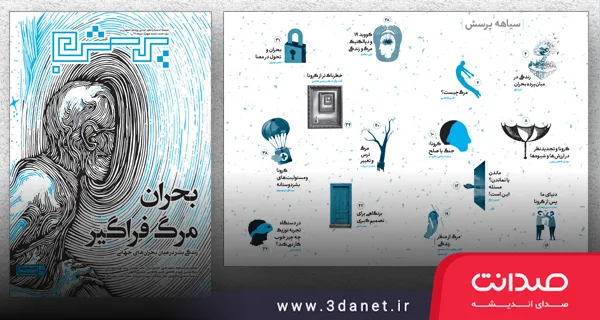
Source: Fourth issue of the special supplement Porsesh of Isfahan-e Ziba newspaper with the theme: “The Crisis of Pervasive Death” – Tir 99
.
.
Discussion1 comments
ربّ عالمین حیات و ممات را می پرورد. این دو بر همدیگر اثر دارند. چگونگی زندگی کیفیت مرگ را تعیین می نماید. البتّه خلاقیّت نابود ساختن نیست. بلکه همکنشی پدیده هاست. چنانچه همه چیز جاودانه می بود هیچ اصلاحی نیز میسّر نمی توانست باشد. یعنی فقط رکود بود که بدتر از ممات است. اینکه دگرگونی های متوالی خیر و شر باشد بستگی به کارهای آگاهانه دارد. دین که همانا اصول هستی است همین قاعده را تبلیغ می کند.