Literature
Arash Naraghi's Essay “The ‘Problem of Death’ and Artistic Narrative: On Samuel Beckett's Malone Dies”
In his novel Malone Dies, Samuel Beckett confronts us with the 'problem of death'; in the absence of grand meaning-giving narratives, death becomes a crisis of meaning. The old man tries to make sense of the disintegration of the 'self' and his own death by creating a story.
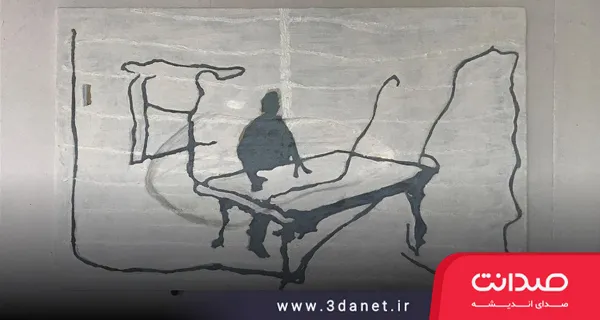
The “Problem of Death” and Artistic Narrative: On Samuel Beckett's Malone Dies
Arash Naraghi, April 11, 2018
1. In Malone Dies, Samuel Beckett brings us face to face with death. He seats us in the boat of his story's old man's gaze, and slowly steers us toward the misty lagoons of the experience of death. We share the experience of dying with the old man of the story. But Beckett's concern in this novel is not merely the recreation of the situation of death and the re-examination of the “experience of death”; he is also deeply grappling with the “problem of death.” The “problem of death” is distinct from the “experience of death” and the “question of death.” Death is an inevitable experience whose shadow flows over every moment of our lives, and at the end of the road, it sits patiently waiting for us. The awe of this singular experience is such that it inevitably confronts us with the “question of death.” The question of death arises from our bewilderment and helplessness in the face of death's anxiety-inducing awe: Why do we die? What meaning does life have in the shadow of inevitable death? But none of these is the “problem of death.” The “problem of death” begins where we are at a loss to answer the question of death. In the pre-modern world, the question of death found a more or less comforting answer within the framework of grand religious or philosophical narratives: A higher wisdom oversees all the details of this world, and every leaf that falls from a branch falls for a reason. Our human existence is not a stone hurled into the heart of a desolate darkness, lost. We come onto the stage of the great divine drama in this world one by one, each play our destined role in this play, and then exit the stage. Pre-modern grand narratives gave meaning to our lives in this world, and in this way, they made our death meaningful. The question of death was raised, but that question, in a mind intertwined with and instructed by the grand narratives of the time, found a more or less clear answer, and did not become a “problem.” But in the modern world, the former meaning-giving grand narratives have, to a large extent, lost their acceptability for many people, or at least have faced powerful and capable rivals. In the absence of the dominant grand narratives that give meaning to human life, the “question of death” turns into the “problem of death”: when life becomes meaningless, death also loses its meaning. The “problem of death” is the problem of the meaninglessness of life and, consequently, the meaninglessness of death—the “problem of death” is the problem of the crisis of meaning, the crisis of the loss of narrative.
2. Everyone dies, but the problem of death only becomes relevant for those who are aware of themselves and their own mortality. The “problem of death” is the result of a kind of self-consciousness. Our human “self” has a deep connection with “consciousness.” From the perspective of phenomenological philosophers, the essence of “consciousness” is intentionality. “Consciousness” is always “consciousness of.” According to this analysis, consciousness disappears without an object of consciousness. The object of consciousness gives consciousness its determination. This determined or focused consciousness can also make itself the object of consciousness and become aware of the transformations and fluctuations of the “self.” But what is the “self” or the “I”? At least from a phenomenological perspective, the “I” is a focused consciousness that is situated “now” and “here.” This focused consciousness connects with space and time through the “body”: “Here” is the place where the body is situated, and “now” is the time that passes “here.” According to this analysis, the focus of consciousness—at least to some extent—depends on its relation to space and time. As soon as the “I”'s relation to the space and time of its situatedness becomes clouded and impaired, that is, the individual fails to grasp “here” and “now,” the focus of consciousness—which is the central core of the “I”—moves toward dispersion, and the individual's “I” stands on the threshold of collapse. “Death,” in one sense, is the disappearance of consciousness and the collapse of the “I.” And human self-consciousness, that is, their cognitive mastery over the states and transformations of the “I,” gives them the possibility to feel the dawn of the “I”'s collapse in advance. The death of consciousness is, in fact, the consciousness in advance of the process of the collapse of consciousness.
۳. The old man in Beckett's story is on the threshold of death. The signs of this death can be seen in the disruption of his relationship with time and space. The old man does not know where he is: Is he in a prison cell? Is he in a room in a nursing home? He does not know. Time, too, is lost to him: he does not know whether it is now day or night, morning or afternoon, whether a day or days have passed since the last time he remembers. The boundaries of time fade in his mind. The only thread connecting him to the world outside the room is a window. But not much seeps into the room from beyond the window: a corner of the sky, the roofs of houses, and, if he has the strength to crane his neck, a glimpse of the street. His memory and consciousness are also on the verge of decay. The old man has forgotten many things, and knows that his consciousness is occasionally lost. Thus, the thread of his awareness is sometimes severed, and the continuity of his consciousness is increasingly subject to decay. The gaps between moments of awareness yawn wider day by day. Therefore, the old man's focused consciousness is exposed to collapse from two sides: from an external perspective, his consciousness loses contact with place and time, and thus its focus deteriorates; and from an internal perspective, the thread of his consciousness is constantly being severed, and his memory, which links his "now" to the past, is fading, and thus not only the focus but also the continuity of his consciousness is on the verge of decay. His focused consciousness is stretched from both sides (inside and out), and his trembling self-awareness realizes that sooner or later his "I" will disintegrate—the sound of death's footsteps is near. But the death approaching him is absurd and meaningless: a frail old man, with poor memory, sometimes unconscious, severed from the outside world, wandering in the foggy space within—without knowing exactly who he is, where he came from, and where he is. There is no coherent narrative to give clear meaning to his life in this room. Everything is shrouded in a thick fog, matters are often incomprehensible, and the old man's existence is like a balloon in the trembling fingers of a child, which may at any moment be aimlessly released and lost forever.
۴. But the old man tries to find a way to confront death—not in order not to die, but to give his death meaning and dignity. He does not want to overcome death, but he wants to solve the problem of death for himself. He wants to die, not to perish. It is quite clear that Beckett's old man has not staked his heart and mind on grand religious or philosophical meta-narratives. He must find a way, before the collapse of the "I," to create a narrative for his life within which his death finds meaning. But how? To delay the process of collapse, the old man tries to maintain the focus of his consciousness by counting and listing the objects around him in the room. The mundane objects of the room become an anchor to which he clings. His relationship with the objects in his room becomes a very complex and deep one. These objects become the pillars of the tent of his faltering "I." Listing the objects and repeatedly counting and reviewing them is a compass by which he drags his lost "I" from the foggy space of unconsciousness to the shore of awareness. The objects postpone the collapse of the "I." But repairing the faltering relationship of the "I" with time and space (or external reality) is not enough. Another canker has gnawed at the "I" or "focused consciousness" of the old man from within: the fading of memory. Memory guarantees the continuity of our identity over time. As memory fades and the gaps between moments of awareness yawn open, the "I" gradually fades. The old man tries, through writing or recording events, to reduce the flight of memories to some extent and thereby reconnect the severed thread of his consciousness. The pencil with which he writes is meant to be his sword against the demon of forgetfulness. These are the old man's efforts to postpone the process of death or the collapse of focused consciousness (or the "I")—his way of coping with death.
5. But the old man knows he will soon die. And he knows full well that his confrontation with death is a temporary ruse and will certainly fail. His effort to postpone death does not stem from a fear of death. He does not fear death; he fears meaningless death, he fears perishing. He tries to buy time, not to prolong his life, but to find an opportunity to overcome the problem of death. He does not flee from death; he flees from perishing. But how does Beckett's old man try to untie the knot of the problem of death and give meaning to his death? Beckett's old man buys time to create a personal narrative for himself. His relationship with "objective reality" has been impaired, so he tries to create a "reality of his own." In Malone Dies, three stories are underway: the story of the old man, or Malone; the story of a boy named Sapo; and the story of a man named Macmann. The old man is the narrator of all three stories. But it is never clear whether the story of Sapo and Macmann is the tale of the old man's own life or not, and whether these stories are fundamentally real, the product of the old man's imagination, or a mixture of the two. The old man writes anxiously and hurriedly, hoping to bring his stories to a conclusion before death. But why is the creation of these narratives (or the recording of these memories?) so important to him? One possible interpretation is that the old man, by creating (or recording?) these narratives, tries to craft a story within whose text he can make his life, and consequently his death, meaningful. The old man's stories become a fulcrum, allowing him to bridge the disjointed moments of his consciousness, and thereby save the continuity of consciousness and, as a result, his personal identity. He places himself within the text of those stories, and thus creates a story for his life so that in moments of forgetfulness and disorientation, he can return to it and find himself in the narration of those stories. A man who attains self-awareness dies, but does not perish. The old man's answer to the problem of death is the creation of a personal artistic narrative to unify the fragmented and scattered parts of a bewildered and distressed "I." A narrative within whose text the life, and consequently the death, of that person becomes meaningful. This narrative is of the artistic kind—a narrative that, unlike grand religious or philosophical meta-narratives, is above all particular and personal.
Does Beckett consider the experience of the old man in his story, in confronting death, to be effective and recommendable for others? In Beckett's writings, there is absolutely no inclination toward meta-narratives. The situation of each human being is so specific that, in his view, the characters of his stories are nothing other than what they appear to be. Beckett deeply shuns generalization; he dislikes the interpretation of his stories. But in the unique experience of the old man in his story, a guiding principle seems to be hidden that is not incompatible with Beckett's personal thoughts and life: the only path to salvation is art; the only kind of narrative that can rescue modern man's death from meaninglessness and absurdity is the creation of an artistic narrative. The problem of death finds its answer in artistic creation.
Is Beckett sympathetic to this interpretation?





Discussion0 comments
No comments yet; let yours be the first voice.