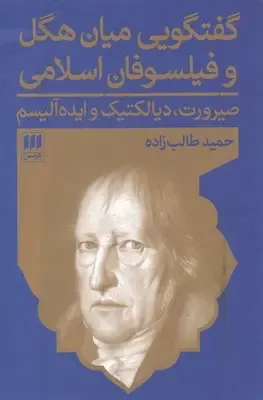
Why this book?
- The author states explicitly that the book is not a comparison of views, an interpretation of Hegel through the Islamic philosophers, or a critique of them in Hegel's shadow, and this "dialogue" approach sets it apart from comparative studies.
- In the preface he gives six reasons for Hegel's importance, including his place in metaphysics and the resonance of his thought in the understanding of modernity.
- Three central Hegelian concepts, becoming, idealism and dialectic, are examined in separate chapters.
- The discussion of idealism runs from conjectural and empirical idealism to absolute idealism and brings in essentialist and existential approaches.
- The author regards Islamic philosophy as a living tradition that must connect with the questions of its own time.
About the book
A Dialogue between Hegel and the Islamic Philosophers: Becoming, Dialectic and Idealism is by Seyyed Hamid Talebzadeh and is published by Hermes. In the preface the author writes that this dialogue is, in the proper sense of the word, a test of the contemporaneity of Islamic philosophy and its encounter with Western thought, of which Hegel is the "plenipotentiary representative." He stresses that the book does not aim at comparing views, imposes no philosopher's opinion on another, and neither interprets Hegel in terms of the Islamic philosophers nor criticizes them in the shadow of Hegel.
In the preface Talebzadeh lists the reasons this dialogue matters. Hegel is a metaphysician who presented the tradition running from Plato to the nineteenth century in its most complete form; he is the philosopher who brought modernity to self-consciousness; his scholastic, argumentative style makes dialogue with him easier; he regards philosophy as the final, rational form of religion; he was influenced by Christian mysticism, including Eckhart and Jakob Böhme; and today he stands at the center of attention through Heidegger and through Alexandre Kojève's lectures. He sees philosophy as rooted in the legacy of the past and at the same time bound to life and the questions of its age.