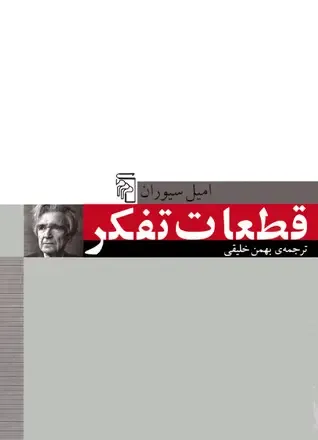
Why this book?
- To encounter Cioran's view of the contradictions and confusions of human life.
- To read an example of the philosophical tradition of aphoristic and condensed thought.
- To reflect on subjects such as suffering, death, religion, love, and literature.
- To become familiar with one of the most distinctive forms of philosophical expression in Cioran's work.
About the book
Fragments of Thought is a collection of aphorisms and short writings by Emil Cioran, a Romanian-born writer and thinker who wrote his major works in French. The book presents his reflections on subjects such as religion, suicide, literature, suffering, love, death, and the human condition in a series of brief and condensed pieces.
Cioran's fragments seek to define human situations, but these definitions are never complete or definitive; they remain limited, incomplete, and insufficient. The brevity and ambiguity of these writings bring them close to the essence of poetry, while the author's personal and emotional tone remains present even when he addresses the most abstract questions.
The aphorism has a long history in Western intellectual tradition, and thinkers such as Pascal, Montaigne, La Rochefoucauld, Nietzsche, and Kierkegaard used it to express condensed reflections on human affairs. Cioran can be seen as a continuation of this tradition: rather than constructing a systematic philosophy, he expresses his thoughts in short, sharp, and sometimes paradoxical fragments.
The book is particularly suitable for researchers and readers interested in philosophy, literature, and Cioran's thought, and may also appeal to anyone drawn to brief, concentrated, and thought-provoking reflections on the human condition.