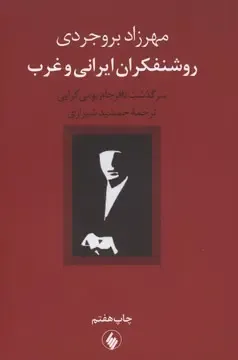
Why this book?
- This book provides an analytical picture of the intellectual history of contemporary Iran and the encounter of intellectuals with the West.
- This work examines the role of nativism in the formation of Iran's intellectual and political discourses.
- The book is useful for understanding the intellectual background of the 1979 Revolution and its ideological developments.
- Boroujerdi's analysis of religious and non-religious intellectuals challenges common views on the history of Iranian intellectualism.
About the book
"Iranian Intellectuals and the West" is a study by Mehrzad Boroujerdi on the intellectual history of contemporary Iran and how Iranian intellectuals reacted to the West, modernity, and the question of identity. The author examines a period between the 1950s and 1990s; an era in which major social, economic, and political transformations, including the Islamic Revolution, took place.
Boroujerdi bases his analysis on a cultural triangle: Western culture and civilization, Iran's pre-Islamic heritage, and the intellectuals' perception of these two. Drawing on the ideas of Michel Foucault and Edward Said, he employs concepts such as Orientalism, Orientalism in reverse, and nativism to examine the relationship of Iranians with the West.
In this book, the author addresses the thoughts and actions of non-religious intellectuals and non-clerical religious intellectuals, arguing that the discourse of nativism was not limited to Shiite Islam but was present among various intellectual spectrums in pre-revolutionary Iran.
The structure of the book includes an examination of theoretical concepts, secular intellectuals, non-clerical religious intellectuals, academic nativism, and post-revolutionary intellectual controversies. In parts of the book, Boroujerdi discusses the views of thinkers such as Ahmad Fardid, Jalal Al-e Ahmad, Ali Shariati, Dariush Shayegan, Reza Davari Ardakani, and Abdolkarim Soroush.
This book is suitable for those interested in the history of thought in Iran, political sociology, intellectual studies, and research on the 1979 Revolution, and it attempts to explain the complex relationship between tradition, modernity, and Iranian identity.
Keeping these points in mind, Boroujerdi in this book primarily addresses the thoughts and actions of non-religious intellectuals and non-clerical religious intellectuals. His argument is that in the years leading up to the 1979 revolution, what was highly prevalent in Iran's intellectual circles was a nativist discourse that was far more substantial, comprehensive, and pervasive than Shiite Islam. Boroujerdi rejects the view that Iran's political culture is uniquely Islamic and believes that the mentalities, cognitions, and debates of Iran's contemporary intellectual elite show that the ideology of the Iranian revolution was not exclusively Islamic at the outset. In other words, Shiism was one of the key pillars of the revolution's ideology, but it was not its only pillar.
From the table of contents
- 1Chapter One: Orientalism, Orientalism in Reverse, and Nativism
- 2Chapter Two: Secular Iranian Intellectuals and the State
- 3Chapter Three: Iranian Intellectuals and the Otherness of the West
- 4Chapter Four: The Philosophical and Political Discourse of the Clergy
- 5Chapter Five: Non-Clerical Religious Intellectuals and the Islamic Alternative
- 6Chapter Six: Academic Nativism
- 7Final Chapter: Post-Revolutionary Intellectual Controversies