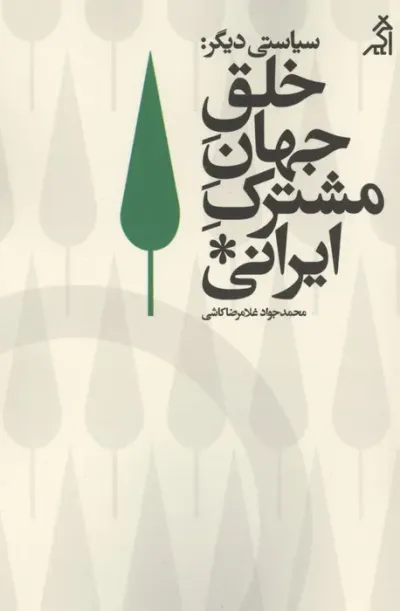
Why this book?
- To understand Kashi's critique of ideological language and the common binaries of politics in Iran.
- To become acquainted with the idea of "building a home" instead of the nostalgia of "returning home."
- To examine the role of friendship, love, responsibility, and everyday life in the formation of a shared world.
- To recognize the distinction between sovereign politics and non-sovereign politics.
- To think about the possibility of democracy and coexistence emerging from a plurality of perspectives and social bonds.
About the book
"Another Politics: Creating a Shared Iranian World" begins with a fundamental question: Can politics be transformed into something more than competition for power? To answer, Mohammad Javad Gholamreza Kashi speaks of the "homelessness" of contemporary humanity and the collapse of ideologies that once provided a sense of belonging, meaning, and security. Against the desire to return to the past, he proposes another metaphor: there is no shared home to which we can simply return; this home must be built.
To explain this shared world, the book brings politics closer to the realm of everyday life. Love, friendship, and ethical responsibility are not marginal or merely private matters in this view, but are among the foundations of collective life. Religion and politics can also play a constructive role when they serve these human bonds, rather than subjugating them.
One of the work's important distinctions is the contrast between "sovereign politics" and "non-sovereign politics." The former operates from a center of power, command, and fear; the latter begins from everyday life, networks of friendship, care, and responsibility. Within this framework, Kashi emphasizes "situational wisdom": thinking and acting with the real possibilities of a situation, instead of waiting for absolute solutions and sudden transformations.
This work continues Kashi's concerns about the relationship between politics, culture, and the lived experience of Iranians, but formulates them within a specific question about the possibility of building a shared life. The intellectual presence of Arendt, Hobbes, and Heidegger also allows the book to examine Iran's issues in dialogue with some fundamental questions of political philosophy and contemporary philosophy.
The book is suitable for readers of political philosophy, political science, sociology, and cultural studies, but its audience is not limited to the academic sphere. Those who think about Iran's future, democracy, social trust, civic action, and the possibility of coexistence among differing viewpoints can also use its proposed framework to reconsider the meaning of politics.