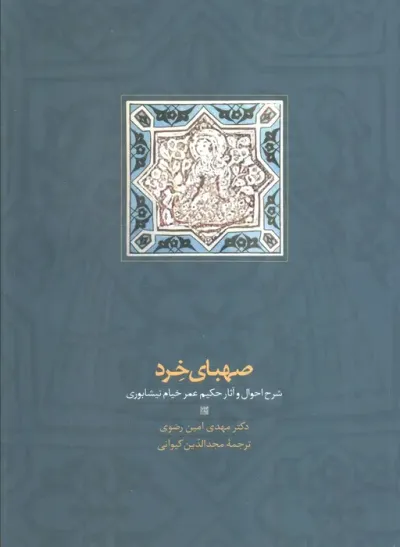
Why this book?
- To understand Khayyam as a philosopher, mathematician, and astronomer alongside his poetic persona.
- To become familiar with the difficulties of attributing the Rubaiyat and the competing views in Khayyam scholarship.
- To examine the role of Edward FitzGerald’s translation in shaping the Western image of Khayyam.
- To understand Khayyam’s influence on European and American literature and culture in the nineteenth and twentieth centuries.
- To explore the place of Khayyam’s thought in the intellectual and cultural history of Iran.
About the book
The Wine of Wisdom, written by Mehdi Aminrazavi and translated into Persian by Majd al-Din Keyvani, is a study of the life, works, and legacy of Omar Khayyam of Nishapur. Aminrazavi seeks to move beyond the one-dimensional image of Khayyam as a poet of wine and pleasure, examining together the different aspects of his identity as philosopher, mathematician, astronomer, and poet.
One of the book’s central concerns is the difficulty inherent in Khayyam studies themselves. There is considerable disagreement over the relationship between Khayyam the scholar and Khayyam the poet, the authenticity of many quatrains attributed to him, and even the image of his personality that has developed over the centuries. The book examines these debates alongside the views of Iranian scholars and seeks to clarify the relationship between Khayyam’s scientific and philosophical writings and the literary legacy attributed to him.
Another major part of the book is devoted to Khayyam’s reception in the West. Edward FitzGerald’s translation of the Rubaiyat made Khayyam enormously famous in the English-speaking world, but it also created a particular image of him: a skeptical, hedonistic, dissenting poet and critic of religious belief. Aminrazavi shows how this image became intertwined with intellectual and social developments in the West, from secularism and humanism to the crises produced by war, turning Khayyam into a mirror for Western debates themselves.