Why this book?
- Understanding the concept of transition as a complex historical and institutional condition
- Examining successful and failed transition experiences in various countries
- Familiarity with the principles of designing a governance system in critical conditions
- Linking academic analysis with practical policy-making issues
About the book
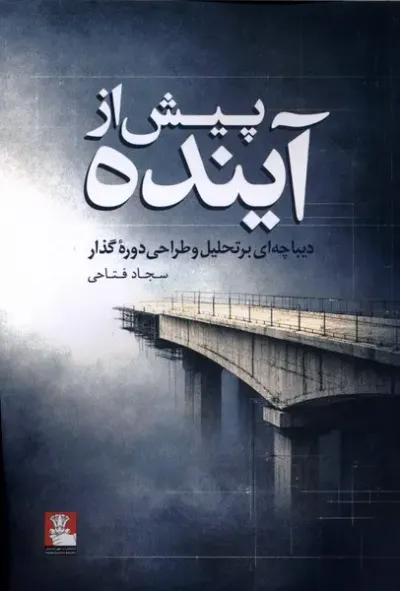
"Before the Future" is a book about the period of political and social transition; a period in which the previous order has weakened and the new order has not yet taken shape. In this work, Sajjad Fattahi attempts to examine transition not as a brief moment between two states, but as a sensitive, decision-driven process whose quality of management can determine a country's future.
The book begins by presenting theoretical discussions on the concept of transition and then examines the goals of the transition period, the architecture of the governance system, the logic of implementation, various scenarios, and potential points of failure. Using examples from different countries, the author demonstrates how a lack of institutional design, state weakness, and hasty decisions can steer the transition process toward instability or collapse.
This work continues Sajjad Fattahi's research concerns regarding governance, sustainability, and the quality of collective decision-making. The book is useful for political and social science researchers, policymakers, students, and readers interested in understanding political change and the future of societies.
"7. The Interim Executive Government Administering the country without long-term policy-making In the architecture of the transition period's governance system, the interim executive government is responsible for the day-to-day administration of the country, not for determining the future political direction. The separation between 'political guidance of the transition' and 'execution of current affairs' is one of the prerequisites for preventing the unchecked concentration of power and the erosion of legitimacy. The interim government, for this reason, must be a professional, limited, and mission-oriented institution."
From the table of contents
- 1Why is 'transition' the most important question for countries in a threshold condition?
- 2Goals of the transition period: (Which goals should be achieved and which goals should not be introduced into this period?)
- 3Architecture of the transition period's governance system: From limited goals to efficient institutional architecture
- 4The logic of implementation, scenarios, and points of failure in transition
- 5Final conclusion