Philosophy
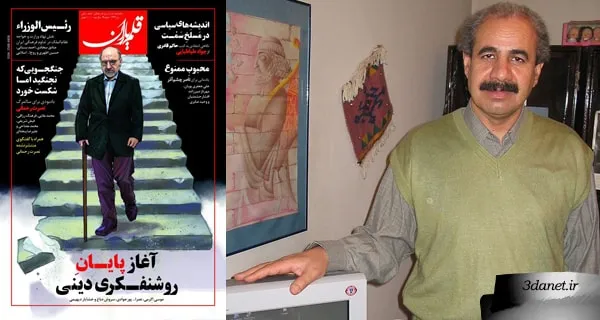
Farda Monthly's Interview with Mostafa Malekian
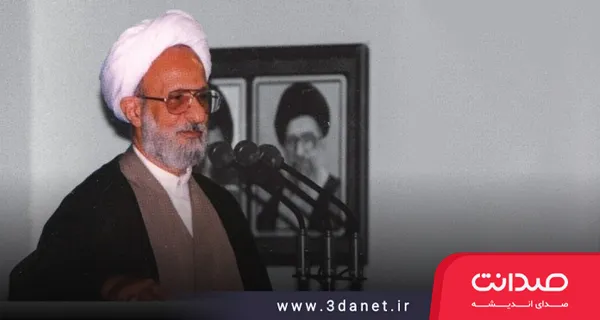
Mostafa Malekian admits he does not practice what he knows and promises to write more. He describes his relationship with Mesbah Yazdi not as a student-teacher bond but as editing books and teaching, says he was never his disciple, yet notes that Mesbah's attention to Western sciences was what drew his interest.
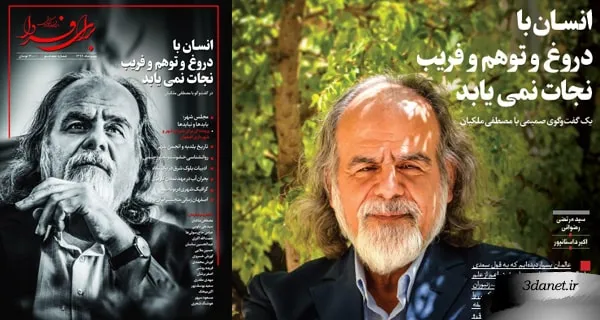
Why do you give lectures and interviews more than you write? In your interview with the Book News Agency, you spoke of three advantages of writing over speech, and of course you also mentioned the inevitability of political action and the conditions in Iran; but doesn't the necessity of striking a balance between social roles and the proportion between design and execution require that, alongside oratory, you give greater importance to books and writing?
Malekian: Hafez says: It is not only I who am weary of my own deeds; the weariness of the learned also comes from knowledge without action. The learned are weary precisely because they do not act upon their knowledge, let alone the ignorant. I do not act upon my own knowledge, and indeed in many instances there is a great gap between my knowledge and my action, and I confess that you are entirely right in this matter. One of the many cases in which I do not act upon my knowledge is what you mentioned.
The second point I wish to make is an excuse worse than the sin, and that is that apparently my audience has understood that my ability in speaking is greater than in writing, and they invite me to lecture far more than they invite me to write. Experience has told me that most people have become interested in my views and opinions through my lectures. I do not recall anyone ever saying to me, "I read your book." I suspect my audience has also realized that in writing I have a heavy, ineloquent, and unrefined pen.
But in speech, I seem to be more successful. I promise here and now that from this year onward I will take the opposite direction. I promise in the presence of four witnesses.
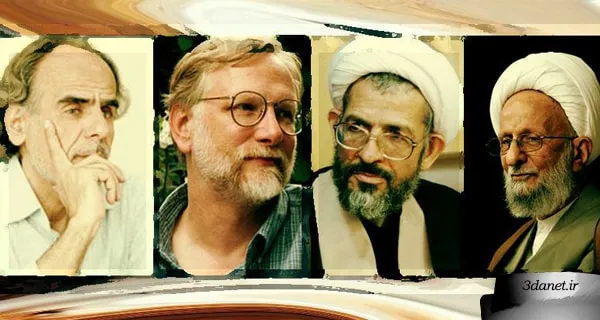
You have had different periods in your life, and you yourself have divided it into five periods. There was a phase when you worked with Ayatollah Mesbah Yazdi, and nothing about that period has been discussed in the media. Now, what harms and damages do you see in that enterprise? Would you explain about that phase and your collaboration with Mr. Mesbah Yazdi? Malekian: When I entered the Qom Seminary in 1979, I was in contact with Mr. Mesbah. Even before 1979, because one of my brothers was his student, I had some distant, passing acquaintance with Mr. Mesbah, in addition to the fact that Mr. Mesbah and my father had known each other and been friends during my father's studies at the seminary. From 1979, when I took up residence in Qom, I came into close contact with Mr. Mesbah. However, one of the points about that period that has been completely distorted and falsely stated is that it has been presented as though I was Mr. Mesbah's student. I only and solely attended his lessons on the psychology of the Asfar. I was never Mr. Mesbah's student in anything other than this lesson of Sadra Shirazi. Yes, I had two other tasks in connection with Mr. Mesbah. One was that for a long period I wrote and edited Mr. Mesbah's works, as is sometimes mentioned in the prefaces to those works. Usually, Mr. Mesbah would deliver a lesson over several sessions; the oral form would be turned into a written form and given to me as raw material, and from the totality of this raw material, with additions that were usually not few, I would compile a book. For example, the book Beyond Marxism, the book Society and History in the Quran, Philosophy of Ethics, Law in the Quran, Politics in the Quran, and so on. This was one task I performed, and in this work, the volume of my writing was sometimes four to five times the original raw material. I would re-edit it and usually referred extensively to other books to complete the discussion.
Another task I performed was that, whether at the Dar-e Rah-e Haqq Institute, or at the Baqir al-Ulum Cultural Institute, or later in its evolved form which became the Imam Khomeini Educational and Research Institute, I taught materials to students; ranging from the English language to the history of Islamic theology, philosophy of religion, philosophy of ethics, history of Western philosophy, research methodology in the humanities, and probably one or two other subjects.
The first year I arrived in Qom, the third cycle of Dar-e Rah-e Haqq was underway and they were accepting students. In that cycle, both my younger brother Mohammad-Baqer and I took the entrance exam to join Mr. Mesbah's training course and study a program with him; we were both accepted. However, after attending for one semester, I found it was of no use to me at all. During that semester, Mr. Mesbah himself did not teach any of the course materials—others taught them—but after one semester, I saw it held no benefit for me whatsoever. I had already read many of those raw materials on my own; I had a university education, and later I even taught the English language course for that same program. After one semester, I resigned.
So my collaboration with Mr. Mesbah was in two areas: one, in his own words from the preface to some of his books, was the editing and writing of works, and the other was teaching at educational institutions administered under his own supervision.
When you say "organizing," does that also include providing arguments?
Malekian: Precisely, providing documentation and argumentation. The books you see in the sources and references of those works were not consulted by Mr. Mesbah Yazdi himself; I consulted all of them. For example, when Society and History from the Perspective of the Quran was taught, Mr. Mesbah's attention was solely on the book Society and History in Mr. Motahhari's series on the Islamic Worldview at that time. But if you look at the book, you will notice references to many books by Westerners, which were my own work. The same applies to Philosophy of Ethics. Therefore, if being a student of Mr. Mesbah means what is customary in the seminaries, I deny it, except for the psychology section of the Asfar, where I attended his class.
The second point is that Mr. Mesbah, at that time, had what you would now call a sect, though I do not accept this term and say he had a circle and gathering known as the Mesbahi circle. Despite being close to Mr. Mesbah, I was never a member of the Mesbahi circle; my own brother was, but I was not. No one ever told me I was one of the Mesbahis, but the fact was that I was interested in Mr. Mesbah personally due to three characteristics. I say I was interested, and I emphasize that I was never a disciple of Mr. Mesbah, nor have I ever been a disciple of anyone in my life, whether Eastern or Western, ancient or modern.
The first reason for my interest: Mr. Mesbah, to the best of my knowledge, was the sole cleric in the 1970s who paid attention to the necessity of learning Western sciences and knowledge and insisted that seminary students must learn Western sciences and knowledge. For me, who was always fascinated by Western culture—not civilization—this was intriguing. Of course, there is no doubt that someone like Mr. Mesbah studied the West only to oppose it, but in any case, the prerequisite for opposing the West was knowing the West, which no other cleric in the seminary prescribed. At that time, in both Tehran and Qom, Mr. Beheshti was someone who encouraged seminary students to learn modern Western sciences and knowledge, but he was not a permanent figure in the seminary. In the Montazeriyeh or Haqqani School in Qom, Mr. Beheshti and Mr. Mesbah were two figures whose scholarly weight exceeded that of the others, and they were, incidentally, in sharp opposition to each other. The only cleric in the seminary who wanted students to become acquainted with Western culture was Mr. Mesbah, and I greatly enjoyed this.
The second factor in my fondness for him was that Mr. Mesbah, at that time, largely shunned the grandeur, majesty, status, and position surrounding clerics. Mr. Mesbah was not someone who cultivated a clerical aura for himself; he came and went much more simply, interacted with students more simply, and for me, who was familiar with the clergy through my father, it was appealing that he lacked the pomp and circumstance that clerics created around themselves.
The third point was that Mr. Mesbah was generally a man of reflection; he usually monitored his own speech. I rarely saw a word slip from his mouth; rather, he would usually savor his words and respond with reflection and deliberation. This is rare among clerics. Our clerics seem to possess a world-revealing cup, and when you ask a question, they immediately gaze into it and give you an answer. Mr. Mesbah was reflective, a man of measured speech, and rarely uttered unconsidered words, though occasionally, when angered, he would speak unguardedly, but rarely.
These three points had captivated me toward Mr. Mesbah, but I was not his disciple. The reason is that I inherently lack a disciple-like disposition. My father, from childhood, to keep my brother and me away from this disposition, would say, "When I see a very luminous cleric, the first conclusion I draw is that this cleric has just come out of the bath! I draw no other conclusion." I inherited this disposition from my father, as he was no one's disciple, and there were three other reasons I did not become his disciple and distanced myself from the Mesbahi circle:
First, Mr. Mesbah was highly susceptible to dogmatism, rigidity, prejudice, bias, and intolerance toward any dissenting thought, and I did not approve of this disposition. From adolescence, I was very open to all ideas; Mr. Mesbah was very prejudiced and had negative preconceptions toward dissidents, including Dr. Shariati at that time.
The second point is that Mr. Mesbah could not tolerate opposition to himself. He could not be seriously criticized; you could only receive guidance from Mr. Mesbah. You could not seriously engage in a discussion with him and declare your opposition.
The third point is that he read very little and only a very limited number of books.
I remember once I gave him three books to read at the same time: one was Science and Religion by Ian Barbour, translated by Bahāʾ al‑Dīn Khurramshāhī, The Foundation of Sabzavārī’s Wisdom by Toshihiko Izutsu, translated by the late Sayyid Jalāl al‑Dīn Mujtabavī, and The Semantic Structure of Religious and Ethical Terms in the Qurʾān by Izutsu, in the fine translation by Farīdūn Badraʾī. I wanted him to become acquainted with these discussions, and a long time afterward I once politely asked, “Did you get a chance to study the books?” He said, “I didn’t have the time.” In my view, the one thing a religious scholar has no right to say about studying is “I didn’t have the time.” The studies he did pursue were mostly in the field of hadith and narrative traditions, along with some philosophical works. Contrary to the fact that in his talks he always said that seminary students must become familiar with the modern sciences and learning, he himself rarely engaged deeply with a new discussion or exposed himself to a new debate, and this was off-putting to me.
Another aspect of why I was not one of his disciples had to do with the issues of the revolution. During the time I was with him, I myself was very much in favor of the Islamic Revolution of Iran and the Islamic Republic, and I had a great personal fondness for Mr. Khomeini. At that time, however, in the gatherings and interactions I had with Mr. Mesbah, I always saw a kind of indifference toward these matters, and the fascination I felt at that time for Mr. Khomeini was not visible in Mr. Mesbah. Mesbah seriously discouraged those around him from taking part in the war.
At that time, he viewed many of the opinions and views held by the leading figures of the Islamic Republic as having a Marxist tinge; he disagreed with many of Mr. Beheshti’s positions; when Mr. Khomeini condemned the Hojjatieh Society, Mesbah did not go along with this condemnation. These are things I mention deliberately, and whether these positions were right or wrong, at the time I was with Mr. Mesbah they were repellent and off-putting to me. Perhaps now I would approve of some of Mr. Mesbah’s positions because I have undergone an intellectual transformation, but back then, when I was in his company, they were not acceptable to me, and this caused me, for this reason, to have an intellectual and emotional avoidance of him, an intellectual and emotional distancing.
Now some of those positions are acceptable to me, though they were not at the time, but what is still not acceptable to me is that Mr. Mesbah now denies the positions he held back then. For example, I remember in these later years I once heard him telling the Basij members, “Just as we fought on the battlefield during the war years, now we must fight on the cultural battlefields,” and I wonder when Mr. Mesbah ever encouraged anyone to fight. This is simply not acceptable to me, that he is covering up his past.
I myself was the first person to say that I have had five intellectual phases, and the first phase was that of an Islamic and religious fundamentalist. Denying the past is both contrary to ethics and means that a person loathes himself. I hold the view that I must not deny my own past, and ethically speaking, if I were to do so, it would mean that pieces of me are the object of my loathing. There is no reason that, because at some juncture I believed in something on the basis of reasoning and with sincerity, I should later come to loathe that period. I repudiate my four previous phases, but I do not loathe them, because it was not out of caprice, bandwagoning, or being a member of the party of the wind that I held those inclinations; therefore, I have no regrets at all. But I do repudiate them and say that I no longer hold that thought.
I am deeply pained by this point about Mr. Mesbah, that he denies his own past. He was opposed to Mr. Beheshti, but now you see no trace of such a thing, nor of his opposition to Imam Khomeini’s stance against the Hojjatieh Society. Mr. Mesbah never encouraged a single person to go to the front. I have recollections of people who wanted to go to the front and at the same time wanted to have Mr. Mesbah’s approval, but that approval was not forthcoming. I will not refer to more things, and I do not at all welcome this wave of exposé that has emerged in our country. My view is that one of the good attributes of God that we ought to possess is being the Concealer of faults. I am deeply disgusted by the spirit of exposé, which is a Marxist spirit. Another reason I do not recount everything is that if I were to relate something, it would be vehemently denied, and in the current circumstances no one anywhere would testify in my favor; therefore, I will not throw myself into a legal predicament. But I could not pass over these things, because everyone who knows Mr. Mesbah, both his supporters and his opponents, confirms these points.
What is the necessity of recounting even this much that you have said, and what is your purpose in expressing it?
Malekian: In that a part of the attacks that people like Mr. Mesbah now direct at people like me is that you are not reconciled with the Islamic Revolution and the Islamic Republic, I am actually saying that when we were reconciled, they themselves were not reconciled.
.
.
Complete PDF file of this interview
Download from the first server | Download from the second server
.
.
Morteza Rezvani / Akbar Dastanpour Interview with Mostafa Malekian Farda Monthly (Issue 18, Mehr 1396)
.
.

Discussion0 comments
No comments yet; let yours be the first voice.