Philosophy
Mostafa Malekian: Nietzsche said our spirit cannot bear to face reality
According to Malekian, Nietzsche believed that human beings possess neither the mental nor the spiritual capacity to fully access truth. Our minds select facts based on our needs, and our spirit lacks the capacity to bear reality; therefore, truth is the servant of expediency.
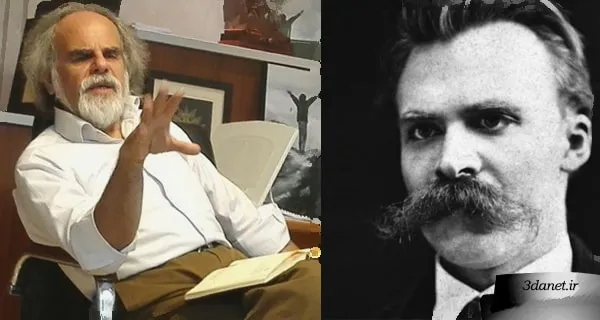
Nietzsche says the example of philosophers with truth is like that of a young villager who has just come to the city and encounters a very experienced, notorious prostitute. This young villager, out of naivety, thinks that when this woman smiles at him, she has fallen in love with him and is heartbroken over him. He thinks she will give her entire being to him. Then he becomes flustered—how she is smitten with us! And he falls into delusion about his own worth and says to himself, how handsome I am, how tall and well-built I am. He has no idea that this woman’s job is this. She is not smitten with anyone; she is the same toward everyone. She smiles at everyone. The philosopher is the same way toward truth; he thinks he can ensnare truth. Sometimes truth has smiled at him—for instance, he has arrived at a fact, and the utmost is that he has, for example, arrived at the fact that “water boils at one hundred degrees” and “syrup is sweet.” In reality, according to Nietzsche, we can never access truth, either mentally or spiritually. First, our mind is always engaged in selection. Even when facts are presented to it, it only accepts those that fulfill its needs. This is why the degree of persuasion of a single argument differs among different individuals. Why does one person find an argument convincing, yet when you present the same argument to your friend, he says, “My heart does not find peace”?
According to Nietzsche, the mental structure of us humans differs. Suppose a person has been constantly oppressed in his worldly life, never having had the power to defend himself. Whenever he tried to defend himself, he received another slap. He has pinned all his hopes on the afterlife and says: after this world, there is a world in which the oppressor will be punished. This person will resist an argument that seeks to prove that “there is no life after death” and will naturally react and cannot accept it. If he accepts it, his spiritual structure will collapse. If such a person is a philosopher, he will exert all his rational effort to prove the firm proofs of the resurrection. Consider the other side of the issue. Someone like Muawiyah, who has indulged in every kind of pleasure, oppression, and gratification in life. Now, if they tell him there is another world in which we will be punished, he resists belief in the afterlife. If it is proven that a resurrection exists, his spiritual equilibrium will be lost. He has no choice but to try to refute the proofs for belief in the resurrection in some way. So we are not neutral in the face of realities. If we see that by accepting an opinion we attain a favorable spiritual state, then we welcome its proof, and if we see that we attain an unfavorable spiritual state, we turn away from it.
But spiritually, Nietzsche believed that humans simply cannot bear all realities. Reality has a shattering, veiled presence. This is similar to what our mystics also said: that humans do not have the capacity to hear all opinions and views. Rumi said a disciple told a spiritual master, “Tell me all the secrets of the visible and invisible worlds.” He said, “Certainly, but on the condition that you first take this box I give you to the market and give it to a certain person, and you must not open it on the way.” On the way, he says to himself, “What is in this box?” and finally cannot bear it and opens it. There was a mouse inside, which jumps out and escapes as soon as the lid is opened. When he recounts the story to the master, the master says, “You could not bear for this mouse to remain hidden in this box for half an hour, so what expectation do you have that I should tell you all the secrets?”
Nietzsche said our spirit simply cannot bear to face realities. Our spiritual capacity as humans is less than what is needed to accept all realities. If you hold the view that “truth is the servant of expediency,” then in your view, relatively speaking, everyone is like this; for example, suppose two arguments are presented to you: one for proving the existence of God and one for negating the existence of God. Because of the belief you hold, you try to present that argument for negating God’s existence in a meticulous way so that it has a flaw and you can say it is invalid. But you do not scrutinize the proofs for God’s existence with such meticulousness. Now, if someone’s belief is contrary to ours, he transfers all the meticulousness that we apply to the proofs negating God to the proofs proving God’s existence.
.
.
Mostafa Malekian: Nietzsche said our spirit cannot bear to face reality
Source: Mostafa Malekian, History of Western Philosophy, Vol. 4, p. 34
.
.



Discussion2 comments
حقیقتا تفکر کردن سخت و طاقت فرساست.
بله علم حصولی چون از جنس صورت است، قطعاٌ راه دشواری است اما علم حضوری یقینی تر است