Political Science
The Essay “Skepticism and Political Theory in the Thought of Oakeshott” by Aref Ebadi
Thinkers divide into two camps: autonomous reason and skeptics. Oakeshott, critiquing abstract formulas, likens rationalism to a Procrustean bed that destroys reality, distinguishing between technical and practical knowledge.
Skepticism and Political Theory in the Thought of Oakeshott
Aref Ebadi, Postdoctoral Researcher in Social and Political Theory, University of Cambridge
Qalam Yaran Monthly Magazine Issue 30
In a general classification, Western political thinkers (from the Enlightenment onward) can perhaps be divided into two main camps. On one side are thinkers who believe that human reason is an abstract and autonomous element which, if properly employed, will be capable of discerning universal social goods and specifying the ways to achieve them. To create a rational society in which social values are coherently and uniformly integrated, one must first establish the rational principles of society in the theoretical realm. In other words, one must see what universal formulas the "autonomous reason," free from all historical, ethnic, religious, political, identitarian, and cultural dependencies, commands. Knowing the universal formula of human behavior and psyche and rationally discerning the ends of society, the political theorist's task is to devise a roadmap for creating the ideal society. In a society whose principles are based on autonomous reason and whose members have accepted the sovereignty of reason, affairs proceed free from the usual conflicts, and the members of society interact with one another in complete harmony. But why such a society has not yet come into being must be sought in two factors. First, due to erroneous education, people have never been able to rely on autonomous reason. Many factions and groups in society have a vested interest in the ignorance of the people, and thus throughout history have seen their interest in expanding and deepening stupidity among the people. Second, political theorists have also never been able to free themselves from various prejudices, which, like a veil over the eyes of reason, prevent it from moving in the right direction. To reach the ideal society, thinkers must be bolder than ever in theorizing so that they can express the complexities of the world in their rules and ultimately show the path to the ideal society.
In the opposing camp are thinkers who view the above beliefs with skepticism. For these thinkers, abstract and autonomous reason is neither that royal acid which dissolves all problems nor that master key which unlocks every question. Autonomous reason, despite all its power and capability, remains limited and conditioned. For these thinkers, the cold and colorless formulas and rules of the followers of "autonomous reason" are incapable of showing the complexity, beauty, and richness of real human life. The reality of the world and the human psyche is so intricate and convoluted that it submits to no general rule. General rules arise from abstraction and generalization, but no abstraction or generalization is real; only particulars are real. The rules and formulas of the companions of "autonomous reason" do to reality what Procrustes in Greek mythology did to his hapless victims. Procrustes had an iron bed and forced his guests to lie upon it. If they were shorter than the length of the bed, he would crush their joints and stretch their limbs until they matched the bed's length. But if the person was taller than the bed, he would cut off their body until it was exactly equal to the bed's length. In either case, the unfortunate individual lost their life based on an arbitrary standard. Formula and rule do the same to reality, that is, distorting or destroying the diverse reality of the world based on a general rule. One of the most important political philosophers of the twentieth century who applied his energies to demonstrating the weaknesses of excessive reliance on reason is the renowned English philosopher Michael Joseph Oakeshott (1901-1990).
Oakeshott was deeply skeptical of the use of general rules and abstract formulas in the sphere of politics, and wrote one of his most brilliant essays on this subject, titled “Rationalism in Politics” (Oakeshott, 1947/1991). Oakeshott distinguishes between two kinds of knowledge: technical knowledge and practical knowledge. By technical knowledge, he means knowledge that can be clearly and transparently expressed as a rule or formula. It should be noted that Oakeshott defines the word “technique” both as the “method” of study or inquiry for arriving at general rules concerning human conduct, and as the “result” of that method (Tseng, 2003: 134-135). In this type of knowledge, the correctness of a proposition or claim can be logically demonstrated. The rules of technical knowledge are general, eternal, and universal, admitting no exceptions. In Oakeshott’s view, the “rationalist” is someone who acknowledges only this type of knowledge as valid knowledge. Thus, for the “rationalist,” there is no authority higher than “Reason”; “Reason” can question everything, confident that it can ultimately discover the right answer. It is difficult for the “rationalist” to imagine that “a person who thinks clearly and honestly might hold a different opinion from his own” (Oakeshott, 1947/1991: 6). Although the “rationalist” does not deny the importance of experience, what he means by experience is solely his own “personal experience”; the “rationalist” is, in the strict sense of the term, “self-made,” for he attaches no value to the experience of humanity. The experience of humanity is not his “personal experience.” Each day that begins is, for the “rationalist,” a day free of any commitment, detached from all habits and traditions; every day is, for the “rationalist,” a completely new and fresh day, filled with infinite possibilities for experiencing something new and original. Moreover, the “rationalist” considers only that part of “personal experience” important which can be expressed in precise and universal principles. Details, exceptions, and everything transient and perishable are, in his view, trivial and vulgar matters. For the “rationalist,” the only possible knowledge is knowledge that can be expressed as a rule and formula. Although Oakeshott makes no reference to Kant in his writing, I believe one of Kant’s works can clearly illuminate Oakeshott’s position. In 1793, Kant published an essay titled “On the Common Saying: That May Be Correct in Theory, but It Is of No Use in Practice” (Kant, 1793/1999). One of the issues Kant addressed was the belief held by some that the judgments of philosophers and metaphysicians are of no use in everyday life. Against this claim, Kant argued that the reason some philosophical judgments are of no use is either that philosophers have not issued correct judgments, or that their judgments are insufficient and more metaphysical judgments must be produced. In any case, what Kant never doubted was that all knowledge is equivalent to what can be expressed as general rules and formulas.
In contrast to technical knowledge, Oakeshott speaks of practical knowledge, which is irreducible to general and universal formulas. Practical knowledge is knowledge that an individual acquires by doing something for a long time or through apprenticeship alongside a master craftsman. Although parts of this type of knowledge may be expressible as general rules, not all of it can be formulated, and the individual must acquire this kind of knowledge practically. Oakeshott's favorite example in this regard is cooking (Oakeshott, 1947/1991: 12-14; Oakeshott, 1948/2004: 187; Oakeshott, 2014: 155, 416; Oakeshott, 1958/1991: 159; Oakeshott, 1956/1991: 419; Oakeshott, 1950/1991: 118-120; Oakeshott, 1951/1991: 52-53). For those interested in cooking, there are various books about cooking that can be studied. However, if someone reads all the cookbooks without ever having engaged in the act of cooking, that person cannot be called a cook. To become a good cook, not only is studying cookbooks useful, but the individual must have practically participated in the process of cooking food (Wells, 1994: 135; Costelloe, 1998: 325; Minogue, 2004: 230). Oakeshott believes that the example of cooking nicely reveals two different levels of knowledge and their relationship with one another: on the one hand, theoretical knowledge about the general principles of cooking, and on the other hand, practical knowledge and the cultivation of culinary taste and flair through participation in the cooking process.
It should be noted that Oakeshott did not believe that, in reality, an absolute distinction exists between the domains of technical knowledge and practical knowledge. These two knowledges are intertwined, and human behavior is the result of the simultaneous use of both. However, in some domains, one type of knowledge may take precedence over the other. For example, in scientific and engineering disciplines, technical knowledge usually has the upper hand over practical knowledge, whereas in artistic disciplines, conversely, practical knowledge is more important than technical knowledge. The distinction between the two levels of knowledge is not a novel matter in philosophy, and Oakeshott never claimed to have been the first to notice it. Before Oakeshott, some writers and thinkers such as Aristotle, Edmund Burke, Gilbert Ryle, Michael Polanyi, and Friedrich Hayek had all spoken about the difference between theoretical knowledge and practical knowledge (Ebadi, 2020: 44-47). However, what distinguishes Oakeshott from other thinkers is his emphasis on the epistemological priority of practical knowledge over technical knowledge (Smith, 2012: 136). In Oakeshott's view, any theory is a simplified and general form of a complex and plural reality, which is only comprehensible to the individual when they first have practical knowledge of the subject. For instance, a child does not begin learning their mother tongue by studying grammar; rather, they first learn the language practically and later learn theoretically what grammar is and how it functions (Oakeshott, 1975/2003: 91). What appears in rules and theories is only the abstracted and generalizable parts, and is therefore a caricature of reality, not a full-fledged picture of it.
In Oakeshott's view, although the priority of practical over technical knowledge is more evident in the realm of politics than anywhere else, politics today has fallen into the hands of those whose only knowledge of it comes from books. For these individuals, politics is ideology, meaning their understanding of politics is limited to what can be expressed as abstract rules and formulas (Franco, 2004: 85). For Oakeshott, ideology means abstract, general generalizations about human behavior devoid of any concrete experience—a skeleton stripped of the flesh and blood of political experience, that which can be presented as clear propositions in a manifesto and fed to the followers of a creed (Corey, 2014: 266-267). Hence, what matters is the "truth" of a belief or the "rational" basis of an institution, not how it was formed, sustained, or its utility (Oakeshott, 1947/1991: 8). But as noted, technical knowledge presents a simplified picture of reality, and even that is only possible when we first possess practical knowledge of the subject under discussion. Therefore, a political ideology, rather than being "the quasi-divine parent of political action, is its earthly stepchild." The genealogy of political ideologies indicates that they were initially reflections on customary modes of political conduct, not predetermined rules for political behavior. In other words, political action takes shape first, and political ideology follows after it (Oakeshott, 1951/1991: 51). For this reason, Oakeshott is suspicious of the presence of political theorists in guiding political conduct. The purpose of theorizing in politics is to identify, distinguish, explain, and ultimately understand a phenomenon, not to participate in the phenomenon under study. Of course, political theorizing can itself become the subject of study, but this occurs when a practical subject at one level becomes a theoretical subject at another level (Nardin, 2015: 312).
Oakeshott's skepticism regarding political theorizing is not limited to the domain of describing or explaining political phenomena; rather, he believes that what "rationalists" propose concerning political ends is also problematic. To clarify the matter, Oakeshott employs the two concepts of "enterprise association" and "civil association." By "enterprise association," he means a society or government that has set a specific goal as its guiding principle. In this mode of governance, all mechanisms, laws, and conditions of life are shaped based on the ultimate goal and find meaning only in its light. The ultimate goal here is not necessarily an "otherworldly," religious, or metaphysical one, but can be a completely secular matter. In fact, Oakeshott argues that today in most Western societies, we witness secular goals becoming political and social ends. For example, Oakeshott mentions the concept of "economic growth" and explains how "economic growth" has today become a kind of cult and creed for politicians, such that the entire capacity of society is placed in the service of achieving the goal of "4% economic growth" (Oakeshott, 1960/2004: 303). For this reason, Oakeshott objects as much to the socialist system of the Soviet Union or the Nazi government of Germany as he criticizes the Labour Party government in post-World War II England. In all these governments, we witness a kind of "enterprise association," that is, the planning and directing of society to achieve a specific goal. Although Oakeshott agrees in many respects with the views of a thinker like Friedrich Hayek, he nevertheless claims that Hayek, in his book The Road to Serfdom (Hayek, 1944/2007), was also unable to free himself from the trap of "rationalism." In Oakeshott's view, the negative aspect of Hayek's thought—that is, his criticisms of the socialist system and centralized planning—is entirely apt and justified; however, when Hayek adopts a positive aspect and sets out to delineate his own desirable society, he resorts to the same logic employed by the socialists, that is, a kind of planning, but this time to oppose planning. Hence, in describing Hayek's book, Oakeshott writes, "A plan to resist all planning may be better than its opposite, but it belongs to the same style of politics" (Oakeshott, 1947/1991: 26). In other words, Oakeshott believes that in the aforementioned book, Hayek was unable to completely free himself from the bonds of "rationalism," and what he promotes remains a form (albeit an improved form) of the application of "rationalism" in politics.
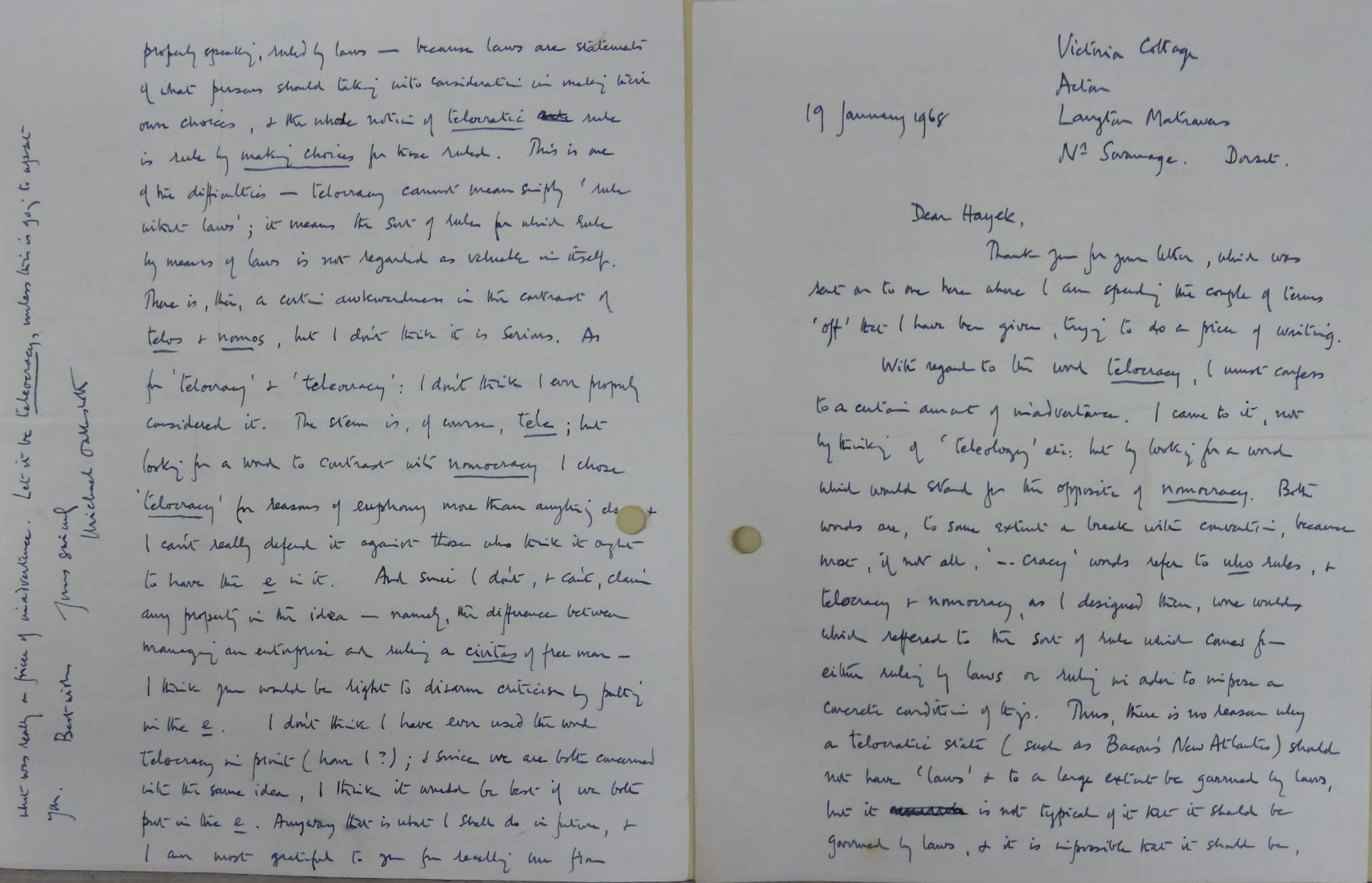
Moreover, Oakeshott believes that political ends are not entirely coherent with one another and that it may be impossible to present a complete and perfect picture of an ideal society. Oakeshott expressed this idea in its most concise form during correspondence that took place in the late 1940s between him on one side, and Popper and Hayek on the other (Oakeshott, 1948; Oakeshott, 1949). During this period, Popper, in two of his works, The Open Society and Its Enemies (Popper, 1945/2013) and an essay titled “Utopia and Violence” (Popper, 1948/1989), drew a distinction between “utopian social engineering” and “piecemeal social engineering.” Popper believed that in “utopian social engineering,” political philosophers imagine an ideal and then strive to steer society toward this imaginary ideal. Since the “utopia” in question is not the product of collective thought but rather an instance of the ideas of one individual or a small stratum of individuals, individuals and groups cannot resolve their differences regarding alternative “utopias” or the methods of achieving them in a “rational,” “scientific,” and peaceful manner. In this respect, all ideas based on “utopian social engineering” are inevitably set on a path toward violence and bloodshed. The alternative Popper offered was “piecemeal social engineering.” In this method, instead of thinking abstractly, the politician attempts to solve the concrete political and social problems they face in a partial and gradual manner. The advantage of this method over “utopian social engineering” is that, firstly, the problem in question has an objective existence and individuals can determine in a “rational” way which issues take priority; secondly, the attempt to solve problems is carried out gradually through reforms in procedures, not in a revolutionary manner by overturning society; and thirdly, using the method of “piecemeal social engineering,” correcting errors and resolving disagreements costs less, as each solution pertains only to a specific case and there is no need for the overall foundation of society to fall apart.
However, Oakeshott opposes the above view. In Oakeshott's view, Popper assumed that “one could simply select one problem of society at a given time and devote all of society's energy to solving that specific case (such as unemployment), and indeed solve that specific case forever” (Jacobs and Tregenza, 2014: 21-22). Oakeshott believes that such an assumption is fundamentally mistaken. In politics (and even in life), one cannot solve a problem forever. Every answer is a conditional solution that, at best, can solve one problem, but will create a new one. Furthermore, the elements of society are intertwined, and it may be impossible to achieve the resolution of one problem without having to pay attention to related issues and cases. Popper's view of society, as the title of his theory suggests, is an “engineering” view that imagines one can replace the gears of a machine without the entire apparatus being affected. Popper's view of society, like that of his compatriot Hayek, is an ideological view based on “rationalism.” Oakeshott also emphasizes that the ends and goals of society do not submit to “rational” or “scientific” debate. The cooperation of individuals in society is not born of their “rational” or “scientific” agreement on the ends of life, because such factors lack sufficient capacity to create solidarity among the members of society. Individuals come together based on “a common civilization (where it exists) or common habits of behavior (where they exist), things that are neither rational nor dependent on reasoning” (Oakeshott, 1948). Now the question that arises is this: if “reason and reasoning” are not the basis for decision-making, then what alternative exists?
In his correspondence with Popper, as well as in his other writings, Oakeshott emphasizes that he is not opposed to “reason” but rather to the viewpoint that considers “reason” alone as the criterion for everything. Oakeshott writes: “There is a great difference between rational inquiry and ‘rationalism,’ just as a distinction must be made between scientific inquiry and ‘scientism.’” Oakeshott is fully aware of not falling into the trap of contradiction, for if someone were opposed to reason in general, they could not demonstrate this through argument, since the purpose of argument is to show the rational grounds for a matter (Oakeshott, 1947/1993: 99). Reason has a share in society and human conduct, but this should not mean ignoring or belittling other factors. In Oakeshott’s view, traditions, or what in his later works he calls “practices,” are of greater importance in guiding human conduct in society. The concept of “civil association” in Oakeshott’s thought is an attempt to show the connection between social “practices” and politics. For Oakeshott, the ideal form of “civil association” is possible when the state does not seek to direct society toward a specific goal or to control the individuals within it. Hence, in “civil association,” not only is no specific end envisioned for society by the rulers, but individuals are not even required to state the “rational” foundations of their beliefs or try to approach “truth” through “critical rationality.” Oakeshott is deeply skeptical of such efforts and does not accept that the state or an assembly of individuals has the duty to guide others in a particular direction. What matters to Oakeshott is that the state provides conditions so that individuals can pursue their conflicting and non-conflicting, rational and irrational, logical and illogical needs and desires as far as possible. For Oakeshott, and later for Hayek, the purpose of legislation is the codification (and not the enactment) of the general rules of society and guaranteeing their enforcement. These laws specify the general rules of human conduct in society without seeking to attain a specific end. For this reason, skepticism towards the attainment of political ends is one of the most important distinguishing features of Oakeshott’s political thought. Rather than seeking the realization of an “ideal society” or reaching “truth,” he devotes his effort to demonstrating the value and importance of the peaceful coexistence of individuals in society alongside one another. In the ideal type of “civil association,” it is the individuals who each determine their own goal in life and the ways to achieve it, without any need for a “rational,” “scientific,” or “logical” justification of that goal. The purpose of “civil association” is the freedom, individuality, and well-being of the individuals in society together, not the logical proof of political propositions. Thus, when it comes to freedom, Oakeshott does not resort to philosophers and political thinkers like Milton and Mill, but turns to skeptics like Montaigne and Hume, whose defense of freedom was contingent upon its practical utility (Oakeshott, 1955/1993: 117).
Despite Oakeshott’s importance in twentieth-century political theory, he is less well-known compared to his contemporaries. The reason for this can be found in several factors. The first factor relates to Oakeshott’s personality. He was a humble and unassuming man who had little interest in appearing in the public eye and repeatedly declined offers of honors (Minogue, 1991). Secondly, Oakeshott’s deep skepticism about the use of political theory and philosophy in the practical sphere was not very compatible with the spirit of his time. Oakeshott spoke of the weakness of political theory in guiding political action at a time when “social planning” in its various forms had ardent supporters among the people, intellectuals, and politicians. And finally, Oakeshott’s thought possesses such a complex coherence that expressing it in the form of a formula or slogan is very difficult. This does not stem from convoluted language or ambiguity in the expression of concepts; on the contrary, it must be acknowledged that Oakeshott’s prose is among the most beautiful and clearest that one can study in the field of political theory. I suspect the difficulty lies in the fact that what Oakeshott says is sometimes so novel and counter-intuitive that it cannot easily be categorized and subsumed under other concepts (Grant, 1998: 218-219).
However, it should not be imagined that Oakeshott's thought is a structure without flaws. Some critics are of the opinion that Oakeshott has not been able to provide a precise definition of some of the fundamental concepts of his theory. For example, it is argued that the definition of "tradition" or social "practice" in Oakeshott's thought is not clearly stated. Since Oakeshott believes that for political decision-making, instead of abstract reason or "technical knowledge," it is better to seek help from social "practice" or "tradition," it is expected that a clear definition of these concepts be provided (Raphael, 1964). Another criticism is directed at the unique form of Oakeshott's conservatism. For instance, Irving Kristol—one of the founders of neoconservative thought in the United States—believes that Oakeshott's conservatism has two fundamental flaws (Kristol, 1996). First, what Oakeshott presents as conservatism is excessively secular, and therefore its acceptance is impossible for religious people. In Kristol's view, religion must be considered the most important factor linking humans to the past and the future. In the absence of religion as a fixed and stable element, finding a suitable alternative for the continuity of traditions in human societies will be difficult. Moreover, by depicting what will happen in the future, religion reveals the correct path for guiding the individual and society. In the absence of religion, humans lose their link to the past and the future without having anything to replace it. Kristol says, "A conservative disposition is possible, but without religion, it has no substance." Second, Kristol claims that Oakeshott's reading of conservatism bears little resemblance to its American version. Oakeshott's view of social "traditions" or "practices" relies entirely on the English political experience. In other words, what Oakeshott says about "tradition" and "practice" arises from the political and social experience of the English people, but such an experience should be considered an exception and not the rule. Kristol argues that, unlike English conservatism, American conservatives are progressive and advocate for increasing political participation. In Kristol's view, although Americans are a conservative nation that has always maintained its link to the past, this has not caused them to live in the past. From childhood and formative years, individuals become familiar with national rituals, the anthem, and the flag, and display them in all official ceremonies. Patriotism in America is a kind of cult and creed that brings together people with different religious, ethnic, racial, and ideological backgrounds and steers them in a specific direction—which is the growth and expansion of American values. This stands in contrast to Oakeshott's reading of conservatism, which emphasizes preserving the status quo more.
Despite all the criticisms leveled against Oakeshott's theory, I believe that parts of his thought possess great strength. Oakeshott's skepticism demonstrates that "utopian" thinking, that is, recognizing an end for social life and steering society toward it, is what a vain and harmful delusion. The purpose of politics is to preserve peace and stability so that individuals can freely pursue their interests and follow what is meaningful to them. As he stated in one of his most famous phrases: "In political activity, men sail a boundless and bottomless sea; there is neither harbour for shelter nor floor for anchorage, neither starting-place nor appointed destination. The enterprise is to keep afloat on an even keel; the sea is both friend and enemy; and the seamanship consists in using the resources of a traditional manner of behaviour in order to make a friend of every hostile occasion" (Oakeshott, 1951/1991: 60). In Oakeshott's thought, politics does not guide us toward any end but rather seeks to preserve tranquility and create an open space so that citizens have the opportunity to pursue the ends of their own lives. Therefore, in Oakeshott's view, one must adopt a conservative disposition in politics in order to be radical in other spheres of life.
.
.
Corey D (2014) Oakeshott's Concept of Ideology. Journal of Political Ideologies 19(3): 261-282.
Costelloe T (1998) Oakeshott, Wittgenstein, and the Practice of Social Science. Journal for the Theory of Social Behaviour 28(4): 323-347.
Ebadi A (2020) The Quiet American: A Conservative Reading. In: Muir R and Colombo E (eds) The Politics of Culture: An Interdisciplinary Interrogation of Popular Culture. Cambridge: Cambridge Scholars, pp.41-60.
Franco P (2004) Michael Oakeshott: An Introduction. New Haven: Yale University Press.
Grant R (1998) Michael Oakeshott. In: Mason R (ed) Cambridge Minds. Cambridge: Cambridge University Press, pp.218-237.
Hayek FA (1944/2007) The Road to Serfdom. Chicago: Chicago University Press.
Jacobs S and Tregenza I (2014) Rationalism and tradition: The Popper–Oakeshott Conversation. European Journal of Political Theory 13(1): 3-24.
Kant I (1793/1999) On The Common Saying: That May Be Correct In Theory, But It Is Of No Use In Practice. In: Gregor M (ed) Practical Philosophy. Cambridge: Cambridge University Press, pp.277-310.
Kristol I (1996) The Right Stuff. Prospect Magazine.
Minogue K (1991) A Memoir: Michael Oakeshott (1901–1990). Political Studies 39(2): 369-377.
Minogue K (2004) Oakeshott and Political Science. Annual Review of Political Science 7(1): 227-246.
Nardin T (2015) Oakeshott on Theory and Practice. Global Discourse 5(2): 310-322.
Oakeshott M (1947/1991) Rationalism in Politics. Rationalism in Politics and Other Essays. Indianapolis: Liberty Fund, pp.5-42.
Oakeshott M (1947/1993) Scentific Politics. In: Fuller T (ed) Religion, Politics and the Moral Life. New Haven: Yale University Press, pp.97-110.
Oakeshott M (1948) Oakeshott to Popper. Corresp and Papers (NRA 43323). London School of Economics and Political Science: Michael J. Oakeshott Archive (Box. 32).
Oakeshott M (1948/2004) The Voice of Conversation in the Education of Mankind. In: O'Sullivan L (ed) What Is History and Other Essays. Exeter: Imprint-Academic, pp.187-199.
Oakeshott M (1949) Oakeshott to Friedrich Hayek (18 April). F. A. Hayek Archieve at Hoover Institution (Box. BLPES 81): Stanford.
Oakeshott M (1950/1991) Rational Conduct. Rationalism in Politics and Other Essays. Indianapolis: Liberty Fund, pp.99-131.
Oakeshott M (1951/1991) Political Education. Rationalism in Politics and Other Essays. Indianapolis: Liberty Fund, pp.43-69.
Oakeshott M (1955/1993) The Customer is Never Wrong. In: Fuller T (ed) Religion, Politics and the Moral Life. New Haven: Yale University Press, pp.111-118.
Oakeshott M (1956/1991) On Being Conservative. Rationalism in Politics and Other Essays. Indianapolise: Liberty Fund, pp.407-437.
Oakeshott M (1958/1991) The Activity of Being an Historian. Rationalism in Politics and Other Essays. Indianapolise: Liberty Fund, pp.151-183.
Oakeshott M (1960/2004) Work and Play. In: O'Sullivan L (ed) What Is History and Other Essays. Exeter: Imprint Academic, pp.303-314.
Oakeshott M (1975/2003) On Human Conduct. Oxford: Oxford University Press.
Oakeshott M (2014) Notebooks, 1922-86. Exeter: Imprint Academic.
Popper K (1945/2013) The Open Society and Its Enemies. New Jersey: Princeton University Press.
Popper K (1948/1989) Utopia and Violence. In: Popper K (ed) Conjectures and Refutations: The Growth of Scientific Knowledge. London: Routledge, pp.355-363.
Raphael DD (1964) Professor Oakeshott's Rationalism in Politics. Political Studies 12: 202-215.
Smith S (2012) Practical Life and the Critique of Rationalism. In: Podoksik E (ed) The Cambridge Companion to Oakeshott. Cambridge: Cambridge University Press, pp.131-152.
Tseng R (2003) Sceptical Idealist: Michael Oakeshott as a Critic of the Enlightenment. Exeter: Imprint Academic.
Wells H (1994) The Philosophical Michael Oakeshott. Journal of the History of Ideas 55(1): 129-145.
.
.





Discussion1 comments
سلام لطفا pdf متون رو هم قرار دهید،سپاس گذارم.