Literature
The Reason of Literature: A Lecture Series by Siamak Mohajeri
In Iran, literature was an epistemic system and the thread connecting traditions, not a matter of taste. With the birth of the literary critic, literature turned to aesthetics and forgot its historical role; 'The Wisdom of Literature' lecture series is a path back to that wisdom.
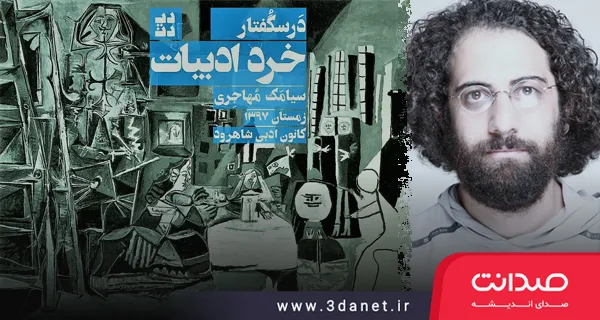
Some, like Seyyed Javad Tabatabai, believe that in the Islamic period, Persian poetry and literature gradually replaced political thought, and that poetry and literature became the foundation of Iran's unity and continuity (A Prolegomenon to the Theory of Decline). This important point compels us to note that when we speak of literature in Iran, we are not merely dealing with a phenomenon of taste based on aesthetic pleasure; rather, literature in Iran has been a kind of fundamental epistemological system that, like a thread, on the one hand established the relationship between the people, the scholars, the kings, and God, and on the other hand linked the four traditions of mysticism, Islam, Iranshahri, and Greece (the West). In fact, poetry and literature were the language of dialogue and the wisdom of Iran's galaxy of opposites, which, as a unifying element, preserved our identity.
With our entry into the new world, which coincided with the Russo-Persian Wars and the Constitutional Revolution, poetry and literature, leaving the court, moved toward the people and played a vital role both during the Constitutional Revolution and the 1979 Revolution. Nevertheless, with the birth of the literary critic in modern Persian literature, literature gradually retreated toward taste and aesthetics and forgot its historical role. In The Reason of Literature, we show how poetry and literature played a part in making the present moment possible and how one can return to the reason of literature.
The moment Hegel showed that reason is the ultimate end and the surplus of madness! he pointed to a very important point, which was that reason is not the opposite of madness but its next-door neighbor. This subtle point propels us to a moment where literature can be the dissimilar twin of wisdom. Reason was born from the womb of madness and wisdom from the heart of literature, but later it busied itself with taming it. The Reason of Literature is a lecture series in which we narrate the history of "taming literature" with the aid of the literary critic's authority.
.
Session One: Discourse on Method
.
Session Two: Discourse on Method
.
Session Three: Discourse on Method
.
Session Four: The Constitutional Revolution and the Problem of Iran
Nima writes somewhere: When I was in Tehran, they would ask, wouldn't changing the meter and rhyme disrupt the foundation of our nationality? We must be able to explain what relationship exists between literature and the foundation of our nationality that at the moment of founding modern literature, the two become so intertwined.
The king's power flowed through the language of the scribe (man of letters); in fact, the divine glory (farr-e izadi) was inscribed upon the bodies of the subjects through secretarial prose and the eloquence resulting from it. But the newspaper demanded another language, a language that had to train minds to become a nation. That secretarial language had to give way to a witty, sharp, and biting language. This moment, besides making critique possible, made the birth of the critic possible, so that by transcending the divine power of the king, it could establish the earthly power of the masses.
.
Session Five: Literature and the Critique of the Academic Project
In the fifth session, by looking at Dr. Saeed Hamidian's book Metamorphosis in the Poetry of Nima and Shij, we critique the academic discourse in the criticism of contemporary literature. How is Nima born as the father of modern poetry? What happens that our literature suddenly acquires a father? We must be able to explain this moment of fatherhood in literature.
.
Session Six: Literature and the Question of Iran
.
Session Seven: A Report to the Ageless Generation of Tomorrow
In the seventh session, with a look at Reza Baraheni's book Report to the Unborn Generation of Tomorrow, the genealogy of the birth of the literary critic and the authority of the critic is examined.
.
Participants' Discussion Session
Before the start of the eighth session and in summarizing the class material, a conversation took place among the participants.
.
Session Eight: Recovering the Reason of Literature
In the eighth session, we address the project of making literature knowable and problematize the thresholds of ontological encounters with literature. How the literary critic, by epistemologizing literature, consolidates their authority and turns literature into a hegemonic matter.
.
.
The Reason of Literature Lecture Series by Siamak Mohajeri
Session Dates: From Fall 2018 to Spring 2019
Organized by the Literary Association of Shahrood University
Source: Didan Telegram Channel
.
.

Discussion2 comments
من جلسه اولش رو گوش دادم بسیار مبحث جالب و بدیعی بود، بسیار ممنون از صدانت بخاطر فضای آموزشی خوبی که ایجاد کرده، منتهی کاش میان صحبت های مدرس کلاس انقدر برخی حرفهای بیهوده نمی زدند در مجموع خیلی لذت بردم
بسیار دقیق و شیوا توضیح داده شده واقعا برای منآموزنده بود