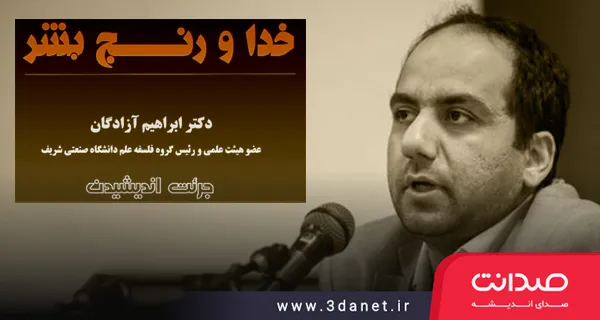
Iranian thinker
Ebrahim Azadegan
Ebrahim AzadeganPhilosophyIranianb. 1972
In their times
Open in the Timeline of Thought


Life and Thought
Ebrahim Azadegan is an associate professor in the Department of Philosophy of Science at Sharif University of Technology and a researcher in philosophy of religion and science. He works at the intersection of the Islamic philosophical tradition and analytic philosophy of religion, re-reading classical theological debates with the tools of contemporary philosophy.
Ebrahim Azadegan is an associate professor in the Department of Philosophy of Science at Sharif University of Technology, a researcher in philosophy of religion, philosophy of science, and the relationship between science and religion. He teaches and conducts research in the Department of Philosophy of Science at Sharif University of Technology, and in academic and research profiles, his areas of work are described as philosophy of religion, science and religion, philosophical theology, and applied ethics.
Azadegan works at the intersection of the Islamic philosophical tradition and analytic philosophy of religion. A significant part of his research is devoted to issues such as divine knowledge, divine immutability, the problem of divine hiddenness, divine love, evil, open theism, religious science, and the relationship between naturalism and science. He strives to re-read classical topics in Islamic theology and philosophy, such as divine knowledge of particulars and God's relation to change, using the language and tools of contemporary philosophy.
In his works, names such as Ibn Arabi, Avicenna, Al-Ghazali, and Mulla Sadra appear alongside recent discussions in the philosophy of religion. This combination ties his intellectual project, on the one hand, to the Islamic tradition and, on the other, brings it into dialogue with analytic philosophy of religion, philosophical theology, and contemporary debates on science and religion.
Azadegan has also addressed the question of the possibility and meaning of religious science in research on 'religious science' and 'naturalistic science.' In this context, his concern is not merely to defend or reject a label, but to examine the philosophical foundations of science, the relationship between metaphysics and scientific method, and the possibility of the presence of theological or naturalistic presuppositions in the understanding of science.
Bibliography
Writings and transcribed lectures10 titles
Ibn Arabi and the Problem of Divine Hiddenness
Divine Love and Divine Hiddenness
Divine Hiddenness and Human Sin: The Epistemic Effect of Sin
Naturalistic Science versus Theistic Science
Evil in a Regulated World
Human Dignity and the Future of the Human Rights Debate in the Islamic World
The Incompatibility of God's Knowledge of Particulars and the Doctrine of Divine Immutability
The Necessity of Existence, Immutability, and God's Knowledge of Particulars
A Critique of Molinism's Coherence: The Incompatibility of Middle Knowledge with Divine Immutability
The Omnipotent, Freedom, and Love: Toward an Open Islamic Theology