Religion
Amir Maziar's essay “Text, Power, and the Sociology of the Religious Text”
Soroush's theory on the relationship between 'institutional religion' and power marks a transition from the sociology of religious knowledge to the sociology of the religious text; Amir Maziar sees the role of power in the formation of scripture and tradition as revealing an aspect of the humanity and historicity of religion.
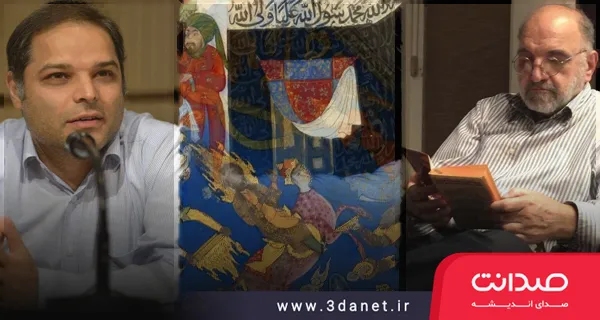
Text, Power, and the Sociology of the Religious Text
Amir Maziar
1_ Dr. Soroush's two recent lectures on "Islam and Power" (the first and second lectures) have rightfully sparked much critique and attention, for Soroush opens a new chapter in the approach to Islam, one that, at least in the recent literature of religious intellectualism, has not been a subject of serious focus. Moving beyond the individual, mystical, and otherworldly image of religion, Soroush speaks of the collective, political, and worldly dimension of religion. However, it seems that in most of the published critiques, the core philosophical and sociological claim of Soroush has been sidelined, and his argument has been taken as an opinion on the character of the Prophet or the history of early Islam. The main subject of Soroush's talk, as repeatedly emphasized in the thirty sessions on Religion and Power, is the relationship of "organized religion" (or positive religion in its Hegelian sense) with power; Soroush claims that religion in this sense is a form of power, and many of the aspects in which it appears and becomes determinate are fundamentally for this very reason. From this perspective, there is no difference between Islam, Christianity, and other organized religions, and what Soroush has presented about the Prophet and the history of Islam are his illustrative examples for this claim in Islam. Examples that he claims have a central presence in what is "considered" religion (in a phenomenological sense). Apparently, critics have not understood that the possible fabricated nature of these elements in "what is considered religion" (i.e., the Book, the prophetic tradition, rulings), especially at the hands of power-holders, not only does not refute Soroush's claim but doubly confirms his view. In what follows, I have tried to highlight this aspect of this theory.
2_ Any theory or opinion about religion is not necessarily an opinion for the "reform" of religion or its "proof and denial." This theory can be aimed at a better and more precise understanding of the phenomenon of "religion" in a general or specific sense and yield the laws and characteristics governing religion as a real and objective matter.
All the problems of religion are not limited to human rights, political Islam, or what has emerged in four decades of Islamic rule in Iran. In contemporary philosophy and thought, theories and issues confront religion that create far more formidable problems for it than these mainly jurisprudential issues. The scope of these theories ranges from Freud's unconscious to Foucault's power. All these concepts can reveal and introduce facets of the religious matter, and neglecting them creates a flaw in religious studies and, consequently, makes theological, reformist, and revivalist theories one-sided as well.
3_ Religion is a phenomenon that both claims a relation to the unseen and the inner essence of the world and also seeks a pervasive presence in society. Religions have generally shaped great political and social powers. Now, this desire for power may or may not be in the text, tradition, or original source of the religion, but a ruling and dominant religion, or a religion seeking pervasive presence, "introduces" the mechanism of exercising power into its text, in the broad sense of the word, because the legitimacy of any religious matter must ultimately return to its religious and sacred text.
The role of power in the formation of religious knowledge, although not explicitly discussed in "The Theoretical Contraction and Expansion of the Sharia," was anticipated in the promise of "the contraction and expansion that occurs in religious knowledge as a consequence of the contraction and expansion of human livelihood" (Contraction and Expansion, Introduction). This discussion fell within the category of the sociology of religious knowledge.
The shaping of the text itself by power was absent in Soroush's theory. Now, Soroush speaks of power as one of the aspects shaping the text and tradition, meaning he moves from the sociology of religious knowledge to the sociology of the religious text, and of course, in an idealist and Foucauldian sense, to the philosophy of the religious text, or paves the way for such a theory; an opening that must be considered very auspicious and blessed, even for believers, theologians, and reformers, and especially for them. This discussion reveals an aspect of the human dimension of the revelatory and religious matter, and in this sense, it is a kind of continuation of the discussion of the expansion of prophetic experience, in which there is talk of "the humanity and historicity of religion itself and religious experience" (Expansion of Prophetic Experience, 1). This time, the keyword for understanding the humanity and historicity of religion is power.
4_ If we take into account the Foucauldian meaning of power, every idea and book that has a social emergence is a form of exercising power—that is, fundamentally, a book cannot have an "effect" and be considered "authoritative" unless a system of power is applied to it, and it thereby itself exercises a form of power. Now, if a book or a message, beyond this, seeks a kind of concentrated, city-founding power that shapes a community (ummah), it will be engaged with the question of power in a far more extensive way.
Religion is one of the fundamental constructs for exercising power in society in the Foucauldian picture (and, of course, before him, the Marxist one), and furthermore, religions like Islam seek concentrated power and the shaping of a religious community and a society of the Book. This "necessitates" that the internal and external apparatuses of exercising power—that is, hidden and overt power—be extensively present within the religious text. And this must be a form of exercising power that can create a balance of forces and even give the upper hand to the community of believers in the era of the religion's emergence and expansion. Otherwise, the religion would not have the possibility of collective and general endurance and survival, and would not become established. This statement is a philosophical and sociological one; that is, it reveals a necessity in reality.
5_ The systems of hidden and overt exercise of power in Islam are extensively present in the scripture (nass), tradition (sunnah), and prophetic biography (sirah).
In the internal dimension, or the hidden exercise of power, boundary-drawing, valuations, the forbidden and the permitted (haram and halal), and everything that, in general, defines the concepts and realms of faith (iman) and unbelief (kufr) are systems of exercising power. To be justified and effective, they resort to sources possessing authority (previous sacred books, "authoritative" theological and ethical concepts, prevalent rituals, etc.) and precisely extend themselves into religious rulings and rituals, going beyond the picture of faith and unbelief as inner, heartfelt beliefs (one of the functions of what Soroush calls "Islam as identity," as the shell of religion, is the systematization of this exercise of power among religious populations). This system systematically expands through the codification of the primal religious event in scripture, tradition, prophetic biography, and, in the next stage, the religious sciences, with the specific capabilities and flexibilities of each, providing the possibility of the religion's survival and endurance amidst social transformations. Understanding these systems is an important part of religious studies and Islamic studies, to which less attention has been paid within Islamic societies themselves, but which receives full consideration in the new literature of Islamic studies—that is, the explanation of how basic religious concepts, narratives of sacred history, the emergence of the religious sciences, and their concepts and chapters possess an ideological dimension.
In the external dimension and the overt face of power, it must also be acknowledged that "Islam" is not merely a religion of calling to faith, giving glad tidings of a blissful afterlife, and warning of the eternal wretchedness of unbelievers in the "Hereafter," nor is its Prophet depicted in the text of the Quran itself as such a conciliatory preacher seeking peace and tranquility. Islam and its Prophet want to form a society and a community (ummah), and not only to defend this society but to expand it, and not only to repel enemies (defensive jihad) but to subjugate, suppress, and, if necessary, annihilate the unbelievers (offensive jihad). This desire has fully emerged in the text of the Quran and in the depiction of the Prophet of this religion within it, and in the process of codifying religious tradition and prophetic biography, it has been emphasized, and this depiction has been reconstructed and completed (even if these indications were not in the scripture, they would have emerged in some form due to the collective, civil, and expansionist necessity of this religion).
The rulings on Islam and unbelief, judgment and punishment, jizya, jihad, armed struggle (qital), apostasy, etc., pursue this goal and constitute the overt aspects of exercising power. Aspects of exercising power that are sometimes, in themselves, incompatible with our contemporary concepts of basic human rights and accepted moral foundations, let alone the fact that the form and manner of this exercise of power in the text of the Book, prophetic biography, and tradition is of the kind that prevailed in the era of the emergence and formation of the Book and tradition, and for this reason, can be repulsive and unpleasant for the contemporary space and reader.
6_ The incompatibility of Quranic rulings on Islam and unbelief with basic human rights is not a secondary, supplementary, or interpretive matter in Islam, and religious intellectuals themselves, including Soroush, have been pioneers in raising this issue within religious thought and critics of overlooking such Islamic texts and rulings. For this very reason, in order to realize an Islam compatible with human rights, freedom, and democracy (a “compassionate” Islam), they called for something beyond ordinary jurisprudential ijtihad (see the essay “Toleration and the Management of Believers”) and sought a rethinking of the religious text itself and ijtihad in the principles (Jurisprudence in the Balance). This idea is widespread in the works of religious intellectuals from Soroush to Kadivar, and I emphasize here particularly Kadivar’s book Islam and Human Rights, which clearly demonstrates instances contrary to human rights within the religious text itself. Such authoritarian Islamic rulings are undeniably considered part of the Quranic text and the “accepted and definitive” tradition and prophetic conduct, although we cannot know today what the real Muhammad and his message were truly like before their codification and portrayal in “the Book, the Tradition, and the Prophetic Conduct.” What is novel in Soroush’s recent view is the explanation and elucidation of the existence of these authoritarian aspects based on the idea that Islam is not merely an invitation and call to faith, but that Islam is a power, and the personality of its Prophet is depicted as thoroughly intertwined with this power-seeking and authoritarian face of Islam.
This image of Islam and the Prophet has been the dominant face in early texts and particularly in sciences such as jurisprudence, which, in Ghazali’s apt phrase, is a “worldly science” that, now in light of the idea of power, can be said to be a system for exercising power within the fabric of society and over bodies and actions (and not, of course, over hearts, inner selves, and souls: the realm of faith).
This power-oriented and authoritarian face is not present only in the system of rulings; rather, for these rulings to be justified and effective, they must also have a basis in theology and sacred history. Hence, the God of the sacred text, His acts and attributes, His Throne and Footstool, His wrath and mercy, judgment and punishment, and ultimately His heaven and hell, stand in a close relationship with this system of power. If the Prophet is decisive, hostile to enemies, and a slayer of unbelievers, so too is his God. Of course, this same Prophet, this same God, and this same Book also possess a compassionate, merciful, forgiving, and generous face; if they did not, this religion would have no positive aspect, and its negative, unilateral exercise of power would not be effective or enduring. But these two faces exist together in the text, theology, and religious rulings—though not necessarily in balance—and are necessitated by this fundamental philosophical and sociological idea that religion is power, and particularly in its founding phase, it exercises even the most naked and intense forms and methods of power, in conjunction with the customs of the time. (It must be acknowledged that the mystical image of God and the Prophet, and dense concepts such as lover and beloved, even if they have an origin in the text—see the views of Louis Massignon and Paul Nwyia—were later achieved through the expansion of those allusions based on other sources and in the era of the consolidation and establishment of the religion.)
This statement is a depiction and explanation of the actual state of affairs and a philosophical account of the idea of religion as a collective, comprehensive, and community-building phenomenon; that is, in its capacity as a power.
7_ What constitutes a correct moral judgment about this depiction, how one can speak of an Islam compatible with freedom and human rights despite this text, and how the expansion and spread of these authoritarian ideas in the religiosity and practice of contemporary believers can be prevented, pertains to theology and not to the study of religion. (Soroush’s earlier steps, such as considering the Book as human, asserting the expansion of prophetic experience, viewing the tradition as dynamic, and deeming it necessary for ethics, reason, and human rights to govern the text rather than being extracted from it, chart a path for such a theology.)
The theologian must understand that religion, like any human phenomenon, is entangled in the hidden and overt relations of power exercise within the context of society and history, and beyond this, Islam itself contains a layer of a centralized apparatus of power exercise within its very core and text, which is clearly present and systematically expands not only in certain events and hadiths but also in the system of its core concepts, rulings, and primary texts. Reducing the power-oriented and authoritarian aspect of Islam to certain hadiths, narrations, and rulings, and failing to see it within the system of fundamental theological and jurisprudential concepts of the Quran, results from a limited conception of the concept of power and a superficial, one-sided view of the text.
Now, any reformist or theological project must advance its program with this reality in mind, and not with a one-dimensional conception of religion as a celestial subtlety that contains only guidance and admonition within its text, and whose prophet is merely a bearer of glad tidings and a warner concerning the otherworldly fate of believers and unbelievers. One must also see and grasp the worldly, power-oriented face of glad tidings and warning within religion.

Discussion0 comments
No comments yet; let yours be the first voice.