Why this book?
- To understand the relationship between religion and modernity in a world where religion has neither been eliminated nor remained uniform.
- To become acquainted with the constructive meaning of doubt in contrast to relativism and prejudice.
- To reflect on ethical and political coexistence among groups with conflicting beliefs.
- For readers interested in religion, secularism, pluralism, and fundamentalism.
About the book
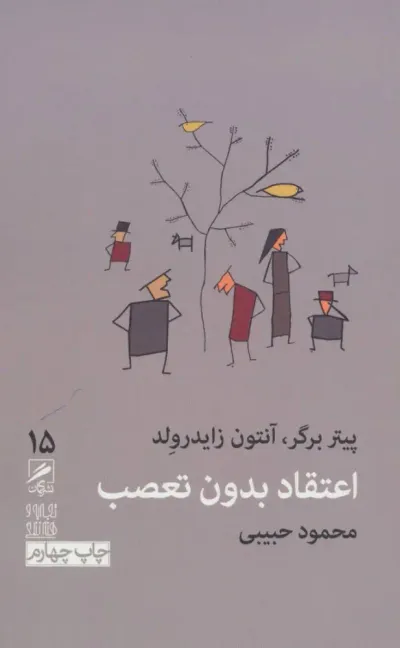
"Belief Without Prejudice" addresses one of the important questions of the modern world: how can one be a believer in a pluralistic society without becoming prejudiced? Modernity had promised to marginalize religion through rationality and secularism; but historical experience has shown that religion has not only not disappeared, but continues to be present in various forms in the social and political life of the modern world.
Peter Berger, along with Anton Zijderveld, speaks in this book of a situation in which human beings and social groups with different religious, moral, and cultural beliefs are compelled to live alongside one another. The issue is not merely a difference of opinion; the disagreements are sometimes over highly sensitive subjects such as abortion, homosexuality, secularism, public morality, and fundamentalism. The book's question is how, in such a situation, one can remain faithful to one's own moral beliefs while not considering the opponent an enemy.
The book's central answer is "doubt"; but not the paralyzing doubt that makes any judgment or decision impossible. By doubt, Berger means a kind of intellectual and ethical caution that allows a person to believe, but to avoid absolutism and intellectual violence. From this perspective, doubt is not the enemy of faith, but the condition for its maturity.
In the course of its discussion, the book addresses the history of modernity, religion, psychology, Marxism, relativism, the failure of totalitarianism, and fundamentalism as a modern phenomenon. "Belief Without Prejudice" is suitable for readers who wish to think more deeply about religion in the new world, the possibility of dialogue between conflicting beliefs, and the relationship between truth and tolerance.