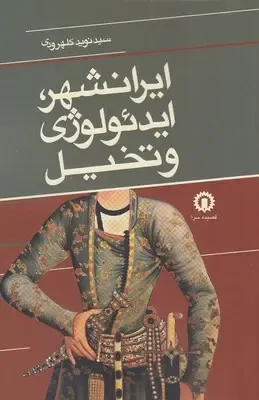
Why this book?
- To understand the relationship between narrative and imagination with politics and national identity.
- To become acquainted with a Ricoeurian reading of ideology and Iranshahr.
- To trace the evolution of the Iranshahri heritage from the Sasanians to the contemporary era.
- To recognize the place of Seyyed Javad Tabatabai in the discussion of Iranshahri political thought.
About the book
"Iranshahr, Ideology, and the Imagination" is a book in the field of Iranian political thought that examines Iran within a network of concepts such as imagination, myth, narrative, and ideology. Inspired by Paul Ricoeur, the author understands ideology not merely as a negative concept, but as a form of thought structure and narrative application in collective life.
The book begins by explaining concepts such as nation, nationalism, and ideology, and then addresses the function of imagination and narrative in politics. It subsequently examines the Iranshahri heritage in the Sasanian period, its transformations during the Qajar and Pahlavi eras, and its relationship with politics, education, kingship, and national identity.
A significant portion of the book is dedicated to Iranshahri political thought and the place of Seyyed Javad Tabatabai. The author seeks to demonstrate that Tabatabai's thought cannot be reduced to the common, reductionist sense of "ideology," as he is himself a critic of the ideological view of Iranian history.
This book is suitable for readers interested in Iranian political thought, the concept of Iranshahr, narrative theory, national identity, and the intellectual controversies surrounding Iran. It is also an analytical and problem-oriented text for those who wish to understand the relationship between myth, social imagination, and politics in Iranian history.