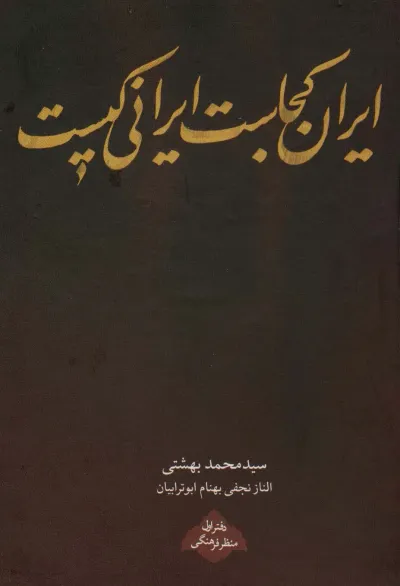
Why this book?
- To become acquainted with the concept of "ahlīyat" and its relationship with land and culture.
- To understand how geography and history influence the formation of Iranian identity.
- To learn about the authors' definition of culture and how it differs from common perceptions.
- To examine the relationship between modern technology and humanity's disconnection from its environment and land.
- To become familiar with the concept of "cultural disposition" and the differences between societies based on their historical experience.
About the book
"Where Is Iran, Who Is Iranian?" is the first volume in a series that addresses the question of Iran and being Iranian. In this volume, Seyyed Mohammad Beheshti, Elnaz Najjar Najafi, and Behnam Aboutorabian pursue the issue from a cultural perspective, starting with the question of how the people of a land develop "ahlīyat" (at-homeness) with their environment over time, and why this bond has weakened in the contemporary era.
The central concept of the book is "ahlīyat." From this viewpoint, being a native of a land is not reduced merely to political citizenship or residence within a geographical boundary. Ahlīyat is the result of a society's long coexistence with its environment, the formation of a kind of historical knowledge, and the emergence of a specific way of living and engaging with the world. Therefore, the authors distinguish between lands with a long history of social life and societies that have largely been shaped in the shadow of modern technology.
The book is organized into seven discourses, beginning with the necessity of becoming native to the land once again and proceeding to discussions on ahlīyat in the age of technology, the cultural landscape, the definition and redefinition of culture, and finally, the concept of cultural disposition. Within this framework, Iran is considered not just a political unit, but a historical and cultural geography where long-term living has generated a specific kind of knowledge and collective character.
This work can be read in the context of Seyyed Mohammad Beheshti's concerns about the Iranian person's relationship with heritage, geography, the city, culture, and the history of Iran. His attention to "ahlīyat" is an attempt to explain Iranian identity through lived experience and the historical relationship with the land, rather than merely through abstract or political definitions of identity.
The book is useful for those interested in Iranian studies, cultural studies, Iranian identity, social history, and the relationship between culture and geography. It also provides a clear and thought-provoking entry point for readers who want to understand the roots of the crisis in Iranians' relationship with their land and how culture is formed within the context of history and environment.
Iran is among the lands where a long and continuous history of life has generated a specific knowledge, and its natives, by virtue of possessing this knowledge, have found a distinct and defined identity. Iran is an arid and low-attraction land; it has neither abundant liquid resources nor a uniform climate. Similar conditions in other parts of the globe have caused those areas to remain uninhabited.
From the table of contents
- 1We Must Become Natives of Our Land Once Again
- 2Ahlīyat in the Age of Technology's Dominance
- 3The Cultural Landscape
- 4Definitions of Culture
- 5Redefining Culture
- 6Cultural Disposition
- 7The Relationship Between Cultural Dispositions