Why this book?
- To read an essayistic and poetic account of faith and spirituality.
- To reflect on the relation between nature, self-knowledge, hope, and ethical life.
- To become familiar with Sedigh Ghotbi’s view of faithful spirituality in the contemporary world.
- For readers interested in mysticism, ethics, Rumi, and the meaning of life.
- To see how a simple metaphor such as the tree can open a fresh way of understanding how to live.
About the book
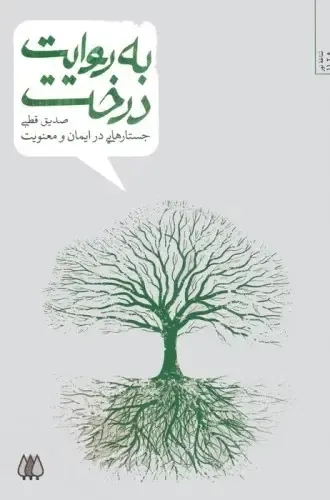
As Told by the Tree, subtitled Essays on Faith and Spirituality, is a work by Sedigh Ghotbi that addresses faith, ethics, self-knowledge, and spirituality through a series of essays. The book’s central idea begins with the metaphor of the tree: a tree whose roots, growth, silence, generosity, endurance, and hope for spring become a model for a spiritual and ethical way of living.
The book is not a systematic treatise in theology or kalam; rather, it is an intellectual and existential wandering through subjects connected to the everyday life of contemporary human beings. In these essays, Ghotbi draws on nature, lived experience, Persian poetry, religious teachings, and thinkers such as Rumi, Saadi, Hafez, Shariati, Buber, Kierkegaard, and Kazantzakis to reconsider concepts such as hope, giving, responsibility, suffering, peace with oneself, and the meaning of life.
The book’s structure rests on the variety and relative independence of its essays. Chapters such as “Why Did I Come?”, “Sell Cleverness and Buy Bewilderment,” “The Allurements of the Qur’an,” “Win a Heart If You Can,” and “Either It Will Pass, or the Ship Will Break in These Whirlpools” show that the author understands faith not merely as a set of beliefs, but as a way of being, seeing, and acting.