Why this book?
- It explains concepts such as social action, identity, power and inequality through tangible examples from everyday life.
- It shows how what we call "individual choice" takes shape within the limits of norms, values and social pressures.
- It examines our relationship with time and place, technology and consumerism in the contemporary world.
- It distinguishes sociology from history, anthropology, psychology and economics, and makes a relational, network-based view the centre of the discussion.
- Its third edition was published in 2019 in memory of Bauman, and it is accessible to students and general readers alike.
About the book
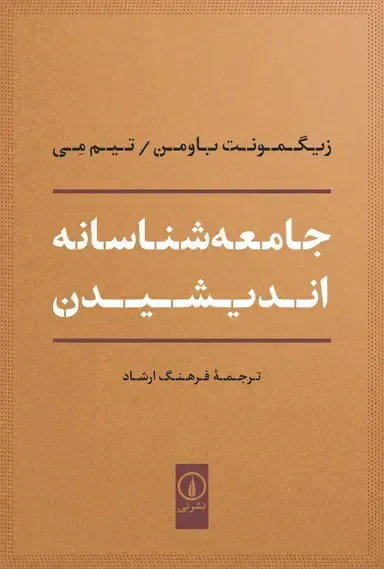
Thinking Sociologically is by Zygmunt Bauman and Tim May, and Farhang Ershad has translated it into Persian; Nashr-e Ni has published the Persian translation. The book was first published in 1990 and has been revised several times. The Persian translation is based on the third edition, published in 2019 in memory of Bauman. The book's roots go back to Everyday Sociology, which Bauman wrote in Poland in the 1960s.
The book's central question is how a sociological view of social issues differs from other ways of thinking. The authors treat social life not as a set of statistical data and complex theories but as human relations and everyday experiences. They therefore show that individual identity is always formed within a social setting, and that the "self" cannot be understood apart from the "other." They stress that people exist within a network of dependencies and mutual relations, and that their behavior cannot be reduced to individual choices.