Sociology
A Panel on Thinking Sociologically by Zygmunt Bauman and Tim May
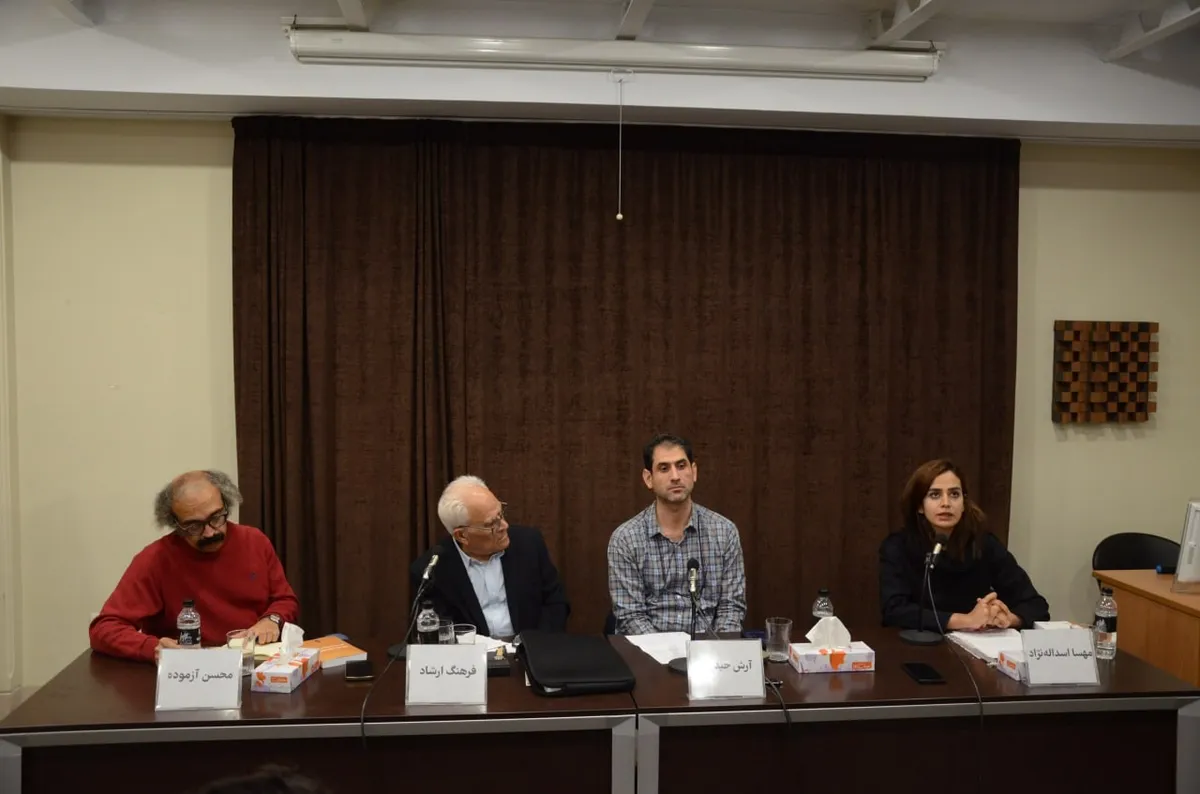
A panel discussion on Thinking Sociologically by Zygmunt Bauman and Tim May was held with Arash Heydari, Mahsa Asadollahnejad, Farhang Ershad and Mohsen Azmudeh. From different angles, the speakers addressed the standing of sociology, the relationship between the individual and society, the connection between translation and the production of ideas, and the role of the sociological gaze in rethinking everyday life.


Zygmunt Bauman
نویسنده کتاب
Tim May
نویسنده کتاب
فرهنگ ارشاد
مترجم و سخنران
مهسا اسدالهنژاد
سخنران
Arash Heidari
سخنران
Mohsen Azmoudeh
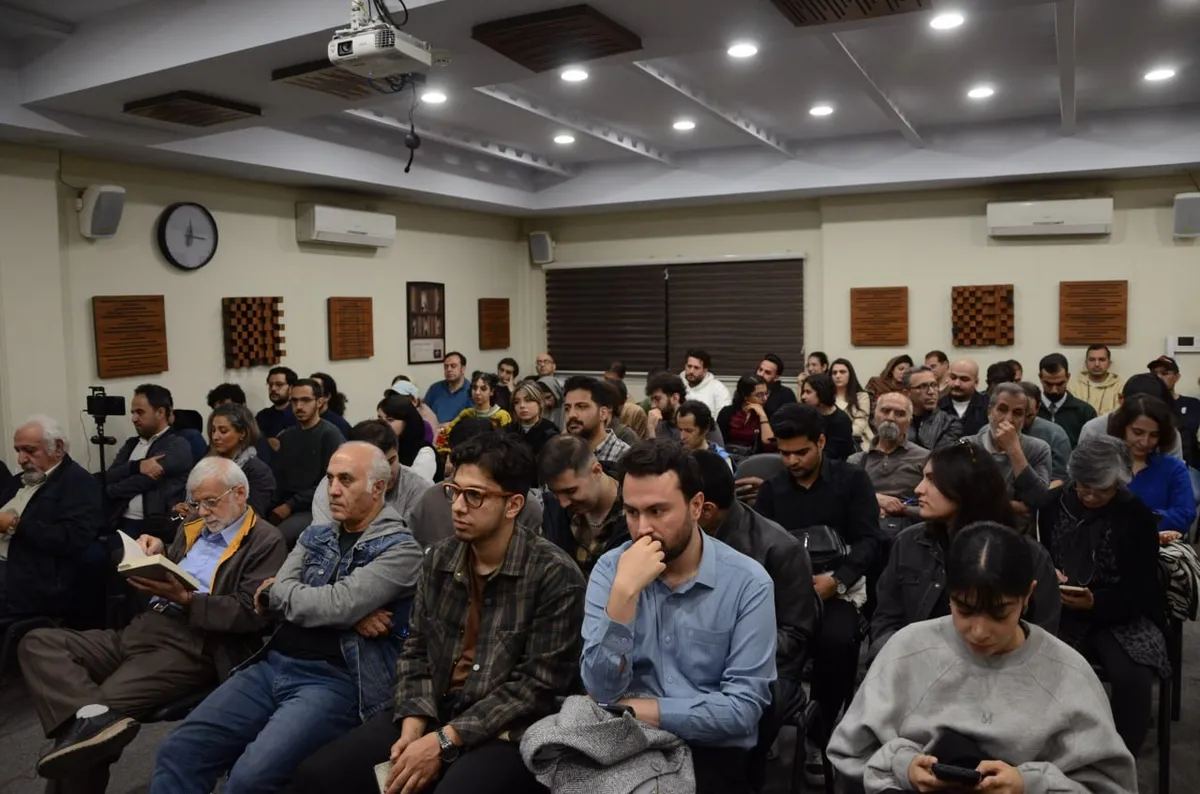
گردانندهA panel discussion reviewing “Thinking Sociologically” by Zygmunt Bauman and Tim May, in Farhang Ershad’s translation, was held on Wednesday, 13 Aban 1405, hosted by Nashr-e Ney. Arash Heydari, Mahsa Asadollahnejad, Farhang Ershad and Mohsen Azmudeh took part, speaking from a range of angles about the standing of sociology, ways of understanding the social world, and the relationship between thought and everyday life.
“Thinking Sociologically” seeks to introduce the reader to a particular sociological way of seeing: looking anew at what seems self-evident in everyday life and understanding the relationship between individual experience and social relations. In this approach, phenomena cannot be understood apart from the contexts and relationships in which they take shape. Mahsa Asadollahnejad noted at the panel that, besides setting out foundational themes, the book also attends to more recent subjects such as the body, the environment and ecological issues.
Sociology in the Service of Human Freedom and Dignity
Farhang Ershad, the book’s translator, did not explain his choice of the book solely by its scholarly and pedagogical importance; his acquaintance with Zygmunt Bauman’s life and character also played a part. Pointing to the experiences of war, displacement and exile in Bauman’s life, he said these experiences helped shape his sensitivity to power, freedom and human relations. As a teenager, after the occupation of Poland in the Second World War, Bauman went with his family to the Soviet Union; after the war he returned to Poland, and in the wake of the political upheavals of 1968 he was forced to leave the country. In 1971 he joined the University of Leeds in England, where he continued a major part of his academic career. Ershad also said that the translated text is the third edition of the book, published after Bauman’s death in 2017 and in his memory.[1]
Stressing the ethical dimension of Bauman’s thought, Ershad did not regard sociology as merely a discipline for describing or explaining social phenomena. In his view, this discipline acquires real meaning and credibility when it serves human freedom, the reduction of inequalities and the safeguarding of human dignity. Citing Bauman, he said: “If sociology is not at the service of freedom, social justice and the effort to manage inequalities, it is not sociology.”
The book’s translator also described Bauman’s worldview as interpretive and historicist: an approach in which social phenomena cannot be understood without attention to historical context, people’s lived experience and the need to interpret social relations. On such a view, the sociologist’s responsibility is not limited to knowing structures; the human consequences of those structures also come into focus.
Ershad said he had not seen an autobiography written by Bauman himself, and that what he wrote about him in the book’s preface was gathered from interviews and secondary sources. He had drawn on a collection examining the lives and ideas of several dozen contemporary social thinkers, and, citing Smart, said that what Bauman wrote carries the scent of strangeness and exile while being at the same time accompanied by respect for human dignity and freedom. According to Ershad, Bauman, who had once been a member of the Polish Communist Party, later left the party; yet he kept his critical and radical outlook, arriving at a “moderate radicalism” that can be felt in all his works. In this connection Ershad also referred to Hafez: “We have not come to this door seeking pomp and station; / fleeing the blows of misfortune, we have come here for refuge.”
He also said that the conception of sociology in this book is to some extent indebted to C. Wright Mills;[2] to make clear what sociology wants and what its concern is, the author draws on Mills. Ershad himself attended the annual conferences of the British Sociological Association from the 1970s and had seen Bauman at close quarters. He recalled Bauman’s closing address at the 1997 conference, which was about globalization and whose title Bauman had coined by combining “global” and “local.”[3] After the address, Ershad wrote Bauman a letter from the airport asking for a copy of the text so that he could render it into Persian. Within a week Bauman sent the article, signed in his own hand. For this coinage Ershad chose the Persian equivalent of “glocalization,” and said that in the same article Bauman speaks of the polarization of mobility: the ability to use time to remove the constraints of place is concentrated in one part of society and divides the world into two groups, those who become global and those who become local and are pushed to the margins.
Ershad also recalled Bauman’s conduct at that gathering: despite being hard of hearing, he listened to questions from close up and answered them, and after the address he presented the bouquet he had been given to his wife, who sat in a wheelchair at the back of the hall. According to Ershad, these gestures strengthened his own emotional bond with Bauman.
Translation: From Transmitting Knowledge to an Intellectual Project
Arash Heydari tied the discussion of the book to a broader question, the relationship between translation and the production of ideas. In his view, translation in Iran’s intellectual tradition has not been merely the transfer of words and concepts; in certain periods of history, from the scholarly activities of the House of Wisdom through the Constitutional era to the present, it has been part of an intellectual project of understanding the world and formulating society’s problems. He stressed that a translator must enter into serious dialogue with the text; otherwise translation may turn into an activity for gaining prestige and symbolic capital, and instead of helping people think, it may take the place of thinking.
In his reading of the book, Heydari emphasized how it differs from Bauman’s better-known works, such as “Liquid Modernity,” “Liquid Love” and “Liquid Fear.” In his view, in this work Bauman departs from his own distinctive, unfamiliar idiom and moves toward a more conventional, more pedagogical register in sociology. Heydari said that while reading the text he did not find it easy to locate Bauman’s familiar voice; even so, he does not necessarily consider this difference a weakness of the book, but sees it as a feature of a work written to teach the fundamentals of sociology.
Another axis of Heydari’s reading was a defense of society as a whole and of social bonds. To describe this orientation he used the phrase “critical conservatism,” which by his own account is a metaphor and a personal reading of the book, not a definitive name for the authors’ position. In this reading, while retaining a critical sensitivity to inequality and relations of power, Bauman insists that social life cannot be reduced to independent individuals or to identity groups separated from one another. Society is a network of mutual relations and obligations that makes shared life possible.
Heydari set this position against two tendencies: neoliberal individualism, which reduces society to a collection of individuals cut off from one another, and a kind of identity politics that, by foregrounding group boundaries, may fade shared bonds. In his view, concepts such as gift, debt, exchange, intimacy, organization and consumption are deployed in the book to show that individual life always takes shape within a network of social relations.
Heydari stressed that these were his personal impressions and might be mistaken. In his view, at certain moments in the book one hears the voice of Durkheim, as though a sociologist who had been radical all his life had, in his late works, come to defend the social “whole.” Heydari said Bauman is too sharp-sighted not to see the failure of the movements after 2008 and the spread of identity politics on the left. In his view, the book captures a moment when society is being torn apart between two forces: a right that sees society as a collection of individuals and a left that breaks movements into fragmentary identity groups. Against both, Bauman understands freedom in terms of the individual’s relation to the whole of social life.
Heydari named three features that surprised him in the book: the text is not as strange as Bauman’s other works, it shows some moderation relative to his earlier radicalism, and it has moved closer to sociology’s standard idiom. He added that perhaps these result from a change in the author’s position, and that he finds it brilliant that a first-rank intellectual, as a university professor, writes an introductory sociology textbook.
Thinking Sociologically: Understanding Relations
Mahsa Asadollahnejad regarded the book’s most important methodological feature as its emphasis on “relational understanding.” In her words, a subject is understood sociologically when it is not examined in isolation and its relation to other phenomena and domains of social life is made clear. Sociology is therefore both a scholarly discipline and a way of thinking that crosses academic boundaries, drawing on history, economics, politics, literature and other fields to understand social reality.
Asadollahnejad described the book as a survey and a teaching text in which Bauman’s own views emerge only in a limited number of passages. In her words, the book does not start from schools of thought, the great figures of the discipline or specialized fields, but from the interweaving of “method” and “problem.” Any subject can be made a sociological problem, provided it is not seen in isolation, like a windowless monad, and its relation to other subjects and fields is shown. She linked this point to Mills’s influence on Bauman.
In the relational view, the social begins with the encounter with the other; hence one can neither explain everything solely by large-scale structures nor understand individual action apart from its historical and social context. The task is to explain the relationship among individual, structure and institution, as well as the link between the local and the global. Asadollahnejad connected this approach to the condition of the liquid world, a world in which human bonds have become fragile and social relations unstable. In such a condition, in place of the “legislating reason” that seeks to discover universal and definitive laws, an “interpreting reason” becomes necessary: a reflexive rationality that continually rereads changing realities and requires boldness to confront them.
In Asadollahnejad’s view, if one wanted to sum up the book in a single sentence, one could say that it is about taking a holistic view of things. By “whole” she does not mean an abstract whole; whole and part work together. Someone who explains everything through structures, or who sees the individual and the event in a vacuum, is in either case not thinking sociologically. She also regarded this as a shortcoming in how we analyze everyday problems: we often lack the capacity for relational analysis.
Asadollahnejad added that Bauman takes subjectivity seriously too. In works such as “Liquid Modernity,” “Liquid Love” and “Liquid Fear,”[4] one finds a subject who, because nothing in the modern world has remained solid, acts in a fragile and provisional way. Hence even a relation we have identified is not fixed forever, and relational understanding must not turn into a legislating kind of understanding. It was at this point that she brought in the distinction between “legislating reason” and “interpreting reason,” which in her view also has a Nietzschean inheritance.[5] In her words, early sociology pursued great ideas and ideals, and Bauman says the age of that reason has ended. What is needed now is a dynamic, sensitive reason that continually assesses the situation. Bauman calls this “boldness,” and says that the person living in late modernity is fearful, for whom boldness is the hardest thing of all.
Imagined Communities and the Weakening of the Public World
Asadollahnejad then turned to the concept of the “imagined community”: communities built on shared identity and a sense of belonging, which can offer a reassuring image of solidarity in the face of fear and uncertainty. Yet these communities do not necessarily have the power to change external conditions, and at times, by stressing purity of identity, they end up excluding those who do not fit the group’s dominant definition. From this perspective, a crisis of recognition emerges when the demand to be recognized leads to the entrenchment of a uniform, unchanging identity.
Asadollahnejad said Bauman is not particularly optimistic about “being together”; in a fragile society, coexistence can be dangerous and generate violence.[6] In her view, as the sovereignty of nation-states fades, “society” itself, in its earlier sense, has also lost its importance. In his other works Bauman says that sociology today must stress the social, not borders. In such a situation the “imagined community” takes shape: an emotional community founded on likeness, which gives its member an image of himself, creates intense emotional commitment and sets exclusionary mechanisms in motion.
Asadollahnejad added that in the postmodern setting, because the meaning of the border has faded, these communities paradoxically put their borders on display. This display is accompanied by casting out those who lack the required emotional commitment or who do not go along with the uniform image of “who we are.” Bauman regards the stranger as someone who is not like us and who for that very reason provokes fear and must be repelled. He explains fundamentalism by this same logic, and stresses that he does not mean religious fundamentalism alone, but also contemporary movements that explain everything by relying on their own foundations and images. These communities lack executive and institutional power, and because they have no effect on the outside world, fearfulness grows within them and the desire for purity and cleanness intensifies.
Of the two problems that in her view are linked to this formulation, Asadollahnejad listed first the “crisis of recognition.” According to her, the politics of recognition and identity politics are only a step apart;[7] when someone says “recognize me,” he presupposes a uniform and fixed identity and even deprives himself of the possibility of becoming a stranger to himself. She asked whether wholehearted defense of the recognition of every identity is compatible with a belief in the contestability of boundaries. In her view, the two contradict each other in many places.
She also questioned the relationship between cyberspace and the public world. In Asadollahnejad’s view, presence on social media should not be treated as directly equivalent to participation in the public sphere. The public world requires real, embodied presence, conversation, disagreement and acceptance of the limits of shared life, whereas cyberspace may make it possible to remove or attract others without bearing the costs of direct encounter. She described this situation as an extension of the logic of the private world into the public realm and a sign of the weakening of the common ground of social life.
Asadollahnejad also recalled a line from Todd McGowan, who says that even if we show that no neutral, impartial public world exists, assuming such a world helps us gain distance from ourselves. In her view, the condition of the public world is impartiality and neutrality. The world of the internet is a continuation of the logic of the private world and passes itself off as the public world: a person can sit on the sofa at home, simultaneously issue verdicts about thousands of people, quarrel with them and be approved or rejected, without paying any price. The public world means the presence of bodies and faces before one another, and this requires “place.” The internet swallows place and space and gives the illusion of being present everywhere, which is a kind of evasion of limits and denial of the body.
A Sociological Gaze: A Model, Not the Model of Models
In the closing part of the panel, Ershad said the book was written both for the thinker who has not studied sociology and for someone whose professional identity is bound up with it. He stressed that he does not regard the book as the “model of models” but as one model. In his phrase, it is like a coat that has all the parts of a coat but does not necessarily fit everyone. Hence its chapters and concepts should not be taken as the standard to be imitated; each person must understand sociology in his own way, in keeping with the history and society in which he lives. In his view, a teacher of sociology in Iranian society must think about responsibility, in addition to the pursuit of justice and freedom.
Ershad also said that Bauman was influenced by Foucault and by the Frankfurt School, but followed neither. He saw some of Bauman’s arguments as close to Habermas’s “communicative action,” yet Bauman is neither Habermas, nor Lukács, nor Bourdieu, though he respects all three. His hermeneutics too is distinct from Gadamer’s and Heidegger’s, and goes its own way. Ershad added that Bauman set aside “postmodernity” and spoke of “liquid modernity,” and that this change of name stemmed from a deeply rooted critique of existing conditions.
Defamiliarization and the Sociological Taste
In his last remarks, Heydari, in addition to the relationality Asadollahnejad had spoken of, pointed to the centrality of “defamiliarization” in the book. In his view, the fundamental concern of all the chapters is the “sociological taste,” a taste that makes sociological imagination, logic and reason possible. To explain this idea, he recalled Ghazali’s words reproaching jurists for losing the “taste of sacred experience”: they know the Qur’an and the hadith but are gripped by a conceptual obsessiveness and fail to grasp the metaphorical character of the text. According to Heydari, a concept always remains incomplete when explaining the world, while a metaphor summons a vast volume of meaning.[8] Bauman’s sociological language makes use of metaphor because it strives, against “common sense,” to keep turning what has become habitual into a problem for thought.
Heydari said this defamiliarization brings Bauman to a kind of “learned pessimism” about imagined communities and liquidity. In his view, liquidity is not something simple and mild, and at any moment it can turn into a logic of excommunication; cancel culture is an example. He likened this situation to scenes in Haneke’s films in which everything proceeds calmly until a devastating violence suddenly breaks in. According to him, unlike Benjamin, who said that through this door the Messiah might perhaps enter,[9] Bauman considers it more likely that the Dajjal will enter. Heydari called this the very “critical conservatism”: taking a stand against the evil that seeps out of liquidity, and defending social life.
Translation as Interpretation
In closing, Ershad also spoke about his own work in translating the book. In his view every translation is an interpretation, and knowing the language and its grammar is only the minimum a translator needs. He said he is still not satisfied with his translation and finds it heavy, but that he is answerable for it only to the extent that he chose this book, not as a defender of everything Bauman says. Ershad explained that Bauman is a perfectionist whose sentences sometimes run to nine or ten lines with the verb coming at the end, something difficult for a Persian speaker to read; for that reason, in some places, with permission, he departed from the structure of his sentences. He hoped that from this model one could arrive at a sociological way of thinking that would also suit Iran’s history and society.
What emerges from the discussions as a whole is that “Thinking Sociologically” matters not only as an introductory book for acquainting oneself with a discipline. The work, and the readings of it offered at the panel, invite the audience to practice a gaze that goes beyond everyday self-evidence: seeing the relations behind phenomena, understanding the individual in connection with society, and rethinking the relations that both make coexistence possible and can lead to exclusion and inequality. On this horizon, sociology is not merely a body of knowledge for explaining the world, but an effort to understand it critically and to defend the possibility of a free, shared life.
[1] “Thinking Sociologically” was first published in 1990, and its third edition appeared in 2019 under the names of Bauman and Tim May. Bauman died in Leeds in January 2017.
[2] A reference to C. Wright Mills’s book “The Sociological Imagination” (1959).
[3] The term "glocalization" was popularized by Roland Robertson. Bauman draws on it in his discussions of globalization, including in "Globalization: The Human Consequences" (1998). Ershad himself stressed that the word was not coined by Bauman.
[4] "Liquid Modernity" (2000), "Liquid Love" (2003) and "Liquid Fear" (2006).
[5] A reference to Zygmunt Bauman's book "Legislators and Interpreters" (1987).
[6] For Bauman's discussion of community and security, see "Community: Seeking Safety in an Insecure World" (2001).
[7] On this subject, one may consult Charles Taylor's discussion in "The Politics of Recognition" (1992) and Nancy Fraser's critiques of it.
[8] A reference to Hans Blumenberg's discussion of metaphor, including in "Shipwreck with Spectator" (1979).
[9] A reference to the end of Walter Benjamin's "On the Concept of History," in which every moment is a "narrow gate" through which the Messiah might enter.









Discussion0 comments
No comments yet; let yours be the first voice.