Religion
Mostafa Malekian's Lecture at the Review Session of Michael Palmer's Book 'On God'
Distinguishing five domains—belief, faith, worship, supplication, and ritual—in relation to God, Mostafa Malekian divides the arguments for God's existence into two broad camps: those who see no need for proof, and those who require empirical or rational demonstration.

A Review of the Arguments for the Existence of God
A Critique and Review of the Book 'On God' by Michael Palmer, Translated by Na'imeh Pourmohammadi – Book City – November 2014
Mostafa Malekian
A Review of the Arguments for the Existence of God[1]
All the arguments that have been put forward throughout the history of human culture, especially those presented by theologians, mystics, and philosophers to prove the existence of God—and naturally, their opponents have also recounted these arguments—can perhaps be systematized in the way I will now describe:
Distinguishing Between the Discussions About God
First, I must say that regarding the existence of God, five topics must be distinguished from one another and should not be conflated. If we consider the five existential domains of the human being, that is, if we observe the personality and character of every individual, the human personality and character are composed of five domains, which are:
1) The domain of beliefs, 2) The domain of feelings, emotions, and affects, 3) The domain of desires, 4) The domain of speech, and 5) The domain of deeds.
You will see that when I propose those five topics concerning God, each one corresponds to one of these five domains.
1- Belief in the Existence of God
One discussion about God is the belief in the existence of God, meaning the belief that God or gods exist(s)—that is, the belief that in the universe, God also exists—whether a God in a general sense, a specific God, or gods in a general sense.
2- Faith in God
The second discussion is faith in the existence of God. Michael Palmer has conflated belief in the existence of God with faith in God. Belief in the existence of God pertains to the doxastic and epistemic domain of human existence, that is, to the domain of beliefs and knowledge, doubts and suppositions, and so on. But faith in the existence of God pertains to the domain of our emotions, feelings, and affects. Faith in the existence of God resides in this very domain.
3- Worship of God
The third discussion is the worship of God. This discussion pertains to the third domain of the human being, namely the domain of desires.
4- Supplication and Prayer to God
The fourth discussion is supplication and prayer to God. I note that supplication is different from prayer. This discussion pertains to the fourth domain of human existence, namely the domain of speech.
5- Acts of Worship in the Specific Sense
The fifth discussion is acts of worship in the specific sense, such as ritual prayer, fasting, the Eucharist, baptism, lamentation, and so on, which are related to the domain of human deeds.
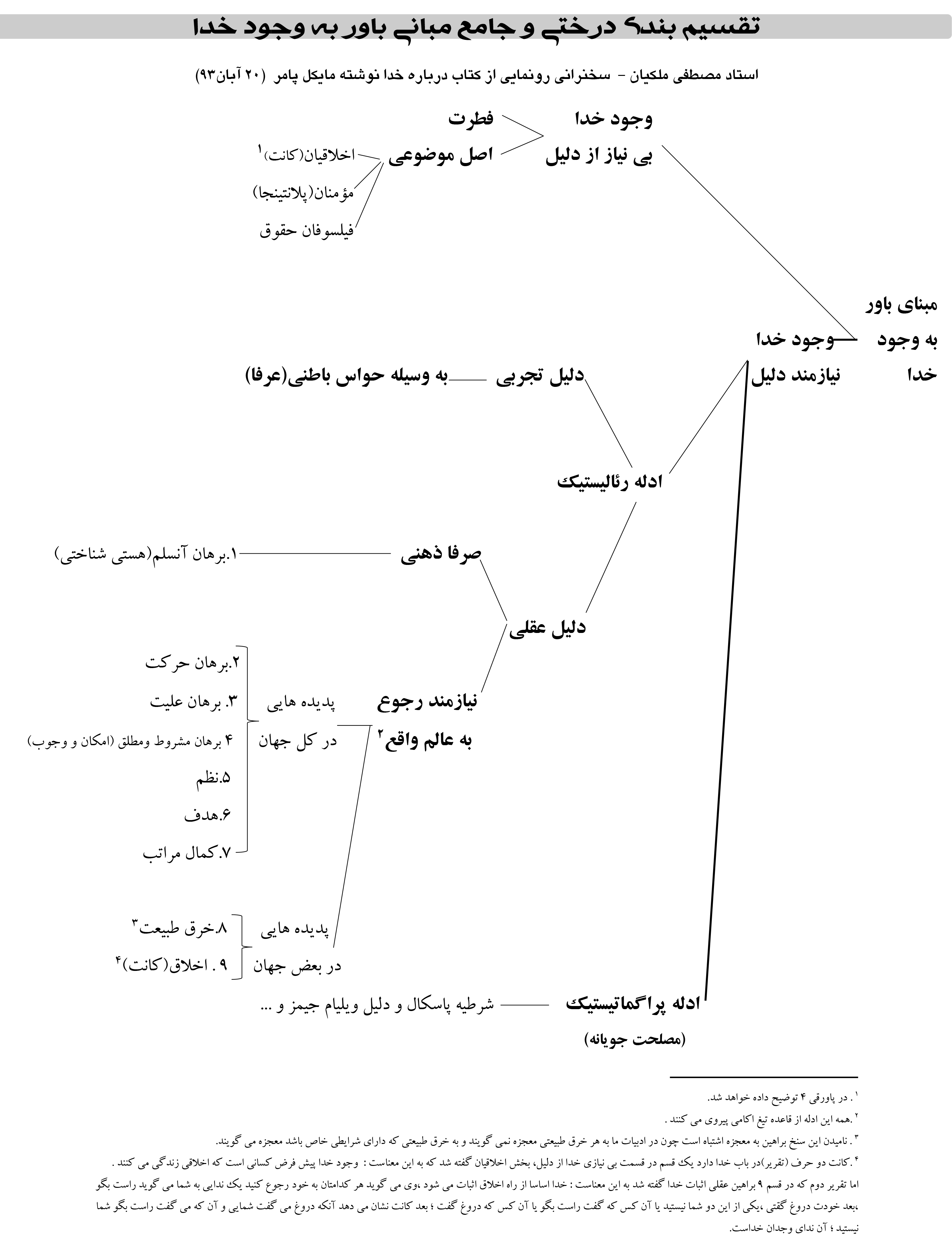
All five of these must be supported by reasons. Among these five discussions, Michael Palmer's book addresses the first discussion, that is, belief in the existence of God. Well, we want to see what humanity has said throughout history about the existence of God. The discussion I am presenting is a tree-like discussion that branches out.
A Classification of Believers in the Existence of God
Group One: Those Who Maintain There Is No Need to Prove the Existence of God
First: Some have said that belief in the existence of God does not need to be proven at all. That is, reason has no place in the realm of God's existence. Well, we ask why? And here, two groups emerge.
1- Proponents of the Innateness of Belief in God
Some say there is no need for a reason because every human being, in every place, time, condition and state, in every society, in every culture and era, whether consciously or unconsciously, believes in the existence of God, and since they believe in the existence of God, they have no need to provide a reason. A reason is useful to me where there is an opponent before me, but when all human beings in all times and places believe in the existence of God, there is no longer any need to provide a reason. These people held that belief in God is innate and said that belief in the existence of God is part of our essence.
2- Proponents of the belief in God's existence being axiomatic
A group says the existence of God is needless of reason, but not because all human beings believe in the existence of God, but because the existence of God is an axiom for a group of human beings. So a group of human beings is meant, not all of them. For a group of human beings, the very axiom of their life is that "God exists." Do you ever ask a mathematician to prove that from a point outside a line, only one line can be drawn parallel to it? No, because this is an axiom of mathematics; if someone does not accept this, mathematics will have no foundation or basis. Now let us see who has taken the existence of God as an axiom:
At least three groups can be found in this regard, which are:
a) Ethicists. This group cannot live morally unless the axiom of their life is that there is a God. This view was Kant's view. Kant, of course, had another view as well, which I will also mention. Kant said that if the axiom of someone's life is not that God exists, they cannot live morally at all; so all human beings who live morally have as the axiom of their life that God exists.
b) Believers. Alvin Plantinga expressed this view. He says that for believers, the existence of God is one of the axioms, and no one can be asked to prove the axiom of their life.
c) Some philosophers of law. If we want to ascribe "rights" to human beings, we must necessarily also believe in the existence of God. So all philosophers of law and jurists who believe that human beings have inherent and innate rights (natural rights) have the existence of God as their axiom.
Group Two: Proponents of the need to prove the existence of God
Second: Another group believes that a reason must be provided for the existence of God. This group itself is divided into two categories. We ask them: what kind of reason must be provided to prove the existence of God?
1- One group says we must provide empirical evidence.
2- Another group says we must provide rational and philosophical reasons.
Category One: Proponents of empirical evidence
Those who believe in empirical evidence are the mystics. They say we can accept the reason of someone regarding the existence of God who has experienced the existence of God, and there is no doubt that by experience they mean inner experience (Introspection). Mystics generally believe that no rational reason suffices to prove the existence of God. Empirical evidence must be involved, that is, religious experience. That is, we mystics and possibly the founders of religions and denominations are the ones who have a reason for the existence of God because we have experienced God Himself, not through the external senses, however, but through the inner senses.
Some even believe that experience through sensory perception of God is also possible, meaning we can even perceive God, which they also call empirical evidence, but this experience is different from the experience that a certain French surgeon spoke of, saying that until he found God under his scalpel, he would not believe in His existence. What this group says differs greatly from the experience that the famous French surgeon, Claude Bernard, spoke of. The experience this group presents is inner experience.
Category Two: Proponents of rational and philosophical reasons and their two main groups
Those who fall into the first category of this group claim that they have an ontological argument for proving the existence of God, the best example of which is Saint Anselm. Anselm said, pay no attention to the external world at all and go into your own mind; you will see that the existence of God can be proven. In other words, as Anselm and his commentators have expressed, the point is that from conceiving of anything, you cannot prove its existence except for God. The moment you conceive of God, you understand that God must exist. If I conceive of a triangle and say that a triangle is a surface bounded by three intersecting straight lines, by the mere conception of the triangle, I do not arrive at the conclusion that a triangle must necessarily exist in the real world. If you provide a definition of the metal gold—for instance, that gold is a malleable, ductile, non-oxidizing metal with luster—it does not follow from this definition that gold exists in the external world. If I tell you that a unicorn has a single horn, now that you have conceived of this unicorn, it does not follow from this conception that a unicorn must necessarily exist in the external world. Anselm said that God is the only exception; if you can conceive of Him, then you realize that He must exist externally. So there is no need to take a peek at the external world. Can you conceive of God? If you say no, I cannot, then that is that. But if you can conceive of Him, then I will prove to you that this thing you have conceived of exists in the external world and must exist. These types of arguments, whether they succeed or not, are called ontological arguments. I will mention one example: The conception one must have of God is that God is a being than which nothing greater can be conceived. Just conceive of this: a being than which nothing greater can be conceived. Now I ask you, does this 'being than which nothing greater can be conceived' exist only in your mind, or does it exist in the external world as well as in your mind? Now, between a God that is only in my mind and a God that, in addition to being in my mind, also exists in the external world, which one is greater?
It is clear that it is the one that is both in my mind and, in addition to my mind, exists outside my mind. Why? Because if God exists only in my mind, then at least one being greater than it is conceivable, and what being is that? A being that, in addition to being in my mind, also exists in the external world. And from this, I conclude that if God truly is a being than which nothing greater can be conceived, God must not exist only in the mind but must also exist externally. The reason is this: consider two candidates for God. One is a being than which nothing greater can be conceived and that exists only in the mind; the other is a being than which nothing greater exists and that, in addition to our mind, also exists externally. Now, which of these two candidates is truly that than which nothing greater can be conceived? Well, it is clear that it is the second one.
Similar to this argument are arguments that provide a definition of God and say that from the definition, we prove the existence of the defined in the external world, without paying any attention to any reality of the external world. These arguments are called ontological arguments.
Group Two: Proponents of Referring to the External World in Arguments for the Existence of God
Now we turn to the second group, who say we must refer to the external world, and those external matters themselves guide us toward God. All these arguments share one common feature, which is that they all employ Ockham's razor. Ockham established a rule known as Ockham's razor. Some have said that although Ockham formulated this rule, humanity had accepted it since ancient times but was not consciously aware of it.
A Brief Explanation of the Rule of Ockham's Razor as the Common Feature of the Second Group's Arguments
That rule is this: Do not believe anything exists unless it falls into one of these two categories:
First, you must perceive it through one of your external or internal senses
or
Secondly, if you do not perceive that thing with any of your external or internal senses, the existence of that thing must be a necessary condition for the existence of something that you do perceive with your external or internal senses.
For example: why do I believe in the existence of heat? Because I am now sensing heat. So, if I believe in the existence of heat, and if I believe in the existence of the color blue, or if I believe in the existence of a certain sound, it is because I sense its instance. In these examples, I am perceiving them with my external senses.
On the other hand, if I believe in the existence of sorrow and joy, it is because I feel them within myself. So Ockham told us that if you want to believe in the existence of something, you have only two ways:
First, to perceive the thing itself, that is, the instance of that concept, through one of your external or internal senses, like the examples I mentioned; and the second way is to believe in their existence without these two senses, and the method is as follows:
There is another thing, and because we perceive that other thing through an external or internal sense, we believe in its existence according to the first clause of Ockham's rule. Then we say, well, according to the first clause, I have come to believe that that thing exists, but if another thing, which I do not perceive with an external or internal sense, did not exist, this thing I have perceived could not exist. Let me give an example to clarify this point:
Suppose we are sitting in this enclosure and have no connection with the outside world; all the doors are closed, and there is no window to look outside, and no sound reaches our ears from outside. We have been sitting here for 3 hours, and after 3 hours we go outside and see that all the alleys, streets, and walls... are wet.
I perceive the wetness through my external senses, and because I perceive it, according to the first clause of Ockham's rule, I must accept its existence. But alongside it, I also come to believe in the existence of another thing, and that is "the existence of rain."
If rain had not existed, we could not explain the existence of wetness. It is true that I have not seen the rain itself, but I have seen something called wetness, and because I have seen wetness, according to the first clause of Ockham's rule, I believe that wetness exists. Then I say that if another thing (namely, rain) did not exist, this wetness would also not exist, and the wetness could not be explained. So we believe in the existence of rain, even though we have not seen it itself.
Let me give another example: what do they do in all judicial courts? In the first place, when a crime is proven, how is it proven? Has anyone other than the murderer himself witnessed the murder scene or not? No. So how do we reason that a person named Zayd is the murderer? Because I have seen a series of matters, and since I have seen them, they are undeniable. For instance, I have seen the tremor in Zayd's body, I have seen the bloodstain on a corner of Zayd's clothing, I have seen Zayd's fear of the police, then I have understood that Hasan was not present in any of the places he claimed to have been, and so on... None of these matters are deniable because they have been perceived by the external or internal senses. And now we say, if Hasan were not the murderer, none of these matters would have occurred, such as the bloodstain on Zayd's clothing, his tremor, and so on. It is here that Ockham says you must believe that Hasan is the murderer.
The Epistemological Implications of Accepting Ockham's Razor
This rule is called Occam's Razor. If you adhere to Occam's Razor, your world becomes uncluttered. Because we believe in the existence of many things that we have never perceived, neither through our external and internal senses, nor is their existence necessary to explain the existence of something else that has been perceived by the senses. That is, if you and I were to commit ourselves practically and theoretically to Occam's Razor, we should not believe in the existence of many things we currently believe in, and this very act causes the world to become uncluttered. The world of our fathers and mothers was very crowded because at every qanat they went to, several spirits were there; in every bathhouse they stepped into, the jinn were holding a wedding or a funeral; in the forests, there were clamorous phantoms; and in the desert, there was a ghoul. The world was crowded, and if we apply Occam's Razor, the world becomes uncluttered because we should only believe that sensible things exist, or if they are not sensible, their existence is necessary to explain sensible things. Now, what have you seen in the world that requires you to assume the existence of jinn? Apparently, you have not seen anything, so do not assume the existence of jinn. Someone can believe in the existence of jinn who has either perceived jinn through sensory perception or says, "I have seen something in my life that could not have been seen if jinn did not exist." So, I have seen that thing and believe in its existence, and therefore I must also believe in the existence of jinn. The instances of the first clause of Occam's Razor are called empirical concepts, and the instances of the second clause are called theoretical concepts.
The Difference Between Philosophers and Mystics in Belief in God
Mystics believed in the existence of God because of the first clause of Occam's Razor. The first clause of Occam's Razor says: if you perceive something, believe in its existence. According to their primary claim, mystics had perceived God.
But philosophers have believed in God according to the second clause of Occam's Razor.
A Classification of Philosophers' Arguments for Proving the Existence of God (Based on Reference to a Specific Phenomenon)
First Category: Realist Arguments
Now we ask: what have philosophers seen in the world that led them to find God? Philosophers have mentioned ten arguments for proving the existence of God, meaning they have seen ten things and, based on them, have believed in the existence of God:
1) Motion:
Aristotle said we see motion in the world, and it is impossible to deny that motion exists. So, according to the first clause of Occam's Razor, since you perceive motion, you must say motion exists. Then we demonstrate that if God did not exist, motion would not exist either. For this reason, Aristotle's God is called the Unmoved Mover, that is, the Mover of all.
2) Causality:
A group said that in the world, we witness the existence of a cause-and-effect relationship, so we cannot deny the existence of the cause-and-effect relationship. Then we say that if the Cause of causes did not exist, there would be no cause-and-effect relationship among beings. God, in this approach, is the Uncaused Cause (the Cause of causes or the First Cause).
3) Conditionality or Unconditionality:
This discussion is known in philosophical books as necessity and contingency. Let me give an example: right now you hear my voice. Can you imagine a situation where, if that situation did not exist, you would not hear my voice? Yes, if there were a vacuum between my space and yours, you would not hear my voice; if your eardrum were torn, you would not hear my voice, and so on. What conclusion do you draw from this?
We conclude that your hearing my voice is a phenomenon conditional upon several conditions (the absence of a vacuum, …). The phenomenon of my voice being heard by you is a conditioned phenomenon. Now, do you know of anything in your life that is not conditioned? Anything that is conditioned is, in reality, contingent. All the entities we see around us—their existence in the next 10 days is conditional upon the existence of certain things; if those conditions do not exist, those entities will also not exist. Thus, they are all contingent, meaning they may exist and they may not exist. Now, the philosopher says: I will show you something that must not be contingent (the Absolute Existent), that is, free from all limitations and constraints. If you ask about its future, I answer that this being must necessarily exist; if you ask about its past, I say it has necessarily always existed. This being accepts no limitations or constraints. Therefore, whether the universe rises or falls, this Absolute Existent will remain in the same state. Thus, absolute existents are the Necessary Existent. The philosopher proves that it is impossible for all beings in the world to be conditioned and contingent, and that there must be at least one Absolute Existent (the Necessary Existent), whom we call God. Now, why is it impossible for a world full of conditioned beings to exist on its own? The reason is very clear and has been mentioned in detail in philosophical books, which we will not repeat here.
4) Order:
They have said that we arrive at God through the order we observe in the universe; that is, from order they have arrived at an Orderer, who is God.
5) Teleology:
A group has said that we see the beings of the world cooperating for the realization of a series of purposes. Beings other than humans cannot possess purpose on their own, because only a being possessing knowledge and will can have a purpose. On the other hand, we witness that the world is moving in a purposeful manner, and yet we also see that in the universe, only humans can possess purpose. We understand that the rest do not have purpose, and that someone is injecting purpose into them, and that is God.
6) The Most Perfect of Degrees[2]:
A group has said that in the universe, anything that admits of degrees must have a perfection. For example, if I told you that the water in this glass is warm and the water in that glass is warmer, we can only speak of warm and warmer if we have already conceived of an absolute warmth. By estimating the temperature distance of this glass from that absolute warmth and perceiving the temperature difference, we utter this statement. If I see a person who is beautiful and another person who is also beautiful, and I say that this person is more beautiful than that person, it becomes clear that I have considered an absolute beauty and measured the distance of these two from it, seeing that one is closer to absolute beauty and the other is farther away. Thus, comparison is impossible unless there is an absolute in the aspect being compared. Absolute means infinite. Up to this point, we have seen phenomena that were universal. But a group has said that there are certain events that do not encompass all the events of the world. However, because they exist, God must exist.
7) Miracle:
Regarding miracles, I will make two points. When miracles are discussed in the West, their discussion differs from that of us Muslims. The first point is that when we speak of a miracle, we take the miracle as proof of the truthfulness of the prophet, and we say that if someone claims prophethood and does not produce a miracle, it shows he was not truthful in his claim. In the West, a miracle has three significations:
a) A group, especially Jews, take the miracle, as we do, as proof of the truthfulness of the prophet's claim,
b) A group takes it as proof of the existence of God, and
c) A group considers the miracle as proof that a certain religion is the true religion.
The second point is that we do not call every extraordinary event a miracle, but we consider every miracle to be extraordinary, and we do not regard every extraordinary event as a miracle. In the West, when they say an extraordinary event has occurred, they conclude from this that God exists.
8) Morality:
A group says that morality exists in the world, and if morality exists, then God exists. This was said by Kant. Kant made two statements regarding the existence of God; in the first, he said that God is a presupposition for some human beings in the world, that is, a presupposition for the lives of those who live a moral life. But here Kant is not speaking about a presupposition; rather, he wants to prove God. He says, look within yourselves, you see that someone inside you says, if you are asked a question now, tell the truth. But you lie. One of these is not you. Kant says the one who lied was you, and the one inside you who said tell the truth, that was not you. Kant says there is someone within you who commands you to moral goods, or more correctly, to moral rightness, and forbids you from moral evils or moral wrongness. Who is this that carries out these moral commands and prohibitions within us, and whom we sometimes obey and sometimes disobey? Through this path, God is proven. God is, in fact, that very voice of our conscience within us. Kant and Rousseau believe in this path.
Second Category: Pragmatic Arguments
The Difference Between Realist and Pragmatic Arguments
All the arguments mentioned here were realist or theoretical arguments, but we also have other arguments that are pragmatic and practical. The realist arguments, if successful, prove that the proposition "God exists" is true. But a group of philosophers believes that this approach is not at all correct, nor is it even possible, and that it is simply impossible to prove that "God exists" is true; one must abandon the realist approach and turn to the pragmatic approach.
They say that belief in "God exists" is expedient. Up to this point, the arguments mentioned were all truth-seeking; now we want to enter into expediency-seeking arguments.
A Brief History of Pragmatic Arguments
The history of this approach in the culture of the Abrahamic religions apparently goes back to a hadith that Shiites narrate from Imam Sadiq, and Sunnis have narrated this discussion from Imam Ali (AS). The essence of these arguments is this: if you are wise, do not bet on the losing horse, and the winning horse is God. They say we have three propositions before us:
a) Belief in the existence of God
b) Belief in the non-existence of God
c) Absence of belief in the existence of God
We must bet on the first option.
You see in the works of Ghazali – Ihya' Ulum al-Din – that this discussion is attributed to Imam Ali. In Shiite texts, this statement is also attributed to Imam Sadiq. Later, when Ghazali's Ihya' was translated into Latin, this discussion entered Western culture, and Thomas Aquinas took this discussion from Ghazali but paid no attention to it and merely mentioned it. Pascal mentioned this argument in the 17th century, gave it a mathematical form, and it became famous as Pascal's Wager. He says if you want to bet, bet on the "existence of God," for this is in your best interest. Later, William James offered another version of this wager, and I believe that this version is much more serious than Pascal's Wager.
Now we ask, is this "being expedient" itself provable or not? I personally believe it is absolutely not provable. It is not at all clear whether we should bet on the existence of God or on the non-existence of God. I am not saying we should not bet. You can bet and even win, but you might also enter into truth-seeking arguments. William James's version of the pragmatic argument is far better than Pascal's own version.
.
.
.
.
Source: Sedanet Cultural Website
[1] . Mostafa Malekian's lecture in the critique and review of the book "On God" written by Michael Palmer and translated by Naeimeh Pourmohammadi. The present text pertains to: the first part of the professor's lecture, where he recounted the arguments for the existence of God and presented a tree diagram.
[2] . This title has been inserted by the author of this text.
.
.
Audio of Mostafa Malekian's Lecture at the Review Session of Michael Palmer's Book 'On God'
.
.
Introducing the Book On God
The book On God is an educational text and a resource in the field of analytic philosophy of religion, which critically examines six arguments for the existence of God. These six arguments are: the ontological argument, the cosmological argument, the argument from design, the argument from miracles, the moral argument, and the pragmatic argument. In fact, the book is the product of an introductory course in the philosophy of religion at the University of Bristol, published as a book by Routledge in 2001. The book has six chapters, each dedicated to one of the six arguments. In this book, Palmer addresses the historical trajectory of the arguments, from the earliest readings to more recent ones, using a method of critical analysis.

.
.
Introducing the Book's Author; Michael Palmer
Michael Palmer, the English author and philosopher of religion, was born in 1945. He received his doctorate from Durham University. His doctoral dissertation was on the theology of Paul Tillich. Palmer was initially a teaching assistant at McMaster University and the University of Marburg. He also studied at Marlborough College and the University of Bristol, and thereafter spent many years as the head of the Religion and Philosophy department at the Manchester Language Centre.
His books are usually the product of his teaching, hence they are written in an educational style. The book Moral Problems, which was one of the best-selling books of the 90s and has also been translated into Persian, served for years as a textbook for moral philosophy in schools. His area of interest is the philosophy of religion. In 2008, his two-volume work The Philosophy of Religion was published. The book The Question of God, published in 2001, along with his other book, Religion from the Perspective of Freud and Jung, published earlier in '97, are the results of two courses he taught during the years '91-'95 at the University of Bristol. The book Moral Problems in Medicine was also published in '99.

.
.
Introducing the book's translator; Naeimeh Pourmohammadi
Dr. Naeimeh Pourmohammadi was born in 1980. She received her master's degree in Islamic Philosophy and Theology from Allameh Tabataba'i University and her doctorate in 2011 in Islamic Philosophy and Theology from the Islamic Azad University, Science and Research Branch. The title of her doctoral dissertation is a comparison of the theological approaches of Kierkegaard and the early Ash'arites, which was published in 2011 by the University of Religions and Denominations Press. In 2010, the Elmi Farhangi Publishing Company released her translation of the book Return to Reason by James Clark. Pourmohammadi is currently an assistant professor at the University of Religions and Denominations in Qom, where she teaches and researches in the fields of philosophy of religion and theology. She is also a visiting professor at the University of Paderborn and Goethe University Frankfurt in Germany. Some topics in the philosophy of religion, such as religious epistemology, the relationship between religion and ethics, the examination of arguments for and against the existence of God, the problem of evil, and the problem of suffering, are among her areas of interest and expertise.

.
.






Discussion1 comments
خیلی خوب و مختصر بود برای تحقیق دانشگاهی می خواستم ممنونم از شما