Sociology
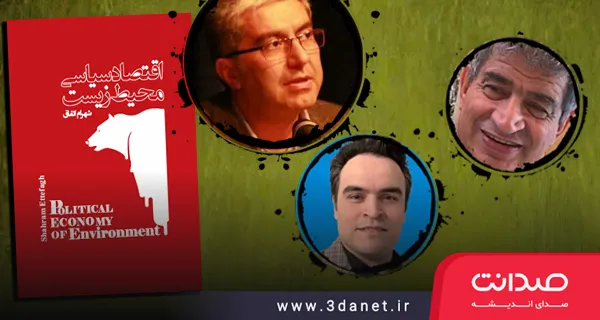
On the Book Class and the Environment by Shahram Ettefagh
Shahram Ettefagh's Class and the Environment can be seen as two books in one: the first three chapters explore class concepts and philosophical foundations, while the fourth examines the intersection of environmental and class issues.


Mojtaba Tabatabaei
AuthorOn the Book Class and the Environment
The book Class and the Environment is the latest work by Shahram Ettefagh, recently published by Amareh Publications. The book Class and the Environment can be regarded as two separate books within one. The first three chapters explain the most pivotal concepts of social classes and, ultimately, these definitions. This part of the book will be of interest to researchers in the fields of political economy, social sciences, and philosophy. Another chapter of the book discusses the link between environmental and class issues, and those interested in the environmental field will enjoy reading it.
In the book's introduction, we read:
In the "First Chapter" of this book, we will review the formation of class theory and, in the same place, analyze the crises of this theory. This chapter presents a preliminary picture of the backgrounds to the emergence of class theory, its basic definitions, the reasons for its failure and decline, as well as the views of its opponents.
In the "Second Chapter," the epistemological and methodological aspects of class theories, and especially Marx's theory, are scrutinized. This chapter contains the most foundational concepts of this collection, and the philosophical foundations of the social sciences in general, and class theories in particular, are examined. Since speaking of philosophical concepts through the mediation of their opposing concepts facilitates the task, an effort has been made in most sections of this chapter to introduce concepts as opposing pairs: methodological dualism or pluralism, logical dualism or pluralism, two opposing conceptions of the human being, two different understandings of knowledge, two conflicting approaches to the content of social theory, two different methods in the study of the humanities, and two distinct views on law and ethics.
Unlike the first chapter, which contains references to empirical findings and evidence, the second chapter, free from the empirical realm, has placed meticulousness in the method of cognition and the possibility of its realization on its agenda.
The failure in applying class theories has prompted some leftist thinkers to seek solutions, and therefore, the "Third Chapter" is dedicated to introducing the efforts of this group to reconstruct class theory. Studying these views holds multiple significances: first, to hear from them and know that the inefficacy of "class theory" is a serious issue; second, to become informed of the dispersion of opinions among leftist experts regarding class and class analysis. Furthermore, to realize that the inferred concept of class or social classes among the theologians of the humanities no longer signifies a demonstrated and singular concept.
Up to this point in the book, the author intends to introduce the fundamental concepts and foundations related to class theories, and the book's content fits within the framework of political economy concepts, social sciences, and philosophical foundations. But in the fourth chapter, the environmental aspects of the issue emerge. The author has described this chapter as follows:
In the "Fourth Chapter," we will address class-based environmental claims and examine examples of them. Over the past few decades, the destructive effects resulting from various types of pollution in soil, air, water, and the Earth's atmosphere have increasingly become one of the serious concerns of human society, leading to numerous crises such as the loss of biodiversity, the climate change crisis, and environmental degradation in general. The successive 2020 and 2021 reports of the World Economic Forum on the most significant future risks to human societies indicate that the "environment," both in terms of the likelihood of occurrence and the severity of its destructive effects, is at the forefront of our world's risks. On the other hand, however, this situation has also become a pretext for achieving political goals, and "class-based environmental" claims are one example of this. In the fourth chapter, some of these examples are examined in the form of thematic case files.
In the short fifth chapter, a concise summary of the book's content is presented, and it is titled "An End to This Research Work."
Three methods for purchasing the book online have been introduced: (1) visit the Amarah Publishing website, or (2) send a message via WhatsApp to the phone number 09368764391, (3) send a message via Telegram to the phone number 09368764391. In all three purchasing methods, shipping of the book is free.





Discussion0 comments
No comments yet; let yours be the first voice.