Environment
A Series of Talks by Shahram Etefagh Critiquing Thinkers of Environmental Political Economy
In conversation with Mojtaba Tabatabaei, Shahram Etefagh critiques the ideas of political economy thinkers on the environment—from Naomi Klein's claims about capitalism and climate to Thomas Piketty's theories on carbon inequality.

A Series of Talks by Shahram Etefagh Critiquing Thinkers of Environmental Political Economy
In a Conversation Between Mojtaba Tabatabaei and Shahram Etefagh
Organized by the Sedanet Institute
One of the methods of inquiry into the concepts and categories related to "environmental political economy" is to examine the views of the orators and experts in this field. Views that, although inspired by certain schools of thought, nonetheless, despite those commonalities and affinities, have certain additions or omissions. Therefore, in this series, we have endeavored, in confronting "environmental political economy," to approach some of these thinkers, to see the world through their eyes, and to test the caliber of their claims against the critique of their critics.
.
.
Session One | April 25, 2021
A Critique of Naomi Klein's Views on Climate Change and the Environment
Watch the video on YouTube | Aparat
Listen to the audio on Anchor | Spotify | Castbox | Google Podcasts | Apple Podcasts
Download the audio with a direct link | from Telegram
Is the capitalist system the cause of environmental destruction? If so, in the absence of the capitalist system and market mechanisms, would the environment be immune from destruction and encroachment? Or are there other governing economic and technical laws that rule over the environment? Naomi Klein is known in Iran for two books: first, the book "The Shock Doctrine," and the other, the book "This Changes Everything: Capitalism vs. the Climate." Several translations of these two books are available and have garnered attention in Iranian intellectual circles.
It seems that Naomi Klein's answer to these questions can be readily gleaned from the title of her book, Capitalism vs. the Climate. But Shahram Etefagh, from the perspective of a researcher in environmental political economy, holds a different view. In a past critique of Klein's views, Etefagh wrote: "The book This Changes Everything: Capitalism vs. The Climate, by Naomi Klein, is in some respects a noteworthy example among socialist claims. Studying the writings of this social activist and journalist, who seems to know little about economics and politics, is important primarily because she is sometimes cited by contemporary socialists, and ideas are put forward based on the evidence within this book and the author's fame. The book Capitalism vs. the Climate, despite its anti-capitalist title, carries an important message about the ineffectiveness of anti-capitalist analyses in diagnosing the causes of environmental problems and crises. Moreover, Klein's thought is, on the one hand, full of various contradictions, and on the other, it portrays her unfamiliarity with the most elementary concepts of political economy. Klein, on one side, attacks market-based economic relations, and on the other, presents her audience with a black record of centrally planned socialist economies. If, as Klein describes, socialist countries like the Soviet Union and its satellites, which relied on a non-market, planned economic system, have had disastrous records in environmental protection, then on what grounds is her book titled Capitalism vs. the Climate? If, as Klein emphasizes, Chinese-Maoist socialism and its centralized planning system led to the destruction of nature and an assault on the environment, then which non-capitalist prescription is supposed to save the climate from destructive changes?"
Evaluating Klein's claims about the causes of environmental destruction was only the first aspect critiqued in this session. But the foundations of Klein's methodology were also introduced as the second aspect of the disorder in Klein's theorizing. Klein's crude positivist approach in both books and the logical pluralism (Polylogism) governing the book The Shock Doctrine were other points raised by Shahram Etefagh in this discussion.
The third controversial aspect of Klein's arguments, from Shahram Etefagh's perspective, is Klein's confusion in defining desirable and undesirable ends regarding Milton Friedman's shock therapy. Klein claims that Milton Friedman's conspiratorial shock therapy caused countries like Poland or China to become market-oriented, market-based economies. If we accept, following Klein, that all previous and existing versions of socialism in the world have been rejected and erroneous versions, this question will be raised and remain unanswered: in the absence of this Friedmanite shock therapy, what utopian destination and optimal outcome did Klein expect?
The fourth part of the speaker's remarks in this session was based on examining the economic record of countries like Poland. The economic situation of countries like Poland after undergoing plans like Balcerowicz — which, according to Klein, is called Friedmanite shock therapy — seems very favorable, and the same outcome can be discerned in the path taken by countries like China.
.
.
Session Two | 2 Ordibehesht 1400
A Critique of the Views of Thomas Piketty, Lucas Chancel, and Branko Milanović on Climate Change and the Environment
Watch the video on YouTube | Aparat
Listen to the audio on Anchor | Spotify | Castbox | Google Podcasts | Apple Podcasts
Download audio via direct link| from Telegram
In 2015, Lucas Chancel and Piketty published a 50-page booklet titled “Carbon and Inequality: From Kyoto to Paris.” The “Carbon and Inequality” collection is about 50 pages long and has 8 sections: a summary in French, a summary in English, Section 1) Introduction, Section 2) Financing Climate Adaptation: The Gap, Section 3) History of Greenhouse Gas Emissions: Key Facts and Figures, Section 4) Combining Income Inequality Statistics with CO2e Emissions: A Review of the Research Literature, Section 5) Our Methodology, Section 6) The Global Distribution of Carbon Emissions: From Kyoto to Paris, Section 7) Financial Adaptation Through a Progressive Carbon Tax, Section 8) Results and Prospects for Future Research. But what is the concept of carbon inequality?
Safeguarding the ceiling on global warming requires controlling the amount of carbon emissions on this planet. Such control amounts to accepting a limit called the carbon emissions budget for all inhabitants of this planet. But not all the world's people emit carbon equally. Some emit more and some less than their per capita average share of carbon. Thomas Piketty, Lucas Chancel, and Branko Milanović, along with Hans, Anna, and Ola Rosling, have spoken about inequality in carbon emissions, and among them, some have seen the solution in levying higher environmental taxes.
In this session, as a first step, the basic concepts related to the greenhouse effect and greenhouse gases, the concept of carbon equivalent, carbon footprint, and carbon budget were reviewed. Shahram Etefagh wrote the following on this matter: “Relying on our limitation in the carbon budget, we assume that to safeguard the ceiling of a two-degree Celsius temperature increase, we are permitted to emit only about 580 billion tons (equivalent to 580) from 2018 onwards. If we assume the world's population is about seven and a half billion, the per capita carbon for each person will amount to 74 tons. In other words, every inhabitant on the planet is merely permitted to emit 70 tons of carbon from 2015 onwards.
But the ratio of carbon emissions among countries and their citizens is not equal, and there are significant differences between the average carbon emitted by an American or European citizen and an Indian or Sudanese citizen.
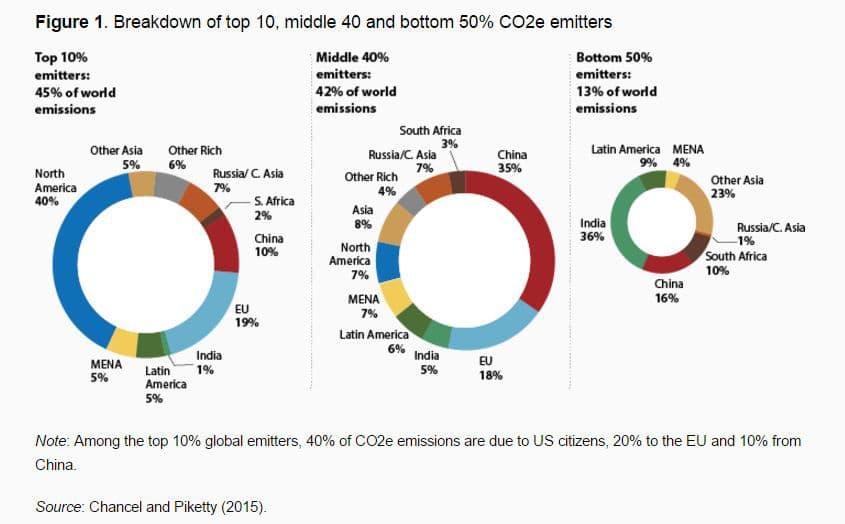
The average carbon emissions per citizen in developed countries are several times the average per citizen in underdeveloped or developing countries.
In Chancel and Piketty's scheme, there is a classification system of consumers across countries and within countries to separate and display inequality in carbon emissions in both the international and national arenas. In one of the most important charts presented in their scheme, the world's citizens, as emitters, are divided into three groups:
1- The top ten percent (10%) of emitters
2- The middle 40% of emitters
The bottom 50% of emitters
For example, according to this report, the top 10% group is responsible for 45% of total global pollution, and the share of citizens of each country in this group is as follows:
1- American citizens are responsible for 40% of this 45% of emissions.
2- European citizens are responsible for 19% of this 45% of emissions.
3- The Chinese are responsible for 10% of this 45% of emissions.
These calculations have relied on a set of data and, of course, the incomes of the citizens of these countries within a comparative structure."
Following the presentation of the problem of "carbon inequality" from the perspectives of Piketty, Chancel, Milanović, and the Roslings, the views of critics were also examined: (1) A critique of the approach of Piketty, Chancel, and Milanović based on defining the relationship between wealth and environmental destruction, (2) An examination of the difference between claims based on lifestyle change compared to taxation, (3) How payment by consumers is like a carbon coupon delegation, (4) The shortcomings of environmental taxation systems, and other topics.
.
.
Session Three | 9 May 2021
A Critique of Yanis Varoufakis's Views on the Political Economy of the Environment
Watch the video on YouTube | Aparat
Listen to the audio on Anchor | Spotify | Castbox | Google Podcasts | Apple Podcasts
Download the audio via direct link | from Telegram
Yanis Varoufakis, an economics graduate, former Greek finance minister, and author of the 2013 book Talking to My Daughter About the Economy, which was published in Iran under the title Talk to My Daughter About the Economy: A Brief History of Capitalism by Ban Publishing and translated by Mr. Farhad Akbarzadeh. In the third session of the series on the political economy of the environment, this work by Varoufakis was subjected to critique.
At the beginning of the session, Mojtaba Tabatabaei pointed to the book's characteristic that the author claims there is an effort not to explain economics to people in simple language, and for this reason, in the early parts of the book, he presents and articulates his economic foundations, and then, at the end of the book, proceeds to draw environmental conclusions from the aforementioned premises. Since the author has written the book in a fluent style, and his references to myths or literary masterpieces carry the reader along, it is highly probable that a reader unfamiliar with economic and political concepts, without recognizing the theoretical disarray in these premises, will sympathize with the book's conclusions and outcomes.
It was therefore decided that Shahram Etefagh, from the critical standpoint of Varoufakis's book, would, in the initial steps, undertake a scattered analysis of the book's definitions and preliminaries, after which the author's environmental claims would also be brought into focus.
As Etefagh describes, this book was published in 2013 at the height of the crises between Greece and the European Union. Varoufakis has leftist and Marxist leanings and claims to offer a new and different narrative of the global economy and the history of capitalism.
Varoufakis begins his book with this important question: why were Australians in the past more backward than the English, why was it the English who conquered Australia, and why did the reverse not occur?
In this book, Varoufakis has attempted, by invoking his materialist perspective—following Marx and Marxism—to answer this question and to show that the roots of social transformations must be sought in material elements. Thus, reasons such as the geographical conditions of the European continent are introduced as the cause for the increase in economic surplus, technological development, and the like in England. Meanwhile, the author's methodological approach is incapable of explaining the reasons for many social transformations, economic differences, and political changes. Furthermore, a fallacy of the Straw Man type is employed so that the main rival theory remains hidden from view, and instead, an invalid rival theory is rejected, with a victory song sung over its grave.
Varoufakis, inspired by the Marxist tradition, speaks of two types of value: "exchange value" and "experiential value," and believes that the problems of our era began when all the "things" of the world acquired "exchange value," and this category replaced "experiential value." In this respect, the "commodification" of everything is recognized as the inevitable consequence and fruit of this sinister affair. A theoretical approach stemming from a medieval notion, traces of which could also be found in the works of Adam Smith—and the diamond-water paradox—and which Marx ultimately also utilized. A method that Marx himself adopted in the first volume of his book Capital to depict how wealth—and surplus value—is created within the social relations of the capitalist era. Although the assault on this theoretical apparatus had begun as early as the eighteenth century, and by the early twentieth century, this episode was considered concluded for the reason that the new economic science had completely abandoned concepts such as "exchange value" and "experiential or use value." For thinkers and intellectuals from the eighteenth century onward had realized that "values" are subjective and are not entities existing outside our minds.
After critiquing the author's methodological foundations, it was time to examine his environmental claims. Varoufakis is a critic of market economy policies in the environmental sphere and says sarcastically that the world's companies have been granted permission for the "right to emit" a certain amount of "toxic gas" into the atmosphere, and these companies are allowed to sell their "right to emit toxic gas" to other companies. But the practical solutions of the critics on this matter appear vague and ambiguous.
One of the important and unfinished topics of this session was the critique of the claim of the "commodification of the environment" in leftist assertions, about which some preliminaries were discussed, and its full examination was postponed to the next session. Also, at the end of this session, a brief reference was made to the performance of leftist parties in Greece.
One method is the Carbon Tax, in which the total amount of pollution is unknown, but the cost of emitting each ton of carbon beyond the permitted limit is known. The other method is Cap & Trade, in which the total amount of pollution is known, but the cost of emitting each ton of carbon beyond the permitted limit is unknown. The expected outcome of employing either method is to follow a decreasing trend in emissions.
.
.
Session Four | 26 May 2021
A Critique of the Commodification of Nature in Leftist Thought: Karl Polanyi, Michael Parenti, David Harvey, John Bellamy Foster, Yanis Varoufakis, Naomi Klein, and others...
Watch the video on YouTube | Aparat
Listen to the audio on Anchor | Spotify | Castbox | Google Podcasts | Apple Podcasts
Download the audio via direct link | from Telegram
One of the critiques raised by Neo-Marxists and some followers of leftist intellectual currents is the commodification of nature. The phenomenon of "commodification" refers to a situation in the capitalist era where everything has become exchangeable compared to the past. In the continuation of these protests, the issue of the commodification of environmental elements, or in short, the "commodification of nature," is also at the center of "leftist" criticisms.
In Shahram Etefagh's view, the phenomenon of "commodification" in leftist claims encompasses two different understandings of the issue. In the first approach, originated by Marx, "commodification" signifies a specific historical, exploitative social relationship between capitalists and labor power. In other words, Marx only called things commodities that were the product of the capitalist process and relations, and in expressing this idea, he wrote (Capital, translated by Hassan Mortazavi): "The product of labor, in all social states, has been an object; but only in a specific historical period of development does the labor expended in producing a consumable object represent itself as an objective property of that object, namely as its value, and the product of labor becomes a commodity." Naturally, natural elements—such as wood from forest trees—also only become "commodities" after entering this scene. Marx's important project was changing the social relations of production and eliminating exploitative relations. Consequently, attention to the metabolic rate of natural elements in Marx's work was a consideration from the perspective of safeguarding the raw materials of production, not environmental protection.
However, in 1944, with the publication of his book The Great Transformation, Karl Polanyi called land, money, and labor fictitious commodities, and in a view differing from Marx, he emphasized that unregulated commodification damages the real character and essential function of these factors. Among other things, the commodification of land—or more broadly, nature—makes meeting the basic needs of human life more difficult or impossible. After Polanyi, other thinkers and writers such as Michael Parenti, James O'Connor, David Harvey, John Bellamy Foster, Yanis Varoufakis, and Naomi Klein raised claims similar to Polanyi's.
As Etefagh describes, "commodification" in Marx's theoretical framework and the "commodification of nature" or "commodification of education" or their like in the claims of post-Polanyi Neo-Marxists are based on different concepts. In other words, "commodification" in the claims of these recent Neo-Marxists is detached from the exploitative concepts in Marx's framework, and for this very reason, different solutions are offered in the two theoretical frameworks, while both face serious difficulties in protecting the environment.
Mojtaba Tabatabai raises questions beyond the aforementioned points and suggests discussing two contradictions: first, a contradiction in Varoufakis's views, where on one hand he considers forest fires to be the result of a lack of exchange value, and on the other hand, he complains about the expansion of commodification—such as the exchange value of a mother's womb or the right to emit pollutants. And second, a contradiction between two books: "Talking to My Daughter" by Varoufakis and the book "A Short History of Progress" by Ronald Wright.
Both contradictions are examined in this session. According to Etefagh, one cannot simultaneously defend the views of both books, and the diagnosis of problems in the book Letters to My Daughter conflicts with and contradicts the arguments of The Progress Trap; although their common ground is hostility toward the capitalist system and invective against it.
.
.
Session Five | 30 June 2021
A Critique of Bill Gates's Views on Climate Change and the Environment
Watch the video on YouTube | Aparat
Listen to the audio on Anchor | Spotify | Castbox | Google Podcasts | Apple Podcasts
Download the audio via direct link | from Telegram
Bill Gates is the founder of Microsoft, a company that owes its wealth and fame to creating new software for our world. The Bill & Melinda Gates Foundation was also established on the initiative of Gates and his wife Melinda in 2000, and today it is the most significant charitable foundation in terms of power, wealth, and scope of action. Shortly thereafter, in 2006, Warren Buffett also came to the aid of this foundation and doubled its financial resources. Although the foundation's primary goal at the outset was poverty reduction and the development of health and sanitation in impoverished communities, such as parts of Africa, they were inevitably forced to enter new, unforeseen areas. Building a clinic or developing employment-generating activities in deprived regions required access to electrical energy. In the struggle over how to build new power plants, Bill Gates became more familiar with the issue of climate change. He then put more serious study on the matter on his agenda starting in 2004. In 2010, he gave a TED talk on the necessity of paying attention to climate change. In 2015, he actively participated in the COP21 conference in Paris. In response to the Keep it in the Ground movement campaign, he divested all his holdings from the oil companies ExxonMobil and BP, uses green fuel for his personal jet, founded TerraPower and Breakthrough Energy companies to develop clean energy and carbon removal, eats fewer hamburgers, and finally, in 2021, published a book titled How to Avoid a Climate Disaster.
All these actions and other work that he, or the foundations and companies affiliated with him, have carried out over these years indicate, on the one hand, the magnitude of the global warming crisis, and on the other, serve as a critique of the approaches of far-right populism and vulgar left populism.
In his recent book, Bill Gates, through a regular and structured process, systematically examines the nature of the problems and solutions step by step, explaining that the annual emission of 51 billion tons of greenhouse gases by human activities must reach zero. He then breaks down the share of different sectors—manufacturing, electricity generation, agriculture and livestock, transportation, and finally heating and cooling systems—in the annual emission of 51 billion tons of greenhouse gases.
Bill Gates writes in his book that we consume 15,000 billion liters (15 billion liters) of oil daily worldwide, which costs about 26 cents per liter in the United States, and all aspects of our lives in the production of goods and provision of services depend on it. He then explains that we must seek a suitable replacement for this energy source. He goes on to point out a series of technical and economic difficulties with the alternatives and introduces the paths that have been taken.
In addition, Gates explains that in some areas, such as carbon-free green production, no noteworthy success has yet been achieved, while by 2060, the existing buildings on planet Earth will double.
Various figures have criticized Gates's content and views, and in this session, we have reviewed some of them. Moreover, in this session of our series of talks on "Environmental Political Economy," we have also answered the important question, "Why is Bill Gates's new book on climate change important?"
.
.





Discussion0 comments
No comments yet; let yours be the first voice.