Environment
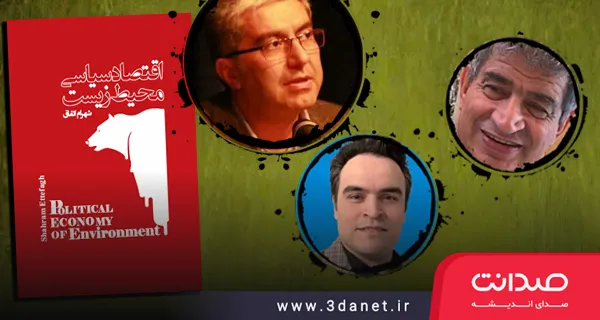
Virtual Lecture by Shahram Etefagh for Iranian Students at UC Berkeley on the Political Economy of the Environment
In a virtual lecture for Iranian students at UC Berkeley, Shahram Etefagh examined the relationship between political economy and the environment. He outlined various types of pollution and the impact of greenhouse gases on ecosystem balance and the Earth's temperature.

Virtual Lecture for Iranian Students at UC Berkeley – California
Hello everyone. My name is Eric White and I am so pleased to have this opportunity to talk about the critical issue of the environment with University of Berkeley students. As you all may Know, environment is one of the crucial crises in our time, and there is an essential connection between the political economy and environment. For this conversation to be better used for Persian-speaking audiences, I will continue my speech in Persian.
Let's go to my office (while cycling …).
Greetings and salutations to you. I am delighted to have this opportunity to speak virtually with the students of the University of Berkeley (California) about the important issue of the environment.
I am Shahram Etefagh, and I have translated and authored books and articles in the fields of engineering and economics. Today, I have been given this opportunity, at your invitation, to speak about one of these subjects, namely the “Political Economy of the Environment.”
My reference will be my own book, a book that is about political economy and the environment. This book is in two volumes, and important topics concerning the environment and political economy are raised in it. So, I will now proceed to explain this subject. And if you will allow me, let us begin with the environment, and afterward we will move on to political economy and examine the relationship between them.
![The Political Economy of the Environment book [Vol.1] - Gisoom Books](https://www.gisoom.com/img/files/user/book/11565456/b0uSBIMb-Fwz9hw_509481_1578139585.jpg)
We all know that we live within cycles called ecosystems. That is, cycles that are a combination of plants, animals, microorganisms, humans, and physical objects, and these ecosystemic cycles exist in a state of equilibrium. Any small change in these cycles causes transformations within them, but ultimately they dynamically try to return to their equilibrium cycle. And the environmental degradations that we cause can damage these ecosystemic cycles. These damages can be so extensive that this equilibrium changes in such a way that we, as a member of this ecosystem, are no longer able to continue our life within these cycles, or cannot continue our life in the same form and with the same quality as we did in the past.
What causes environmental degradation?
One of the things that causes environmental degradation is “air pollution.” We can pollute the air both in the process of producing goods, like the smoke that comes out of factory chimneys, and in the consumption of products, like the smoke that comes out of cars or cigarette smoke, which can also pollute the air. Anything that can pollute the air is considered among the subjects we call air pollutants.
Apart from air pollution, we also have “noise pollution,” the sound resulting from industrial activities, the sound resulting from the consumption of goods, such as when you honk your horn while driving—this sound creates noise pollution—or when you set off firecrackers during the Chaharshanbe Suri festival, or when the sound of firecrackers is heard at festivals; these can create noise pollution. We also have light pollution, which results from the production of artificial light found in cities, roads, and seashores. These can create light pollution.
We have various types of “soil pollution.” Chemical waste that we introduce into the soil, nuclear waste that is buried in the soil, and ordinary garbage that is buried in the soil can create all kinds of soil pollution. Even the remnant of a cigarette butt thrown on the soil can pollute the soil and make that environment toxic for the survival of plants and animals. And there are various other types of pollution that could be mentioned.
We have “water pollution,” which is very important. Through activities such as washing dishes or doing laundry with detergents, or by discharging chemical waste from factory production processes into seawater, rivers, or groundwater aquifers without industrial treatment, we pollute the water.
All the cases I mentioned can damage the “ecosystem cycle.” For instance, firecrackers during Chaharshanbe Suri or festivals, or artificial light on beaches, can disturb and worry animals, possibly causing them to change their habitats. For example, when turtles want to come ashore to the place where they have always laid their eggs, the artificial light created on the beach or the artificial noise there makes them anxious, and they may change their nesting site. Birds may migrate from their previous location and move to a new one. All of this can cause worrying changes and transformations in these ecosystem cycles. Some of these changes are absorbed within that ecosystem, which then reaches a new equilibrium and may not pose a serious threat to us. In other cases, however, this damage may harm the ecosystem to such an extent that our own survival is endangered.
One of the worrying issues in environmental degradation is the emission of greenhouse gases. Our human activities cause the emission of greenhouse gases. Of course, some natural processes, independent of human processes, also cause greenhouse gas emissions, but their volume is very small, and after being emitted, they also leave the atmosphere; that equilibrium has always existed. However, the volume of greenhouse gas emissions by humans has increased enormously since a certain point, such that from the beginning of the first Industrial Revolution, around the year 1750 onwards, we have emitted a large volume of greenhouse gases.
These greenhouse gases have created a blanket around the Earth, such that sunlight passes through this blanket, but heat cannot escape it. In fact, the same situation occurs as happens in greenhouses. Or, for example, you may have had the experience of leaving your car exposed to intense summer sunlight; when you return after a few hours and get into the car, you find that the air inside has become extremely hot. This is because the sunlight was able to pass through the car's glass and enter the interior space, but the heat could not escape, thus creating a greenhouse situation there. And we currently have this greenhouse phenomenon on planet Earth. The problem we have is that from the beginning of the Industrial Revolution until now, we have produced a huge volume of greenhouse gases. The production of these greenhouse gases results from a set of human activities, which I will explain, and the sum of these factors has caused the Earth's temperature to increase by about 0.8 to 1 degree Celsius compared to the beginning of the Industrial Revolution up to the beginning of 2011.
From the beginning of 2011 until today, more greenhouse gases have been produced, and consequently, the Earth's temperature has still increased slightly. And now scientists express concern that if the Earth's temperature rises more than about 1.5 to 2 degrees Celsius (and we are currently experiencing a 1.5-degree increase), if it exceeds 2 degrees Celsius, a series of transformations will occur on planet Earth, damages will be inflicted on this ecosystem. These damages will cause thousands and millions of animal and plant species on planet Earth to become extinct, seas to disappear, the temperature of oceans and seas to rise, and polar ice to melt (which is already happening). The sum of these factors will endanger human survival, and we may enter an irreversible phase where we can no longer compensate for anything. The reason for this is that once greenhouse gases enter the Earth's atmosphere, it takes a long time for these gases to leave the atmosphere. The removal of some of these greenhouse gases takes about 100 years, and for some, it even takes several thousand years.
You should also know that we have a different mix of greenhouse gases, but the most important greenhouse gas we produce on planet Earth is carbon dioxide. The effect of the remaining greenhouse gases is calculated and converted into carbon dioxide equivalent. Therefore, when we talk about the amount of carbon dioxide emitted, we mean the total gases produced as greenhouse gases, which is why it is called CO2e. Or, for example, when methane gas is to be converted into carbon dioxide equivalent in calculations, methane has 28 times the greenhouse effect of carbon dioxide.
Now, how these gases are produced in our natural life is also an interesting subject. For instance, one of the reasons for methane production is cattle farming on Earth. After digestion, cows release a gas, which is methane. The volume of gas that cows release is very large (each cow releases about 140 kilograms of methane). We raise a large number of cows on Earth, and they release a huge volume of methane, and this methane leads to environmental degradation. The translation of this in our natural life means that when we eat a hamburger made with beef, we are causing environmental degradation. And of course, the bread and vegetables used in this hamburger also cause environmental degradation. All these items must be considered in our calculations. So it is clear that every hamburger we consume causes environmental degradation.
When we produce cement, it causes environmental degradation, because every 1 ton of cement releases a very large volume of carbon.
Every email you send causes environmental degradation. Every like you give causes environmental degradation. Therefore, we always live with environmental degradation. That is, human economic activities on planet Earth cause environmental degradation. So the question is, what is the dispute between economic and political theories regarding the environment? You have probably read in newspapers and magazines that the capitalist system causes environmental degradation. And they respond by saying that this is not the case, and that you socialists cause environmental degradation. So what is the subject of these disputes?
As I explained to you, all the activities we do—producing cement, eating a banana (for example, bananas are among the items that cause significant carbon dioxide emissions and therefore cause more environmental degradation). Well, if that is the case, then what is the dispute among different economists about? The reality is that in any system, eating a hamburger, sending an email, or producing a ton of cement will cause environmental degradation. Whether in a socialist country like Cuba or in a market-based economy like South Korea or Chile. There is no difference in this regard. In any system, whenever we produce and consume a good, we will face environmental degradation. The dispute is over which economic system can cause less or more environmental degradation. The dispute is not over whether there is an economic system like paradise where no environmental degradation occurs.
Why does environmental destruction occur? The reason is that the population of planet Earth, from about 10,000–11,000 years BCE (from the time we have information about it), from the dawn of humanity, from the time Adam and Eve bit that apple and were exiled to Earth, until around 1700 CE, was roughly 600 million people. And from 1700 CE, when we entered the era of mass production and the capitalist system, conditions emerged that caused the Earth's population to increase dramatically, and approximately 7.2 billion people have been added to the planet's population in just these 300 years. That is, from the very beginning of human existence until the year 1700 CE, the Earth's population was around 600 million, and a large portion of these 600 million lived in poverty; humans faced numerous problems, there was no way to identify diseases, many people died due to illness, and many other problems existed. From 1700 CE onwards, a series of developments occurred that improved human living conditions, life expectancy increased—for example, 300 years ago, life expectancy was about 30 years, but now this figure has reached, say, 70 years. And the overall material conditions of human life, for education, health, nutrition, and a place to live, have improved, and this has caused the Earth's population to increase rapidly over these 300 years, resulting in the Earth's population rising from 600 million to 7.7 billion people, with roughly 7.1 to 7.2 billion people added to the planet's population in these 300 years.
Well, this population increase puts pressure on the Earth. There is a curve that explains this, called the download curve. This curve says that planet Earth is a place for three things:
1- A place to live
2- A warehouse of supplies and raw materials
3- A waste repository
Planet Earth is where we live, it is a place that serves as a warehouse of raw materials—for example, we use wood from trees, we fish from the sea, we extract metals from mines. And it is also the repository for our waste, because humans have not yet learned to easily recycle the goods they produce and turn them into other products, or for them to decompose very easily and return to nature; and we produce a huge volume of waste, like plastics that people throw in the trash or sometimes into the seas. Now we have a large volume of plastic waste in the seas that has turned into microplastics, and these microplastics have entered drinking water, and the fish we catch feed from that water.
Therefore, we face this crisis because the Earth's population has increased about 13–13.5 times from 300 years ago until now, and this has caused the Earth, as a place to live, a waste repository, and a warehouse of supplies, to have less capacity to meet our needs, and pressure has been placed on planet Earth, and regardless of the type of economic system, all economic systems are involved in this issue, whether we live in a socialist country or a capitalist one.
Now, knowing part of these disputes between left and right political and economic thoughts is interesting, and I will mention a few of these examples. One of the discussions that arises is called the accusation of consumerism. This means that those with leftist leanings make this claim about ideas based on the free-market economy, based on the economic system called capitalism, that excessive consumerism in the market-based economic system or the capitalist economic system causes environmental destruction. Because a large volume of various goods is produced and supplied every day, and people are also encouraged to consume more goods; every day you are faced with a large volume of advertisements suggesting you buy new shoes, try a new drink, go to a new restaurant, or buy new clothes, or travel to a new place.
[The left claims that] all of this is consumerism, and the consumption of various goods causes further environmental destruction, and one of the reasons for environmental destruction is the structure that exists within the free-market-based system or the capitalist system.
Conversely, proponents of the market system or capitalism have much to say in response to the accusations leveled by the left (of course, the market system and capitalism have technical and important differences, details that are debatable, but I won't go into those discussions now; I just want to convey each side's understanding of the issue).
They [proponents of the market system or capitalism] say that once you [the left] claimed that the continuation of the market-based system would lead to the poverty and destruction of all human beings on the planet, but now your claim has reversed, and you assert that all humans have so many goods at their disposal and consume so much that they might die. Therefore, there is a contradiction here. Secondly, who can determine what people need and what they have the right to consume and what is prohibited? The experience in the socialist systems of the 20th century in countries belonging to what was called the socialist camp, like the Soviet Union, was partly such that there was a central organization, for example in the Soviet Union, called Gosplan[1]. There, Gosplan decided which goods would be produced, by whom, and in what quantity. This complicates matters greatly because those bureaucrats or administrators in that central planning office had to decide about everything: what goods, in what quantity, and in what color should be produced. How many types of shoes do people want? Only those specific types of shoes with those particular models should be produced, and no one else has the right to produce more. It was the same with food. Only a few specific types of cheese, for instance, should be produced. That is to say, if we are to change this current model, in which anyone can decide to produce any good they like, and people, based on their needs, acquire and consume these goods, and people themselves determine which goods they like to consume, and if they don't consume them, the producer of that unnecessary good exits the market scene—if we want to eliminate this model, a group of know-it-alls must decide for the rest of the people how many types of shoes people need and how many colors they should wear, and anything beyond that is consumerism and they do not have the right to consume it. This is the dispute between the two sides regarding consumerism.
Another discussion that arises is the issue of profit. In fact, leftist tendencies claim that one of the factors in environmental destruction is the profit-seeking inherent in the capitalist system, and the actors and individuals operating within the market-based system are constantly pursuing their own goals and interests, which can lead to environmental destruction. This is because, to save costs, they might disregard environmental regulations for their own profit-seeking, leading to environmental degradation; and this claim is a valid one and can be true in some places. That is, you can find examples in certain locations, for instance, a factory that, without industrially treating its chemical waste, discharges it into a river or into underground aquifers to incur lower costs. Therefore, this claim can be true. We can find examples on planet Earth.
But on the other hand, proponents of the market system believe that where there is no personal profit or benefit, we can witness a great deal of resource waste. Factories that are not private but state-owned consume vast amounts of raw materials and energy; the consumption of this volume of energy and raw materials itself causes environmental destruction, and this claim is also entirely true, and there is ample evidence for it. That is, you can find numerous examples of state-owned companies and industries, those without private ownership, those that do not operate on the basis of competition, which, because they are not in a competitive environment, can always cause environmental destruction.
It is interesting to know that, around 1980, one of my professors said they had gone to one of the socialist countries for energy consulting on a project related to energy management, and they said that many industrial factories did not have electricity meters, because electricity was state-owned and the factory consumed as much as it could, and well, its product was also for the state, and the people who worked there were state employees. Since everything was state-owned, no one controlled how much electricity the factory consumed, and this was a great disaster, so much so that later one of the reform measures they tried to implement in the Soviet Union was reducing the consumption of raw materials and reducing energy consumption in state-owned factories, which had not been founded on the logic of competition or profit and personal incentives, and there was a massive amount of waste of resources, raw materials, and energy there. So, they also have this to say from their side.
That is, I want to say that when we enter the space of the political economy of the environment, both sides have things to say, and hearing these arguments from both sides is necessary, and when we want to enter this arena, it is important to know what all the existing theories in the field of political economy have to say, and this method can make us aware of different theories.
Look, when we want to talk about a phenomenon, we cannot say, "In my opinion, it is like this." We can give our personal opinion about personal things, for example, in my opinion, tea is better than coffee. The red rose is more beautiful than the iris. The color yellow is more beautiful than purple. This is our personal opinion regarding personal phenomena. But when we want to talk about issues of political economy and enter the realm of science, we must use theories. That is, the things we say should be based on theories and not our personal opinion. Therefore, when we want to comment on a phenomenon, we must know the different theories about that specific phenomenon and speak about it relying on those theories. Hence, I tried in the first volume of my book to present and introduce the various theories in the field of political economy. Let me bring up the things I referred to in the book. For example, in the first volume of my book, I have tried to introduce the schools of Orthodox or Traditional Marxism[2], Market Socialism[3], Participatory Socialism[4], Eco-socialism[5], Mainstream Economics[6], Public Choice Theory[7], New Institutionalists[8], and finally the Austrian School[9], and I have also tried to clarify the connection of these schools with environmental concepts to some extent. In addition, I have endeavored to separately introduce the views of independent individuals such as Thomas Piketty[10], Lucas Chancel[11], Branko Milanović[12], Alice Bows-Larkin[13], Kevin Anderson[14], David Harvey[15], Naomi Klein[16], Mahbub ul Haq[17], Kumar Amartya Sen[18], Erik Allardt[19], Yuval Noah Harari[20], Bertrand de Jouvenel[21], and Fritjof Capra[22]. Because these individuals, independent of the aforementioned theories, had discussions about economics and the environment that could not easily fit into the framework of those schools. Therefore, I dedicated the first volume of my book to introducing the concepts of political economy theories and the concepts that were relevant there.
Further on in the second volume of my book, I tried to present the critiques and debates that these theories and schools of thought have with one another, and this is a very important subject. Why is it important?
For example, suppose on a specific topic like "the state," when we want to talk about the state, the question arises: what is our definition of the state? For instance, suppose that to solve environmental problems, the state must play a role. If we make this claim, if we imagine that our mythical savior for protecting the environment is the state, we must see what definitions exist regarding the state. There are some political economy theories that believe the state is the representative and protector of the people's interests. There are some political economy theories that believe the state itself is like an "economic firm," and the politicians within this state are pursuing their own interests. They are seeking more power. They are pursuing economic interests. They are seeking rent, and they are actually trying to solve their own problems, and this simplistic and naive notion that these are individuals who have no personal interests, think of nothing but the public good, and only pursue the interests of other members of society, may not be very realistic.
There are various intermediate theories. There are theories that say every type of state is a state that only pursues its own interests. In every economic system, everyone is engaged in economic activity and generates wealth through the production of goods and services, but the state is the one whose source of income is, for example, collecting taxes from the actors in the economic system. That is, in fact, this state itself is the exploiter of the economic system. Its source of funding is the proceeds from economic activities; and this means that if we hold such a view of the state, can this state really solve environmental issues? Therefore, the matter is more complex than this. That is, to imagine that when we comment on the subject of the environment and when we look at the state as one of the solutions to the environmental problem, when we examine the different definitions of the state that exist and the arguments behind these definitions, we realize that the issue is a bit more complex than our initial conception, and we are compelled, by taking these theories into account, to examine the various facets of the problem.
I prepared a report that is interesting (of course, similar reports exist in large numbers and various studies have been done) and it shows that from about the year 1880 to the year 2011, the amount of government spending relative to GNP, meaning the Gross National Product of countries, for example, in the year 1880 was about 5 percent, 4 percent, 4 percent; all countries of the world, without exception, were at 3 percent, 4 percent, 5 percent, and in the year 2011, this figure reached, for example, 35, 40, 55 percent and experienced a growth of several hundred to several thousand percent. That is, in the period from 1880 to 2011, the expenditures and costs of governments increased dramatically, and while they consume a very large budget every day, they always face a budget deficit and always leave enormous debts on the shoulders of future generations. That is, they indebt future generations. They use the method of borrowing (whether borrowing from domestic sources or borrowing from foreign sources) and future generations become indebted, and as you can see, for example, the US government has a massive volume of this type of debt, and the rest of the governments are in a similar situation.
Therefore, from the perspective of some of these theories, the state is also an economic firm that pursues its own interests, increases its costs every day, likes to make its administrative apparatus broader and more extensive, and pursues its own issues and interests, and we must pay attention to this view, respect it, and look at the phenomenon of the state by taking all these views into account. Well, there are some who, despite all this, believe that a portion of the world's governments have been able to do positive things towards improving people's living conditions. They have a series of evidence, proofs, and documentation. So my point is that in all fields, when we enter the space of different theories, we realize that regarding a single phenomenon, various theories exist, and paying attention to the solutions offered is very important.
For example, one of the things that is said is that governments should solve the environmental problem by levying “taxes.” Does levying taxes solve the environmental problem? Critics of this idea believe that the essence of this idea, which is called a Pigouvian tax[23], is that an economist in the early twentieth century had ideas on this subject and believed that when two people exchange a good with each other—for instance, suppose an automobile factory sells a car to me and I buy this car; in fact, I, as the buyer, benefit from using the car, and the automaker also benefits from selling this good to me. Thus, the parties to this car exchange, both the one who sold it and the one who bought it, have benefited. But the rest of the people may suffer from this exchange. That is, the good I have purchased may cause noise, its smoke may cause air pollution, and others may be harmed by this exchange. Therefore, the Pigouvian tax solution is for the government, as the representative of the public good, to levy taxes on the seller of the good. Levying taxes on the seller of the good causes a shift in the automaker’s break-even cost curve, and developments occur that make the automaker take this issue into account, all of which leads to less damage to the environment and less degradation. But the reality is that in many cases we witness governments levying these taxes while not being displeased with environmental degradation, and these environmental degradations that lead to fines and taxes are in fact a way for governments to acquire revenue, and therefore you sometimes see it becoming more of a source of sustenance and profit for government bureaucrats and officials.
So what is the solution? Look, the issue is an important one, and perhaps this is the last topic I will raise in this session. There are two different perspectives between the left and the right regarding the solution to various problems, including environmental problems. People’s interests are generally not identical to their preferences. For example, suppose that eating fast food, drinking carbonated beverages, eating very fatty cream puffs, may be harmful to their health. Smoking cigarettes and marijuana may be harmful to their health. This is their interest. But their personal preferences or desires may not align with this. That is, people may smoke cigarettes, desire to consume marijuana, desire to eat fast food, desire to eat cream puffs or drink carbonated beverages. Considering that they may or may not know that these are harmful to them.
In political thought, there is a view that imagines that when people’s interests differ from their preferences, a political authority must exist to discern the good and the expedient and then act as the executor of that good and expediency. Suppose a political commander, like the government, discerns the good and expedient, realizes that eating fast food is harmful to people, and bans eating fast food. Or bans smoking. Or bans drinking carbonated beverages. In fact, that authority decides what is in the people’s best interest. This is one way of looking at the issue, which in my book I attributed to John Dewey[24] as someone who imagines that an authority can be defined that discerns the people’s good and expediency and enforces it.
An opposing thought is one that I attributed in my book to Hannah Arendt[25]. And leftist thoughts oppose this theory, while rightist thoughts are close to this view. They imagine that we cannot grant the political sphere such standing and such competence that political commanders would themselves determine what is expedient and what is in the people’s interest, the public good, while themselves having no personal, political, or economic interest, or any interest from rent-seeking, and then seek to implement it. Discerning the public good is not that simple.
Thus, one way of conceiving the issue is that the state, or the political sovereign, or any institution that is to engage in policymaking, possesses the competence to discover the public interest. Whereas opponents of this approach believe that:
(1) The state or the political sovereign sometimes, or never, has the competence to discover the public interest, because the public interest is fundamentally undiscoverable and indefinable.
(2) One cannot be certain that the state, as a social reformer, has no private interest, and
(3) One cannot be certain that, should extensive power and authority be granted to the state, this power can be reclaimed from it and that a transfer of power would be easily feasible.
One of the greatest debates between the left and the right, as I explained earlier, has detailed foundations in the domain of the understanding of human beings, philosophical foundations, and the understanding of knowledge. The definition of epistemology and methodology that exists has an effect on arriving at these two different perspectives. Therefore, if we want to solve the problem of car exhaust and noise and anything similar, the view that opposes granting competence to the political sovereign holds that the solution to the world's problems, including environmental issues, is for the people themselves to become aware of the subject, for their preferences and interests to align with their benefits. Not for someone from the outside to have the competence and standing to want to do such a thing. And it is the people whose tastes and preferences must change, and whenever this change is seriously brought about, and this change in taste and this change in interest is created, we will witness that the problem will be solved.
For example, regarding automobiles, you witness the same situation: many people are interested in buying cars that are more environmentally friendly or using devices that cause less harm to the environment, and no one, as a political sovereign from the outside, has forced them to do this. They themselves discerned what is in their interest and, far from political sovereignty, were able to reach this conclusion. Commenting on and discussing almost all of these topics requires that we certainly have sufficient information about all these theories, as someone who uses the theories, or we might be a theorist and add something to these theories; and I always imagine that understanding the issues of the world around us requires that we have a proper understanding of the various types of these theories and be able to analyze them and gain a reasonable knowledge of them.
Thank you for listening to my remarks, and I thank you for the opportunity given to me, and I wish health, victory, and success for all of you.
Be happy, healthy, and prosperous. Farewell.
.
.
Greetings,
I'm pleased to have this opportunity to speak virtually with the students of the University of Berkeley about the important topic of environment.
I am Shahram Ettefagh and I have translated and wrote some books and articles in the field of engineering and economics. I’m honored to be invited by you and have the opportunity to speak about one of the topics which is "Political Economy of Environment". My reference will be my book, which is about the political economy and the environment. This is a two-volume book that covers important topics related to the environment and political economy. So I'm going to explain this subject now. I will start with the environment, and then the political economy, and look at the relationship between them.
We all know that we live in cycles called ecosystem cycle. These cycles are a combination of plants, animals, microorganisms, humans, physical objects, and these ecosystem cycles are in an equilibrium condition. Every small change in these cycles result in internal transformations. However, these cycles dynamically try to return to their equilibrium condition again. And the environmental damages that we do can harm these ecosystem cycles. These damages can be so severe that alter this equilibrium in such a way that we will no longer be able to survive in these cycles as a member of the ecosystem, or continue to live in the same quality as before.
What causes environmental damages?
I sometimes use my computer to keep the track of the content.
Air pollution is one of the problems that cause environmental damages. We can pollute the air both in the process of producing goods, such as the smoke coming out of factory chimneys, and in the consumption of products such as smoke coming out of cars or cigarette smoke. Anything that pollutes the air can be considered in the category of air pollutants.
We also have noise pollution in addition to air pollution, the noise of industrial activities, noise of using devices, such as honking a horn when you are driving, or when you play with firecrackers at Chaharshanbe Suri ceremony, or the sound of fireworks in festivals can cause noise pollution. We also have light pollution that is caused by the production of artificial light in cities, roads, and beaches. These can cause light pollution.
We suffer all kinds of soil pollution. The chemical waste, the nuclear waste and the ordinary waste that is buried in the soil can cause all kinds of soil pollution. Even cigarette butts left on the ground can contaminate the soil and poison the environment for the survival of plants and animals.
Water pollution, is very important. Doing activities such as washing dishes or clothes with detergent or dumping chemical waste into seawater, rivers, or groundwater without industrial purification following the factory production process can pollute the water.
All the things that I mentioned can damage the ecosystem cycle, such as firecrackers at Chaharshanbe Suri ceremony or festivals, or artificial light on beaches can make animals anxious, and then they may change their habitat. For example, when turtles want to come to the beach, where they always lay their eggs, the artificial light or sound on the beach can disturb them and make them change their spawning ground. Birds may migrate from their former location to a new location. All the things mentioned can alter these ecosystem cycles to cause disturbing changes, some of these changes will be involved within that ecosystem and reach to the equilibration condition again; maybe, no serious danger threatens us, but in some cases, these damages may be so severe and harm the ecosystem to such an extent that our lives are also endangered.
One of the concerns about environmental damage is the emission of greenhouse gases. Our human activities cause the emission of greenhouse gases. Of course, some natural processes, which are independent of human activities, also emit greenhouse gases, but their volumes are very small, and after they are released, they leave the atmosphere, and that balance has always existed, but the volume of greenhouse gas emissions by humans have increased so much over a period of time that we emitted large volumes of greenhouse gases almost from First Industrial Revolution around 1700-1750.
These greenhouse gases formed a cover around the earth so that sunlight could pass through the cover, but the heat could not pass through it, and the same situation occurs as in greenhouses.
Or, for example, you may have the experience that if you expose your car to the intense summer sun, after a few hours you will see that the air inside the car is very hot. This is because sunlight has been able to pass through the windshield and into the car space, but the heat has not been able to escape, so there is a greenhouse situation. And we have this greenhouse phenomenon on earth right now. The problem we have is that since the beginning of the Industrial Revolution, we have produced a large amount of greenhouse gas. Producing greenhouse gas is due to some series of human activities that I will describe, and these have caused the temperature of the planet Earth to increase by about 0.8 to 1°C between the beginning of the Industrial Revolution until the beginning of 2011.
From almost 2011 until today, more greenhouse gas has been produced, and hence, the temperature of the planet has continued to rise slightly. And now scientists are worried that if the Earth's temperature rises above about 1.5 to 2 degree Celsius (which we are currently experiencing a rise of 1.5 degree Celsius); if it rises above 2 degrees Celsius, series of changes will happen on the Earth planet, it will damage this ecosystem, which can cause the extinction of thousands and millions of species of animals and plants on the planet Earth, including seawater, ocean and sea temperatures rise, polar ice melt (which is happening right now), and all of these factors endanger human life and we may enter an irreversible phase, that we can no longer even repair it. This is because when greenhouse gases enter the Earth's atmosphere, it takes a long time for these gases to leave the atmosphere. Some of them take about 100 years, and some even several thousand years to leave. It is good to know that we have different combinations of greenhouse gases, but the most important greenhouse gas we produce on planet Earth is carbon dioxide. The effect for the rest of the greenhouse gases will be calculated and converted to carbon dioxide gas effect. So when we talk about the amount of emitted carbon dioxide, we mean the series of the gases that are produced as greenhouse gases, and therefore it is called CO2e. Or, for example, when methane gas is converted to carbon dioxide in calculations, methane gas has 28 times more greenhouse gas effect than carbon dioxide gas.
Now, how these gases are produced in our natural life is also an interesting topic. For example, one of the reasons for producing methane gas is to raise cows on the planet. After digestion, cows release a gas called methane. The amount of gas that cows emit is very large (each cow emits about 140 kilograms of methane gas). We raise a lot of cows on the planet and they emit a lot of methane gas and this methane leads to environmental damage. The translation of this concept in our life will be this: When we eat a hamburger that uses beef inside, we are doing environmental damage. And of course, in this hamburger, bread and vegetables are used, which harm the environment. And all this must be taken into account in our calculations. So it is clear that every hamburger we eat causes environmental damage.
When we produce cement, it harms the environment, because every 1 ton of cement emits a very large amount of carbon.
Every email you send harms the environment. Every like you make harms the environment. Therefore, we always live with the destruction of the environment. That is, human economical activities on the planet harm the environment. So the question is, what is the dispute between economic and political theories about the environment? You have probably read in newspapers and magazines that the capitalist system harms the environment. And oppositions say in response that this is not the case and that you socialists harm the environment. So what are these disputes all about?
As I explained, all the activities we do from producing cement to eating bananas (for example, bananas are among the things that emit a lot of carbon dioxide and therefore cause more environmental damage). Well, then what is the dispute between different economists? The fact is, in all systems, eating a hamburger or sending an email or producing a ton of cement will harm the environment. Whether in a socialist country like Cuba or a market economy-based country like South Korea or Chile. There is no difference in this regard. In any system, we will always face environmental damages, when we produce and consume goods. The debate is over which economic system can cause more or less environmental damages. The argument is not that there is an economic system like paradise in which no environmental damages occur.
Why do environmental damages occur? This is because the population of the planet Earth from about 10-11 thousand BC (where there is data on it), from the beginning of human existence, from the time when Adam and Eve bit the apple and were exiled to Earth, until 1700, became about 600 million people. From 1700 AD, when we entered the era of mass production and the capitalist system, a situation arose in which the population of the planet increased sharply, and approximately 7 billion and 200 million people were added to the population of the planet Earth just during these last 300 years alone.
Meaning, from the beginning of human existence until 1700 AD, the population of the planet Earth was about 600 million people, and often a large part of these 600 million people lived in poverty. Humans faced many problems, it was not possible to identify diseases and many people died of disease and there were many other problems. From 1700 AD onwards, a series of changes took place that improved human living conditions, increased life expectancy, for example, 300 years ago, life expectancy was almost 30 years, but now this number has reached 70 years.
And the total materialistic conditions of human life (for education, health, nutrition, and a place to live) have improved, and this has caused the planet's population to increase rapidly in the recent 300 years, resulting in a population of 600 million people reach 7 billion 700 million people and approximately 7 billion 100 to 7 billion 200 million people have been added to the population of the planet in these 300 years.
Well, this increase in population is putting pressure on the planet. There is a curve that explains this called the download curve. This curve says that the planet Earth is a place for three things: 1- Life 2- Storage of supplies and raw materials 3- Waste tank. Planet Earth is where we live, it is a place where we store raw materials, for example, we use wood from trees, we fish from the sea, we extract from metal mines.
And there is also our waste tank because human beings have not yet learned that the goods they produce can be easily recycled and turned into other products, or that they can be easily decomposed and returned to nature. And we produce a lot of waste, like plastics that people throw in the trash or sometimes in seawater. We now have a large amount of plastic waste in the seas that has turned into micro plastics, and these micro plastics enter the drinking water and the fish we catch feed on that water.
So we are facing this crisis because the population of the planet Earth has increased about 13-13.5 times since 300 years ago, and this has made the Earth, as a place to live, a reservoir and a supply depot, have less capacity to meet the needs. And our planet is under pressure, and regardless of the type of economic system, all economic systems are involved in this problem, whether we live in a socialist country or a capitalist country.
Now it is interesting to know some of these disputes between left and right political and economic approaches, and I will mention a few of these examples. One of the arguments is called consumerism accusation. This means that those on the left tend to claim ideas against a free-market economy (a capitalist economic system) and say high consumerism in a market economy or a capitalist economy, will damage the environment.
Because a lot of different goods are produced and offered every day and people are encouraged to consume more goods, every day you are faced with a lot of ads that suggest you buy a new shoe, try a new drink, go to a new restaurant, buy new clothes, travel to a new place. And all of this is consumerism, and the consumption of various goods causes more damage to the environment. And one of the reasons for environmental damage is the structure that exists within the free market-based system or the capitalist system. On the other hand, the supporters of the market system or capitalism have a lot to say about the consumerism made by the left (of course, the market system and capitalism have important technical differences, they have debatable details, but I will not enter into those issues now, I just want express two parties' understandings of the issue). They say that once you claimed that the continuation of the market-based system would lead to poverty and the destruction of all human beings on the planet, but now your claim is reversed and you say that everyone who owns and consumes so many goods may die.
So there is a contradiction here. Secondly, who can determine what people need and what they have the right to consume and what is contraindicated? The experience that existed in the socialist systems of the twentieth century in the countries that were called the socialist camp of the Soviet Union was partly because there was a central organization, for example in the Soviet Union, which was called the Gursplan and Gursplan decided what product is produced by whom and how much.
This complicates the situation a lot because the bureaucrats in the central planning office had to decide about everything, which product, in what quantity, and in what color. People want several types of shoes, only those few types of shoes, especially with those specific models, and no one else has the right to produce more than that. It was the same with clothing. Or only a few types of cheese, for example, should be produced.
If we are to change the current pattern, in which anyone can decide to produce whatever they like, and people will buy and consume these goods based on their needs, and people will determine for themselves what they like to consume a product, and if they do not consume, the person who produced that non-essential product will leave the market. If we want to eliminate this pattern, some know-it-all individuals will have to decide for the rest of the people: how many types of shoe people need. They have to wear some limited colors and it is more than consumerism and they do not have the right to consume. This is a dispute between these parties about consumerism.
Another topic is the profit. The left side claims that one of the causes of environmental damage is the profiteering that exists within the capitalist system and those influencers and individuals operating within a market-based system are always pursuing their own goals and interests, and this can cause the environmental damage. To save money, they cannot follow the environmental regulations for their own profit, and this will lead to environmental damage. And that's right, and in some places, it can be true.
This means that you can find examples in some places, such as a factory that dumps its chemical waste into river water for less money or enters underground aquifers without having to filtering its industrial waste. So this can be true. We can find examples on planet Earth. But on the other hand, proponents of the market system believe that where there is no personal profit, we can waste a lot of resources.
Factories that are not private and are public use a lot of raw materials and energy. Consumption of this amount of energy and raw materials causes the destruction of the environment, and this is true and there are a lot of evidences for this. This means that you can find many examples of state-owned companies and industries, those that are not privately owned, those that do not operate on a competitive basis, which can always cause environmental degradation because they are not in a competitive environment.
And it is interesting to know that around 1980, one of my friend went to one of the socialist countries for energy consulting on a project (for an energy management project) and said that many industrial plants did not have electricity meters, because it was the government electricity and the factory consumed in such a slaphappy way, and the product was for the government, and the people who worked were government employees.
Because everything was state-owned, no one controlled how much electricity the plant consumed, and it was a great tragedy that later on, one of the corrective measures they tried to take in the Soviet Union was to reduce the consumption of raw materials and energy consumption in state-owned factories. This was not based on the logic of competition or profit and personal motivations of individuals and there was a huge amount of waste of resources, raw materials, and energy. So they also have something to say from this side.
I mean, when we enter the political economy of the environment, both sides have something to say, that it is necessary to hear it from both sides, and when we want to enter this field, it is important to know what all the theories in the field of political economy say. and this method can make us aware of different theories. You see, when we want to talk about a phenomenon, we can't say “in my opinion”. We can express our personal opinions about personal things, for example, I think tea is better than coffee. Roses are more beautiful than lilies. Yellow is more beautiful than purple. And this is our personal opinion about personal phenomena. But when we want to talk about the political economy and enter the field of science, we have to use theories. That is, what we say is based on theories, not our personal opinions. Therefore, when we want to comment on a phenomenon, we must know the different theories about that phenomenon and rely on those theories to talk about that phenomenon. Therefore, in the first volume of my book, I tried to introduce different theories in the field of political economy.
Let me bring the things I referred to, in the book. For example, in the first volume of my book, I tried to introduce the orthodox or traditional school, Market socialism, Participatory socialism, Eco-socialism. I tried to introduce mainstream economics school. I introduced the public choice school, I introduced the New Institutionalist School, I introduced the Austrian school of economics.
And I tried to clarify the connection between these and environmental concepts to some extent. The views of independents such as Thomas Piketty, Lucas Chancel, Branko Milanovic, Alice Bows-Larkin, Kevin Anderson, David Harvey, Naomi Klein, Mahbub ul Haq, Amartya Kumar Sen, Erik Allardt, Yuval Noah Harari and Bertrand de Jouvenel and Fritjof Capra. I tried to introduce. These, independent of theories, had debates about economics and the environment that could not very well fit into those schools.
So I devoted the first volume of my book to introduce the concepts of theories of political economy and the concepts that followed. And then, in the second volume of my book, I tried to critique and discuss the theories that these theories have towards each other. And these are very important issues. Why is it important? Suppose, for example, that on a specific issue, such as the government, when we want to talk about the state, what is our definition of a government? Suppose, for example, that the government has a role to play in solving environmental problems.
If we make this claim, if we think that it is our legendary savior for preserving the state environment, we have to see what the definition of the state is. Some theories of political economy believe that the government represents and protects the interests of the people. Some theories of political economy believe that the state itself is like an economic enterprise and that politicians within that state are pursuing their interests. They are looking to gain more power. They are looking for economic benefits.
They are looking for abusing the privileged information, and they are looking for a solution to their problems, and the simplistic notion that these are people who have no personal interest and think of nothing but the public interest and only seek the interests of other members of society is likely not too realistic. And there are some theories in between. Some theories suggesting any kind of government is a government that only pursues its interests.
Therefore, in the economic system, everyone seeks economic activity and produces wealth from the production of goods and services, but the government is the one whose source of income, for example, is the collection of taxes from the economic system. That is this government itself is the exploiter of the economic system. The source of those revenues is economic activities. And that means that if we look at the government in this way, can the government itself solve the environmental problems? So the issue is more complicated than first thought.
when we comment on the environment and when we look at the government as one of the solutions to the environmental problem, when we look at the different definitions of government and the arguments behind those definitions, we find that the subject is a little more complex than we initially imagined, and we have to consider the various aspects of the problem in the light of these theories. For instance, it will be interesting for you to know that from about 1880 to 2011, I prepared an interesting report, and of course, there are many and various and similar studies in this field.
The amount of government spending in respect to the GMP (GDP of countries), for example in 1880, is about 5%, 3%, 4%; All countries of the world, without exception, were 3%, 4%, 5% in 1880. And 2011, for example, this figure reached to 35, 40, 55% and we had a growth of several hundred percent to several thousand percent. That is, between 1880 and 2011, governments have drastically increased their spending, and while they spend a lot of money every day, they always face budget deficits and always leave huge debts in the hands of future generations. That is, they leave the next generations in debt.
They use the borrowing method (both domestic and foreign borrowing) and the next generations become indebted, and as you can see, for example, the US government has a huge amount of this type of debt, and the rest of the governments have the same situation. Therefore, according to some of these theories, the government is an economic enterprise that seeks its interests and increases its expenses every day and wants to expand its bureaucracy and pursue its issues and interests. And we must pay attention to and respect this view and, considering all these views, look at the phenomenon of government.
Well, there are some who, despite all this talk, believe that some of the world's governments have been able to do positive things to improve the living conditions of the people. They have a series of evidence and documents. So my point is that in all areas when we enter the space of different theories, we realize that there are different theories about a single phenomenon, and it is very important to pay attention to the solutions that are presented. For example, one of the things that are said is that governments should solve the environmental problem by collecting taxes.
Will taxation solve the environmental problem? Critics of the idea argue that the so-called Pigovian tax is like this. An economist in the early twentieth century came up with ideas on the subject and believed that when two people exchange goods, for example, suppose a car factory sells me a car and I buy it. In fact, as a buyer, I benefit from using the car, and the car manufacturer has benefited from selling this product to me. So the exchange sides for this car, whether the one who sold it or the one who bought it, have benefited.
But other people may lose out on this trade. This means that the goods I bought may cause noise, the exhaust smoke may cause air pollution, and others may be affected by the exchange. So Pigo's solution is for the government to collect taxes from the seller and buyer of the goods as a representative of the general public. Taxing the seller of the goods causes a shift in the automaker's overhead costs curve, and a change occurs that causes the automaker to consider this issue, and all this leads to less damage to the environment.
But the fact is that in many cases we see that governments collect these taxes and are not dissatisfied with the destruction of the environment, and this environmental destruction that leads to crime and taxes is actually a way to earn budget for governments, and so, sometimes you see it turns to more of a place for government bureaucrats.
So what is the solution? You see, this is an important issue, and perhaps this is the last issue that I will address in this session. There are 2 different views in left and right about solving different problems including solving environmental problems. In general, what people like may be different from what is good for them. Suppose, for example, that eating fast food, carbonated beverages, or eating very fatty creamy bread may be detrimental to their health. Smoking and marijuana can be harmful to their health. This is in their interest.
But their interests or preferences may not be the same. That is, people smoke, are interested in consuming marijuana, are interested in eating fast food, are interested in eating creamy bread or soft drinks, whether they know it is harmful or not. There is a view in political thoughts that thinks that when people’s interests are different from their preferences, there should be a political authority that recognizes the good and the bad and then to act as its executor.
Suppose a political element like the government recognizes the good and the bad and realizes that eating fast food is harmful to the people and forbids eating fast food. Or ban smoking. Or ban carbonated beverages. That authority decides what is good for people. This is one point of view, which I attributed to John Dewey in my book as someone who thinks that a reference can be defined that recognizes what is good for the people and applies it.
An opposite idea is what I attributed to Hannah Arendt in my book. And Left approach is opposed to this theory and the Right approach is close to this view. And they think that we cannot consider such an aspect and such competence for the political authority that the political commanders can easily recognize what is in the interest of people, the public interest, and he has no personal, political, or economic interest in this matter. Or has no interest in rent-seeking (abusing the privileged information) and wants to enforce it.
One way of looking at it, then, is that the government or the political director or any institution that is going to be politicized has the power to recognize the public interest. Opponents of this approach, on the other hand, argue that (1) the state or the political matter sometimes or never has the authority to pursue the public interest. Because the public interest cannot be discovered and defined. (2) one cannot be sure that the state, as a public goodwill, has no personal interest; It is possible. (3) one cannot be sure that in the case of assigning authorities to the state, this power can be retrieved or power transmission is possible.
As I explained earlier, one of the biggest debates between left and right involves detailed foundations in the field of human cognition, philosophical foundations, and cognition of knowledge. The existing definition of epistemology and methodology affects achieving these two different perspectives. Therefore, if we want to solve the problem of car exhaust smoke and noise and anything like that, the opposite view to the authority of politics believes that the solution to the world's problems, including environmental problems is that people themselves to be aware of it. Their preferences and favorites match their interests. Not that someone from the outside has the authority to justify doing so. And it is the people who have to change their favorites and tastes, and whenever this change is taken seriously and this change of taste and this change of interest is created, we will see the problem will be solved.
For example, in the case of automotive, you see the same situation where many people are interested in buying cars that are more environmentally friendly or use devices that are less harmful to the environment, and no one as a political leader from outside has forced them to do this. They know best what best interest is, and they were able to reach this conclusion without political authority. Of course, commenting and discussing all of these topics requires that we must have sufficient knowledge of all of these theories, as someone who uses theories, or that we may be a theorist and add something to this theory.
And I always think a better understanding of issues around the world, requires us to have a good understanding of all types and varieties of these theories and can analyze them and gain a reasonable understanding of them.
Thank you for listening to my speech and thank you for the opportunity given to me and I wish you all good health, victory, and success.
Be happy, and healthy.
Goodbye
.
.
References:
[1] Gosplan
[2] Orthodox Marxism
[3] Market socialism economics
[4] Participatory socialism (or Participatory economics)
[5] Eco-socialism
[6] Mainstream economics
[7] Public choice
[8] New Institutionalist Schools economics
[9] Austrian school of economics
[10] Thomas Piketty
[11] Lucas Chancel
[12] Branko Milanovic
[13] Alice Bows-Larkin
[14] Kevin Anderson
[15] David Harvey
[16] Naomi Klein
[17] Mahbub ul Haq
[18] Amartya Kumar Sen
[19] Erik Allardt
[20] Yuval Noah Harari
[21] Bertrand de Jouvenel
[22] Fritjof Capra
[23] Pigovian tax
[24] John Dewey
[25] Hannah Arendt
.
.
Virtual Lecture by Shahram Etefagh for Iranian Students at UC Berkeley on the Political Economy of the Environment
Watch on YouTube
Listen on Anchor | Spotify | Google Podcasts
Download Audio
.
.





Discussion0 comments
No comments yet; let yours be the first voice.