Philosophy
A Review Session of Hossein Masoumi Hamedani's Book 'The Ethics of Writing'
The book The Ethics of Writing by Hossein Masoumi Hamedani, a collection of sixteen essays on writing and translation, was reviewed at a gathering at Shahr-e Ketab. The book frames the crisis of the Persian language as an intellectual and social problem and, in an age dominated by virtual space, offers a platform for thinkers.
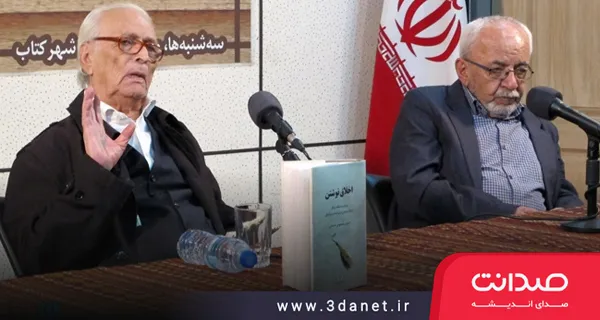

A Review Session of Hossein Masoumi Hamedani's Book 'The Ethics of Writing'
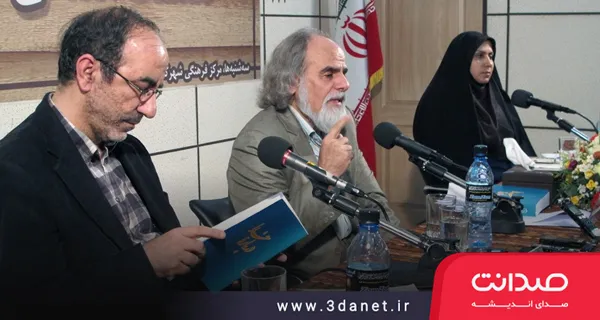
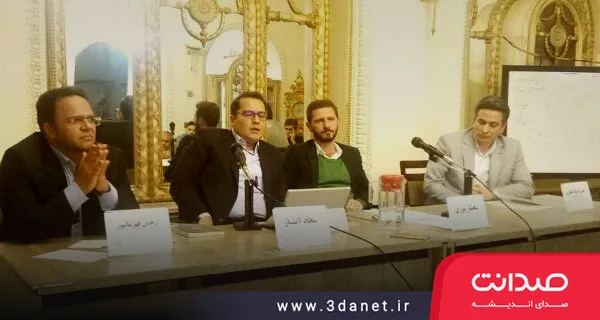
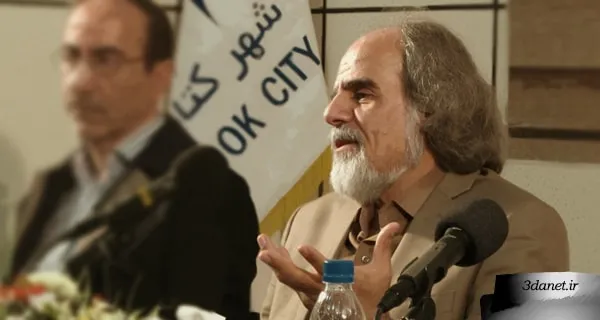
Ghazaleh Sadr Manouchehri (Ham-Mihan reporter): The book 'The Ethics of Writing', by Hossein Masoumi Hamedani, has recently been released to the market by Farhang-e Moaser Publications. By bringing together 16 articles—both translations and original works—centered on the essay 'The Ethics of Writing' by Gaetano Salvemini, the Italian historian and politician (1873–1975), Masoumi Hamedani has provided a platform for contemplating the fundamental issues of writing, translation, and editing. In an era of the expansion and dominance of virtual space and the keyboard over traditional spaces and the pen, this is a most valuable contribution for the Persian language and its thinkers. The weekly session of the Shahr-e Ketab Cultural Center on Tuesday, the 11th of Bahman, was dedicated to a review of the book 'The Ethics of Writing', and was held with the presence of Hossein Masoumi Hamedani, professor of the history of science and member of the Academy of Persian Language and Literature; Zia Movahed, professor of philosophy and logic; Ali Solhjou, editor and writer; Hooman Panahandeh, translator and editor; and Omid Tabibzadeh, linguist and translator.
.
.
Video of Zia Movahed's speech at this session: YouTube | Aparat
Video of Ali Solhjou's speech at this session: YouTube | Aparat
Video of Hooman Panahandeh's speech at this session: YouTube | Aparat
Video of Omid Tabibzadeh's speech at this session: YouTube | Aparat
Video of Hossein Masoumi Hamedani's speech at this session: YouTube | Aparat
.
.
The Problem of the Persian Language Today is Intellectual and Social
Ali-Asghar Mohammadkhani, Cultural Deputy of Shahr-e Ketab: Masoumi Hamedani is one of the luminaries and rarities of our time. The depth and breadth of his knowledge and research in the fields of the history of science, philosophy, and literature are renowned among people of culture, and everyone is familiar with his meticulousness, sharp insight, precision of thought, and correct writing. Over the past five decades, he has published numerous articles on writing, translation, editing, the history of science, book criticism, classical and contemporary literature, and other fields. Beyond these articles and books, and perhaps more so than these works, many of the works of students and other people of culture and the pen—whether writers or translators—have been edited under his supervision or published with his linguistic and scholarly editing, benefiting from his kindness. The book 'The Ethics of Writing' includes 16 articles on writing, translation, and editing, many of which have been previously published in journals. In the book's introduction, Masoumi briefly refers to the decline of book writing and the prevalence of article writing, considering himself more an article writer than a book writer, although he prefers reading books to reading articles. Regarding writing, in the article 'Reading and Writing,' he says these recurring forms reflect the view of not only our society but any society that has not yet entered the stage of written culture and whose dominant culture is oral, towards writing. This view can be broken down into three components. Writing, unlike speaking, is not a universal ability but a special gift bestowed upon certain individuals. Writing, unlike speaking, is specific to certain situations, and writing, unlike speaking, is only accepted in certain forms of expression. Therefore, Masoumi believes that in our schools, no place has been designated for writing, or if it has, it is not taken very seriously. Of course, the problem of the Persian language today is an intellectual and social problem, and since it does not have a single cause, we cannot find a single solution for it.
A Mathematician's Translation Studies
Ali Solhjou: In his essay “What Is Culture?”, Salouhmini says that in order to organize our writings, we have the right not to know certain things; the necessity of not knowing in order to know what is necessary. Let me say right here how good it is that Masoumi uses the word “thing” freely. I have had a great deal of trouble with the fact that many people have become fiercely “anti-thing.” The essay “Reading and Writing,” in seeking the reason for most of our students’ inability to write, arrives at this substantive proposition: that Persian class is a class in which they teach things that are never of any use, and composition class is a class that demands something of the student that they have never been taught. The author has not overlooked the social and economic factors of the issue either. In “The Ethics of Writing,” Masoumi Hamedani says that the prevailing view among linguists is that language is a system that has within itself a reparative mechanism that can withstand any damage and neutralize any blow, because it is a means of communication, and this very fact prevents it from being damaged to the point of losing its communicative role. He then compares this mechanism to its counterpart in nature and says that until just a few decades ago, humans thought that no matter what calamity befell nature, it would not suffer serious harm, because nature also possesses the same self-repairing mechanism as language. But we saw that this was not the case, and we have brought a calamity upon nature that is apparently irreparable. Masoumi says that this irreparability is, in fact, a revenge that nature is taking on us. Keeping in mind language’s capacity for truth-telling and, to the same extent, for lying, the author warns in a philosophical manner that we should treat language well and not twist it to the point that a time comes when it, too, twists us; when it takes away our common tongue and mutual understanding.
In his article “Linguistic Corruption,” Masoumi explains that when we refuse to use language to express reality, we fall into bombast and grandiloquence that gradually corrupt the language. Ordinary people speak very well, but when television reporters corner them somewhere and ask, for instance, their opinion about the city’s sidewalks, they are suddenly influenced by seemingly authoritative grandiloquence and think they must speak ponderously, talking in a way that neither they nor anyone else understands. Likewise, in “The Difficulty and Necessity of Authorship,” he has shown his ability to find suitable solutions in protracted disputes. In the debate between proponents of authorship and translation, instead of pitting the two against each other and mounting a futile defense of one side, the writer places them in a constructive and creative relationship and demonstrates how this approach leads to an elevation in the quality of both. Also, in “In Defense of Cultural Journalism,” he takes the side of the underdog and strives, with reasoned argument, to show the incorrectness of prejudiced views against journalism, especially where he warns of the danger of academic writings entering the field of journalism—whose task is something else entirely. In any case, defending positions that have fewer advocates is one of Masoumi’s characteristics. Regarding the articles in The Ethics of Writing in the field of translation, it must also be said: in “Word Selection and the Independence of the Persian Language,” by describing the inclination and proficiency of Iranian scholars in writing in Arabic and the possibility that Arabic might thereby become the language of science in Iran, Masoumi very effectively illustrates the factors that averted this danger and brought the Persian language to life as a language of science, giving due weight to the role of poetry and the poet. In this article, it is as if we are traveling with the writer, and while traversing the ups and downs of the Persian language, sightseeing, we arrive in the blink of an eye from the first century AH to the fourteenth century and the founding of the Academy, and a general picture of this path remains in our minds. In “Translating Scientific Texts into Persian,” by reviewing the current that shaped the development of translation in Europe and pointing out the similarities that are among the requisites of this path, he addresses the inadequacies of translating scientific texts and their cause, concluding that without writing in a scientific language, one cannot produce a good translation of science. Furthermore, in “A Few Points on Translating Philosophical Texts,” he raises the subject of the evolution of philosophical terms and the problem this change creates for their translation. Masoumi rightly writes that when, for example, the science of physics evolves, the works written in its wake can be easily read without paying attention to its past. But, he says, this is not the case in philosophy. In philosophy, one cannot be content with the final product; rather, the entire process must be studied, and it is precisely this change of the product throughout the process that becomes problematic in the translation of terms in a philosophical text.
The content of the editorial articles in this book can be summarized as follows: “The Persian Script and the Computer” is probably the first Persian writing to address the hardware issues of the Persian script. The gist of the matter regarding orthography is this: an illogical logic; only convention and its observance. In “The Maladies of Editing,” by identifying several maladies in editors (the fault-finding editor, the fault-concealing editor, the dictionary-afflicted editor, the know-nothing editor, the know-it-all editor, the word-obsessed editor, and the language-creating editor), Masoumi explains the fundamental blights of editing in a highly engaging language and demonstrates its dos and don’ts. “In the Margins” is also a comprehensive article on the types of footnotes in authorship and translation, with the advantage that, unlike many such writings, it does not merely say, for example, “Do not give unnecessary footnotes,” but shows what an unnecessary footnote is. Masoumi’s other article, “The Crushing Reply,” is a precise and artful psychological description of unhealthy and misunderstanding-ridden environments of critique-writing, instances of which are unfortunately not rare in our press. Barbara Ritt’s “The Referees’ Journey” is a comprehensive checklist for evaluating a work from various aspects. The questions are so precise and meticulous that no flawed writing passes through its filter. In “The Quarrel over Copyright,” by recounting a dispute between the cantankerous Salinger and a writer who used a letter from him in his own writing, and the story of Salinger taking the case to court, Masoumi shows that quoting from the works of others in other countries has its rules and accountability.
To Those Who Knew Everything About Something
Omid Tabibzadeh: In the introduction, Masoumi considers this book a collection of articles and distinguishes the status of a book from that of a collection of articles, but I believe this is a book. My impression of these articles in this collection differed from my initial impression of them. Salvemini’s article, which Masoumi translated and published in 1975, acts like a thread connecting these articles together. This article is not related to writing, but to culture and the ethics arising from culture, and that is precisely what links this article to this book: ethics in writing. I imagine Salvemini wrote this article in reaction to the elites and intellectuals who contributed to the formation of Fascism in Italy and Nazism in Germany, or the formation of a certain type of Communism. Elites who knew everything about one thing but, unfortunately, did not know one thing about everything. In other words, Salvemini’s article is about elite intellectuals who hold an ideological view. In a part of this article, there is a very interesting Latin phrase meaning, “A mathematician who knows nothing but mathematics is no more than a beast.” To avoid this way of looking at and acting in the world, there is no choice but to turn to intellectuals who know everything about one thing and know a little about everything, and have an understanding of their surroundings, rather than viewing the world solely within the limits of their own expertise. Unfortunately, this affliction has also befallen our academic society today. This perspective of Salvemini’s has remained constant throughout all the articles in this book. Collections of articles by people like Saeed Nafisi or Mojtaba Minovi do not have the status of a book because their viewpoints changed according to the exigencies of the times, but what has remained constant from the 27-year-old Masoumi, the translator of this article, to the present day, is precisely this issue of ethics arising from culture; that we have no right to specialize in one field and, with a narrow view limited to that angle, entrap society and ourselves in calamities. In my opinion, the status and importance of this book is like Najafi’s “Don’t Write Incorrectly,” because these articles (as Dr. Haqshenas puts it) make us language-aware; that is, they suddenly make society aware of a phenomenon called “language,” which had previously seemed self-evident to us. Of course, the level of “The Ethics of Writing” is far higher than “Don’t Write Incorrectly.” If “Don’t Write Incorrectly” offers us recommendations useful for any editor, this book is somewhat more serious and is for any writer who deals with more specialized subjects, and in addition to occasional writing advice, it also points out ethical recommendations. In my view, this book is valuable in two respects: first, it has a very fluent and coherent prose that presents the most difficult material to the reader in the simplest possible way. This seems obvious, but when we try to write like this, we realize that writing this way is by no means an easy task. Even reading this prose (without being too concerned with its content) influences our own prose and way of thinking, because writing is, in fact, a form of thinking; second, this book offers us two virtues: one is technical editing advice, and the other is the ethics of writing. A few years ago, I wrote an article in the field of phonology and submitted it to a linguistics journal. The reviewer approved the article, but noted in a letter that the article had been simplified to such an extent that it was not befitting a scientific-research journal. Therefore, I was forced to submit to this unethical act and rewrite the article in a difficult style, because in this society, articles and books are written that no one but the author themselves understands, and there must always be someone accompanying the book to teach it. This is, in fact, the epitome of being unethical, although even more unethical than that, charlatanism is also abundant; meaning the author themselves does not understand what they are writing.
One of the most important articles in this collection for me is the article “Word Selection and the Independence of the Persian Language.” This article begins with a common and accepted phrase among Iranian linguists regarding the language of science: “One of the fortunes of us Iranians is that our national language and our scientific language are one and the same.” This point seems simple, but in practice it has not gone beyond a slogan, and Masoumi’s article is the only one that has raised questions about this and answered them with reasoning. If we look around us, there are societies where their national and scientific languages are not the same, and they encounter many problems. I will briefly add a point to this discussion. Some of our elites believe that if we write our scientific texts in English, it will be more beneficial for science. Firstly, the issue of scientific language in the exact sciences, especially physics, chemistry, and mathematics, has levels. In some societies, the linguistic level for scientific expression is zero; some reach the sixth grade of elementary school, and some up to a high school diploma. No precise research has been done regarding Persian, but I imagine that the language of science in Persian can cover up to a certain extent of the undergraduate level. But this does not mean that in any society the language of science can express everything to the utmost. Even languages like German and French, which are very advanced in expressing scientific matters, when it comes to extremely specialized topics, prefer to write in English, firstly because their language is not ready to express such matters. Secondly, because if that specialized material were written in German or French, only four or five people might be able to read it, whereas in English it would have a larger audience. Therefore, in my opinion, the language of science can be international and there is no problem with that, and in any case, we are happy that we have reached this level and hope this level rises even higher. In addition, there has always been a language as the international language among scholars; at one point Latin, at another Arabic, at another Sanskrit, and today it is English. However, regarding the humanities and social sciences, the issue is different. Would it have been better to write these sciences in Persian, or would it have been better to write them in English? Here we realize the importance of this issue: if social sciences were to be written in English, they would not solve the problems of our society. Our fortune is that journals have not welcomed our English articles, because that would have solved our problems. Instead, these journals recommend that we send them a text refuting or confirming a theory, or provide them with new information that they can use in their theoretical studies. The importance of the language of science goes back to this very matter, and I also confirm Masoumi’s statement.
The Illusion of Communication
Hooman Panahandeh: These articles are written in a standard language and the standard register of essay writing—very expressive, clear, and in a sense, simple. But this simplicity is deceptive. Precisely for this reason, someone needs to be there to say: pay attention to this simple sentence. Behind this fluency, smoothness, and simplicity lies a world of experience, practice, taste, talent, and intelligence. This was an aspect of the book that was constantly on my mind while reading. In any case, in a situation where we are dealing with unpleasant forms in prose and weak content, the existence of such a book is a boon. Bernard Shaw believed in a form of socialism and, at the same time, was an advocate of aristocracy in the realm of thought. We must be strict about writing and the selection of writings. In this era, we are dealing with a virtual space in which many constraints have been broken, and its negative aspect is that writings are seen and published that, in the age of newspapers, would have had to pass through several filters to be printed, and might ultimately not have been published at all. In such a situation, reading a book that is about writing and the ethics of writing, and is itself an exemplar of the virtues it expects the reader to adopt, is essential. Masoumi Hamedani writes somewhere about the illusion of speaking to the whole of society, which I think is a commentary on our current state and brings to mind the writings that people produce these days on various platforms, imagining they are writing for the whole of society. It appears that words and sentences are produced in abundance. Their primary function, as linguists say, is communication, so we fall under the illusion that we are communicating. But apparently, we are not communicating, because we are saying something that only our own sect understands and cheers for, and which it did not need to read at all, since it already believed in it. Such a text is written in an absolutist language with which people outside this sect cannot connect, and if they do not develop an aversion to it, they will derive no benefit from it either. An aspect of the ethics of writing is precisely this: do not think you are writing only for your own group of followers; you are also writing for those outside this circle.
A Definition That Fits Masoumi's Stature
Zia Movahed: This volume is the tip of an iceberg of culture whose dimensions have not yet been observed, and it will only be seen in its entirety when all its aspects are displayed, provided that Dr. Masoumi does not exercise restraint in this endeavor. One of Masoumi's traits is putting his own works on hold for the sake of facilitating the work of others; he even throws obstacles in the way of his own work. For example, I do not know whether he will ever translate his dissertation—an innovative work, at the highest level of research on Ibn al-Haytham's optics—from French into Persian. Eyewitnesses to his defense session in France have spoken of the admiration of the scholars present at the session, yet he remains silent: not a single report of that session, what a pity. When Roshdi Rashed, one of the leading figures in the philosophy and history of science, was asked to introduce someone to write his scientific biography, from among all those colleagues, he introduced Dr. Masoumi, the result of which is a book of over 200 pages in French.
At any rate, this collection is a selection of articles by Dr. Masoumi on the Persian language and its various applications, from reading to writing, translation, and editing. Relying on a notebook I myself have written on essay-writing and its importance, conditions, and aspects, entitled “Of Course, It Is Clear and Evident,” I can say that these essays rank among the finest in Persian, and I would certainly extend this judgment to his French and English essays as well. In this brief opportunity, instead of dwelling on the song, I will speak of the singer. I have a great deal to say about each of these essays and their novel points, which I will address in detail in another piece. Among the important aspects of Masoumi’s work are the theses written under his supervision. I was unable to convince the successive heads of the “Iranian Institute of Philosophy” to publish these theses—which are often works of excellent scholarship—instead of the trivial and insignificant books they do publish. Included in this collection is a translation of an article by Salvemini titled “What Is Culture,” which concerns the definition of a cultured person. In Salvemini’s view, a cultured person is someone who knows everything in their field of specialization and something about everything else. This definition fits Masoumi perfectly. Masoumi knows everything in the history of Islamic science, but what is remarkable is that he sometimes knows a great deal about everything as well. For instance, he has written some of the best pieces on the poetry of Sohrab Sepehri—who is not my favorite poet—and he enumerates and knows such points that I doubt Sepehri ever dreamed of them. Masoumi is someone who always considers himself indebted to culture. He writes in the introduction: “I make no effort to establish a connection among the articles in this book,” and five lines later writes: “What justifies the publication of these writings in a single book is the relevance of their subjects to one another.” If this is not a connection, what is it? Setting this point aside, he keeps the discussion at a conceptual and abstract level. For example, where he gives the example of “speech and discourse,” he does not clarify what the difference between these two terms is. This, of course, is due to Masoumi’s philosophical mind, which engages more with concepts than with instances. In our culture, certain individuals have been honored with the title of ‘Allameh’ (polymath), such as Allameh Qazvini, Allameh Dehkhoda, Allameh Minovi, and a few others. I have measured each of these great figures against Dr. Masoumi and have concluded that the time has come to honor Hossein Masoumi Hamedani with this title.
Writing in the Human Tongue
Hossein Masoumi Hamedani: In the “booming market” of book publishing, the question of the author’s/translator’s/writer’s motivation for publishing a book has lost its importance, and the abundance of titles is a blessing that exempts us authors, translators, and compilers from answering why we publish a book. Especially since I might be faced with the question that these articles were written over many years and perhaps some of them have passed their expiration date, so why should I have collected and published them together. Also, I might be asked, when many of these articles are available on humanities databases, what is the point or benefit of collecting and publishing them in book form in this economic climate. The truth is that I myself was not free from this concern. The reason for this is that the articles gathered in this book are not all the articles I have written in the selected fields of this book. It seemed to me that some of these articles of mine have historical value, and therefore I left them out of the table of contents and do not intend to publish them separately in book form. Regarding writing, editing, and the art of translation, many books have been published in Iran, and perhaps my only motivation and justification for bringing these articles together is that I have looked at some of these issues in a different way, not that I am something special. Also, due to my own amphibious existence, that is, because I have one foot in the humanities and one foot in the natural sciences (at least the history of natural sciences) and am not uninterested in philosophy, I may have raised issues that have not been much addressed. It seems, as quoted from the introduction, that a “change of situation” justifies the publication of this book. Now that, thanks to the virtual space, we are moving toward a situation where everyone writes in a corner of the virtual space, their language is determined by their readers or audience, and their type of outlook is dictated to them in accordance with the requirements of their own corner, we are heading toward a fragmentation, one of whose manifestations is the prevalence of colloquial language in writing, which perhaps did not exist at one time or was limited to satirical publications or novels. In such circumstances, the implicit points of these articles possibly give those who do such work greater awareness of the metalinguistic consequences of their chosen paths. Some of the articles in this collection were written under different technological conditions; for example, some of the information in the article on the Persian script and the computer is probably not up to date, and the basis from which I started may have changed today, but the issue still remains as pressing as ever.
Another benefit I had in mind in publishing these articles was that, with the proliferation of academic research articles, writing in plain human language is becoming something obsolete in obsolete fields, and my effort has been to write in plain human language, understandable to all people. I could have written these same subjects with more pomp and circumstance, numerous citations, and recourse to outlandish theories, but the intellectual and public climate these days, especially the academic climate, has created something in me that makes me want to distance myself as much as possible from that mode of writing. Although the demands of my work sometimes force me to write specialized articles, I am at ease knowing I do not need to write for everyone. For instance, the article 'In Defense of Cultural Journalism,' which is more critique than defense, is the result of my concern about the fate of serious magazines in Iran that are neither classified as academic-research, nor are they academic, and day by day they drift further from being magazines, turning into textbooks, their audience becomes limited, and in general, the principle or the language upon which any kind of journalism is founded weakens in them, and the necessary training for journalism, whether general or cultural, is almost disappearing. Such concerns were among the reasons for publishing this book. Regarding the avoidance of providing examples, I must say there are two reasons for this. One is that I am not one for taking notes and making records, and now, in the final years of my life, I see how bad this habit is. When I was young, I had a good memory and many things would stay in my mind, especially, as Dr. Movahed says, the things that shouldn't have stayed in my mind. But now I think, I should have cultivated this habit in myself from the beginning. I am one of the most senior and oldest editors, and I have grappled with all kinds of texts and seen all sorts of flaws and merits in them. At the very least, I could have noted these down. Apart from this, I am truly always afraid that giving an example will become a prelude to a quarrel. For instance, if I were to say that by setting 'gofteman' against 'discourse,' nothing has happened in the realm of creation, I would get into a conflict with my own close friends. But in the article 'A Few Points on Translating Philosophical Texts,' I truly believe that the most insignificant issue in the world of science and philosophy is 'terminology.' Because a term, in and of itself, is nothing but a shorthand. What is important is what lies behind that term.
I always think that every authentic piece of writing has a kind of autobiographical aspect and contains something of the author themselves. Perhaps some of these objections that friends have raised about my work partly reflect back on me, that I am inattentive to some matters and pay more attention to others.

Discussion0 comments
No comments yet; let yours be the first voice.