Philosophy
Mostafa Malekian's Lecture at the Critical Review Session of the Book Guide to Critical Thinking
Mostafa Malekian considers critical thinking essential for scientific, technical, and artistic disciplines and counts it among the types of thinking. It comes into play when the audience disputes the premises or steps of an argument.
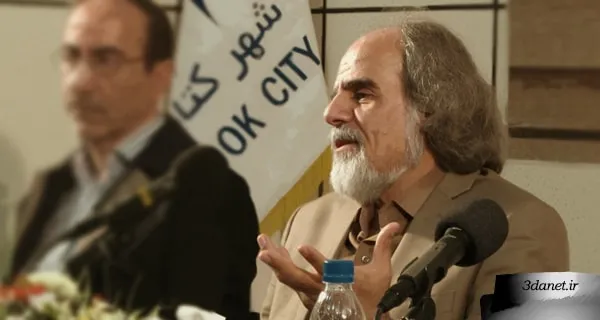
Mostafa Malekian: In discussing critical thinking, it is first better to know to which of the epistemological domains in the humanities critical thinking, or critical thought, or evaluative thinking relates. What we refer to as a discipline deals with all fields, which are divided into three broad categories: "scientific," "technical," and "artistic." In some of these disciplines, the primary task is to know the universe in the broadest sense of the word and to understand what happens within it. In others, however, such a goal is not pursued, and the aim is to bring about change in the universe.
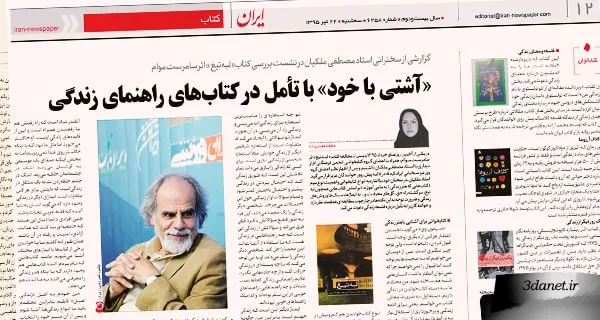
The present text, which was published in today's issue of Iran newspaper (Monday, October 28, 2013), has been edited and written based on Mostafa Malekian's lecture at the critical review session of the book "Guide to Critical Thinking" .
In discussing critical thinking, it is first better to know to which of the epistemological domains in the humanities critical thinking, or critical thought, or evaluative thinking relates. What we refer to as a discipline deals with all fields, which are divided into three broad categories: "scientific," "technical," and "artistic." In some of these disciplines, the primary task is to know the universe in the broadest sense of the word and to understand what happens within it. In others, however, such a goal is not pursued, and the aim is to bring about change in the universe. In scientific disciplines, we know the universe merely for the sake of knowing it, but in technical and artistic disciplines, we know the universe in order to find the way to change it. On the other hand, the goal of changing the universe differs between technical and artistic disciplines; meaning that in technical disciplines, we want to change the universe to create tools that help us achieve our goals; and in artistic disciplines, we want to add to the beauty of the universe, or, to put it pessimistically, to diminish its ugliness. Ultimately, however, both technical and artistic disciplines change the universe. "Changing" is a concept that shares the same referent as the concept of "action"; changing means taking action, and taking action means changing. It is impossible for an action not to be transformative, and it is impossible for a transformation not to occur through action. Therefore, technical and artistic sciences are, in fact, sciences whose ultimate end is "action." But theoretical sciences, which were the first category, are sciences whose ultimate end is not action but rather "contemplation."
A Useful Tool in Solving Problems or Resolving Difficulties By a hypothetical convention, every question in scientific disciplines is a "problem" that requires a "solution," and every question in technical and artistic disciplines is a "difficulty" that has a "way of resolution"; therefore, in the totality of human disciplines, we are either seeking to solve problems or to resolve difficulties. The first point to be made about "critical thinking" is that it is useful in both domains, that is, in scientific disciplines as well as in technical and artistic disciplines. In other words, it can be said that critical thinking is a tool that, whether I am a scientist or a critic of science, a technician or a critic of technique, an artist or a critic of art, in all three cases this tool is not only useful to me but essential; to the extent that without it, I will be neither a great scientist, nor a great technician, nor a great artist!
Types of Thinking The second point is that, given the very short history of critical thinking literature in our country, it is sometimes observed that some speak as if, in their view, thinking or the attribute "critical" is an evaluative attribute for thinking; as if to say that critical thinking means good thinking and if a thought is not critical, it is not good thinking! It has even been seen in the texts of some of our writers that they say of someone who possesses critical thinking that they think well and are a master of the art of thinking! Under these circumstances, it is natural that if someone lacks critical thinking, they are considered to possess weak and poor thinking, and such an interpretation is entirely incorrect. Thinking has various types, and one of its types is "critical thinking." In fact, we can have six types of thinking, one of which, or with an interpretation we will explain, at most two of which are critical thinking. Investigative Thinking The first type of thinking that humans possess is investigative thinking; investigative thinking is the thinking employed in the domain of inquiry, and inquiry is correctly applied only where we do not know the solution to a problem or the way to resolve a difficulty at all; and our inquiry begins with sheer not-knowing.
Investigative thinking finds meaning regarding the thinking of someone who has begun the process of inquiry, and this interpretation differs from someone who is aware that they do not know the solution to a problem or the way to resolve a difficulty and has set out to find it.
Argumentative Thinking The second type of thinking is argumentative thinking, in which we know the solution to the problem and the resolution of the difficulty, but our audience does not accept it! Under these conditions, we demonstrate to the audience through reasoning that the solution to the problem or the way to resolve the difficulty is precisely what we say. In other words, argumentation is for showing that our answer to the question posed is correct.
Critical Thinking The third type of thinking is critical thinking or critical or evaluative thinking (critical thinking), in which we go one step further. In this type of thinking, a way to resolve the problem or a solution to the difficulty has been presented, and we have also demonstrated through reasoning that this way is definitely the answer to the question, but our audience raises a dispute in the reasoning, or in one of the premises of the reasoning, or in one of the steps of the reasoning, or in one of its presuppositions; in this situation, the disputant (audience) criticizes us and, in the position of critique, employs their critical thinking. In this critical thinking, we must observe a series of methodological dos and don'ts.
Defensive Thinking The exact opposite of critical thinking is defensive thinking. When the audience criticizes our thinking, we too must defend and say that the step about which you had doubts, your doubt can be resolved; the premise in which you were disputing, your dispute can be answered; the presupposition that you did not accept, I will now make you accept. Consequently, we defend our opinion and have a thinking that has a defensive aspect.
Negotiative Thinking The fifth type of thinking is a type that only has meaning in the practical sciences; that is, in technical or artistic disciplines, and especially technical ones; and that is negotiative thinking, how we can negotiate with one another. In the theoretical sciences, "negotiating" in the sense of "giving ground" has no meaning. In other words, negotiation is for a time when I have the answer to the question, and you also have the answer to the question, but your answer to the question does not convince me, and my answer to the question does not convince you either; so neither of us can drive the other from the field; yet, in any case, in the realm of practice, something must be done; consequently, we consider the middle ground and say, for example, that to some extent I will relinquish my claims, and to some extent you will too, and with this method, a step forward is taken. This is a method that finds much application in the world of politics, education, and so on. In the style of negotiation, it is determined what type of thinking pertains to negotiation, how we should exercise prudence and compromise with our rivals.
Creative Thinking Creative or inventive thinking is the sixth type of thinking, in which we seem to imitate God and invent something through our thought. The difference between inventive thinking and the five previous types of thinking is that there is no doubt that those five types have known and researched methods; but can methods also be proposed for creative thinking such that if we adhere to them and follow them step by step, we become creative? Here, there is no room for ambiguity! It has mostly been said that creative thinking is not a conscious kind of thinking in which one can tell researchers, students, and people that if you follow these steps, your mind will become creative and you will be able to innovate. Although some in the psychology of invention and creativity today have said that we can gradually propose methods that, if not sufficient conditions, are at least necessary conditions for our minds to become creative minds.
Critique More Important Than Defense
In this context, we saw that critical thinking was the third type of thinking; but today, some, in addition to critical thinking, also call the fourth type of thinking, which was defensive, critical thinking. It was said earlier that we have six types of thinking, of which critical thinking is one, or possibly encompasses two of these six types. Therefore, in critical thinking, we have one type of thinking, not two, good and bad; critical thinking only clarifies the type of thinking, which, like other types of thinking, has its weak and strong forms. Whenever we critique someone or defend our own view, we must observe the methods recommended by experts in critical thinking. Now, in this part, of course, critique is more important than defense. Especially if we pay attention to those who have spoken of critical thinking, we see that they have always said that the first principle of critical thinking is that you must first critique your own thoughts using the method of critical thinking, and then the thoughts of others. If we consider that I must constantly become the executioner of my own thought and want to look at myself through a magnifying glass and see the weak points of my own thoughts, we see that a critique is far more important than a defense, and perhaps this is why some have merged defense and critique and called it critical thinking; because it holds greater importance.
The Origin of Critical Thinking
Another point is that the origin of critical thinking is a moral imperative, but its locus is specific. That is, what conceives the necessity of critical thinking is a moral imperative; and it relates to a branch of ethics we call the "ethics of belief." In the ethics of belief, we are told that you must proportion the degree of your attachment and commitment to a belief to the strength of the reasons and evidence that support that belief. The more and stronger the evidence supporting a belief, the greater your attachment and commitment to that belief should become; and the weaker the evidence in favor of a proposition, the weaker your attachment and commitment to that belief should become; and this is the principle of the ethics of belief. Now we must see whether the available evidence testifies with certainty to the truth and correctness of a belief or not? Does it really confirm this proposition or not? And it is here that we turn to critical thinking; therefore, having critical thinking, in addition to advancing us in knowledge, also guides us in fulfilling our moral duty. We must observe this point of the ethics of belief, which is not concerned with the belief itself; it is concerned with how much evidence exists or does not exist in favor of this belief, and asks us to proportion our degree of attachment and commitment to it. Since we want to behave ethically in the realm of thought, culture, science, etc., we need to be skilled in the practice of critical thinking and, moreover, to apply this skill in practice; not just memorize its rules but never put them into action. Consequently, from the "ethics of belief," our need to know and apply critical thinking arises.
The Place of Critical Thinking Among the Sciences
But what kind of science is critical thinking, and where does it stand among the sciences? It is here that, from one perspective, one can say that critical thinking is the intersection of “informal logic” and “epistemology”; the point where these two meet, intersect, or, so to speak, overlap. In other words, every topic in critical thinking books is, from one aspect, an epistemological topic, and from another aspect, a topic related to material (informal) logic. Therefore, we can say that critical thinking is a sub-branch of informal logic and epistemology. From another perspective, however, one can say that critical thinking is in fact a branch of methodology, which itself is a branch of epistemology.
Presuppositions of Critical Thinking
Another point is that critical thinking, and anyone who turns to this type of thinking, has a series of presuppositions; if even one of these presuppositions is absent, there is no necessity for you to turn to critical thinking.
The first presupposition is that, generally, the opinions presented to each of us throughout our lives, and which we are asked to believe, are neither self-evidently true nor self-evidently false; therefore, inquiry is necessary to understand their truth or falsity, and if this presupposition did not exist, there would be no necessity for us to engage in critical thinking. The second presupposition includes the point that we can discern the truth or falsity of many of the propositions presented to our minds and which we are expected to accept. For this discernment makes a fundamental difference in our lives, and we cannot be indifferent to whether they are true or false. The third presupposition is that I, as an individual, cannot trust the mere fact that the speaker of an opinion declares it to be true or false. Since the connection between a statement and the personality and character traits of the utterer is severed, I have no way to understand truth and falsity through that, and I cannot resort to the utterers of the statement; whether the utterers of this statement are all the people on the planet or just one person.
The fourth presupposition posits that, despite all these interpretations, I, like every human being, possess, in brief, the power to discern truth and falsity; for otherwise, it would be said that not only can we not understand who the speaker of truth or falsehood was, but we ourselves also lack the power to discern truth and falsity. Therefore, critical thinking takes root when I believe that I too can, more or less, investigate the truth of the speaker's words and demonstrate the truth or falsity of their speech. And the final assumption is that I engage in critical thinking when I myself feel that I now need to know the truth or falsity of the issue you have presented. (They say that in Sagsin/ a person has two bows/ of those two, one is lost/ what loss is it to us?) This is an assumption we refer to under the rubric of the wisdom of “What is that to me?” We must be careful not to mistake pseudo-problems for problems and not to pursue realities that are of no relevance to us. Every day we are exposed to a bombardment of information, and if we do not want to be buried under the rubble of this information, we have no choice but to prune the jungle of ideas. For if we cannot plant and cultivate sound thought in this jungle, we must at least be able to cut down false ideas. On every point, there are at least 150 opinions, and we do not know which of these opinions is true and which is false, or more false. Our spirit dies under all this rubble of information in which we cannot find our way forward or backward. Critical thinking at least comes and prunes the jungle of ideas presented to us that drags our mind into a kind of bewilderment.
.
.
Audio of Mostafa Malekian's Lecture at the Critical Review Session of the Book Guide to Critical Thinking
Part One/ Part Two / Part Three / Part Four
(For ease of reception, the file has been divided into several parts)
.
.
Specifications of the book Guide to Critical Thinking:
Authors: M. Neil Browne - Stuart M. Keeley
Translator: Kourosh Kamyab
Publisher: Minouye Kherad
Book Language: Persian
Number of Pages: 308
Book Size: Octavo, Hardcover - Year of Publication: 2013 - Edition: 1st
.
.
Mostafa Malekian's Lecture at the Critical Review Session of the Book "Guide to Critical Thinking"
Venue: Shahr-e Ketab | 2013/10/22
.
.


Discussion0 comments
No comments yet; let yours be the first voice.