Why this book?
- To understand the "Narrow Corridor" theory and the institutional conditions for the emergence and endurance of liberty.
- To grasp the relationship between a strong state, a strong society, and their mutual checks.
- To compare the historical experiences of different societies in confronting despotism and statelessness.
- To better understand the link between political institutions, liberty, democracy, and development.
- To become acquainted with the continuation of the intellectual project of the authors of "Why Nations Fail."
About the book
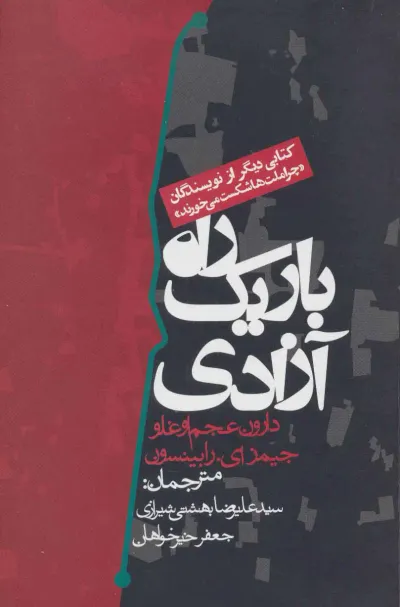
"The Narrow Corridor" by Daron Acemoglu and James A. Robinson addresses one of the most fundamental questions in political thought: under what conditions does liberty arise, and how can it endure? The authors' answer is that liberty typically emerges in a narrow space between two dangers: on one side, state despotism, and on the other, the weakness or absence of a state capable of providing security, law, and public order.
The book's central concept is the "Narrow Corridor," the corridor within which liberty becomes possible. For Acemoglu and Robinson, the existence of a capable state alone does not bring liberty, just as a limited or weak state does not necessarily make people free. Liberty becomes sustainable only when, facing a state with capacity and authority, there is also an organized and capable society, and the state and society can check one another.
To explain this theory, the authors draw on a wide range of historical and contemporary examples. Stateless societies, despotic states, and the experiences of societies that have managed to establish a balance between state authority and social power are examined side by side. These comparisons show that liberty is not a condition achieved once and for all; preserving it requires the continuous dynamism of society and political institutions.