Why this book?
- To understand the role of interest groups in slowing economic growth and reforms.
- To become acquainted with one of the classic texts of political economy and public choice theory.
- To analyze the link between institutions, special interests, stagflation, and social decay.
- For readers who want to view Iran's development and economic issues through a more theoretical framework.
About the book
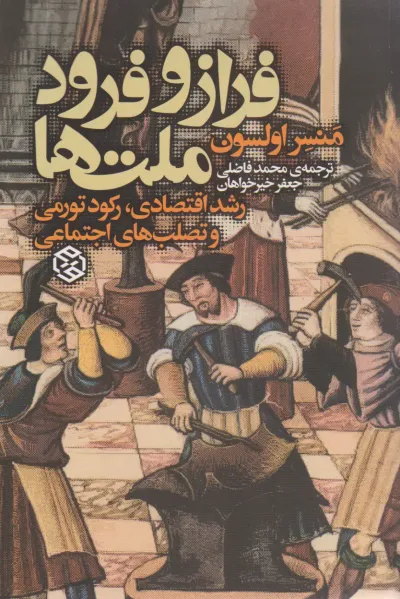
"The Rise and Decline of Nations" is a book at the intersection of economics, political science, and historical sociology. In this work, Mancur Olson seeks to explain why nations and economies do not always move along a path of linear and sustainable growth, and how stable societies may gradually become entangled in networks of special interests, rent-seeking, and resistance to change.
The central idea of the book is that, over time, small but cohesive and organized groups form that lobby for special privileges. These groups, unlike the dispersed majority of society, have a greater capacity for mobilization, bargaining, and influencing policies. The result of such a process can be reduced economic efficiency, slowed innovation, increased inequality, stagflation, and social sclerosis.
This book follows the trajectory of Olson's intellectual project, especially after "The Logic of Collective Action." If Olson had shown in that book that a common interest alone is not sufficient for collective action, in "The Rise and Decline of Nations" he extends this same logic to the level of the history of nations and the performance of national economies. By comparing experiences such as those of Germany, Japan, and Britain after World War II, he shows how the structure of interest groups and power institutions can transform the path of growth or decline of countries.
"The Rise and Decline of Nations" is a worthwhile read for students and researchers of political science, economics, sociology, and development studies. It also provides an analytical and inspiring framework for readers contemplating the issues of institutional reform, corruption, stagnation, public policy, and the future of Iran's economy and society.