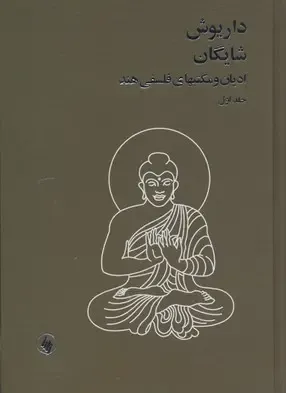
Why this book?
- For a comprehensive introduction to the history of Indian thought and philosophy.
- To understand Hindu, Buddhist, and Jain schools in their historical context.
- To grasp concepts such as Brahman, Yoga, Vedanta, and Indian philosophical traditions.
- To study one of Dariush Shayegan's important works on Eastern cultures.
About the book
"Religions and Philosophical Schools of India" is one of Dariush Shayegan's important works in the field of understanding Indian civilization and thought. In this work, Shayegan strives to present a historical and philosophical picture of India's great intellectual traditions and trace their evolution from ancient texts to more complex philosophical schools.
The first volume of the book is mostly dedicated to the early periods of Indian thought; from the Vedas and Upanishads to the emergence of Buddhism and Jainism, the epic period, the importance of the Bhagavad Gita, and the major Buddhist schools. The author shows how ancient India was one of the great centers of intellectual and spiritual creation in the world.
The second volume is more specialized and deals with the six major philosophical schools of Hinduism: Nyaya (logic), Vaisheshika (natural philosophy), Samkhya (cosmology), Yoga, Purva Mimamsa, and Vedanta. This section acquaints the reader with precise philosophical systems and the fundamental concepts of Indian thought.
This book is suitable for enthusiasts of comparative philosophy, the history of religions, Eastern mysticism, and Asian cultural studies, and holds an important place among Persian-language works on Indian philosophy.