Philosophy
Ethics Without Application: A Look at the Persian Translation of R. M. Hare's Essays on Philosophical Method
The Persian translation of R. M. Hare’s Applications of Moral Philosophy is riddled with errors and misunderstandings; this unsuccessful rendering—an unethical translation of a book about ethics—mirrors the current state of research and translation in our country.
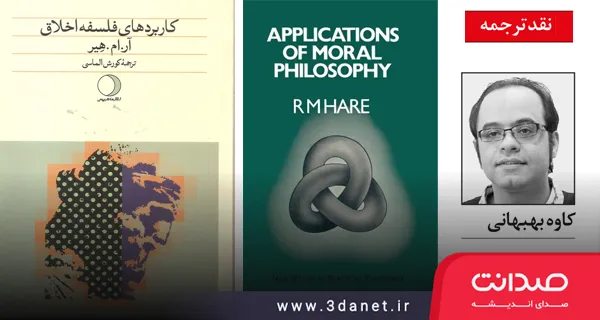
Ethics Without Application
A Look at the Persian Translation of R. M. Hare's Essays on Philosophical Method
(Etemad Newspaper, Issue 4908 - Wednesday, April 21, 2021)
The British philosopher Richard Mervyn Hare (1919–2002) is one of the most important contemporary moral philosophers, whose view in metaethics, known as "prescriptivism" (prescriptivism), is still widely debated. The book Applications of Moral Philosophy is a collection of nine essays by Hare written in the 1950s and 1960s and gathered in this volume, published by Macmillan in 1972. This book has been translated into Persian under the title Applications of Moral Philosophy.[1] The following piece will take a look at a portion of the errors, misreadings, and misunderstandings in the Persian translation of the book, and ultimately aims to demonstrate, based on textual evidence, that this translation has by no means been successful in rendering this work.
Given the theoretical nature of discussions in moral philosophy (especially in the areas of normative ethics and metaethics), a book that speaks of the applications of moral philosophy should, by all accounts, be an interesting book for its audience. This is why the Persian translation of this book has reached a second printing in a short time. But the lack of ethics in the translation of a book on the applications of moral philosophy is a mirror held up to the current state of research and translation in our land. A multitude of translations whose translators do not undertake the task as the conscience of the arduous work of translation demands, do not properly digest the subjects and content included in the book, lack adequate familiarity with the language, whether the target language or the source language, and are even unaware of the fundamental concepts of the discipline in which they are translating. Ironically, the translation of the book Applications of Moral Philosophy speaks of the non-application of ethics, in our current situation, within the sphere of research and translation. Of course, these days, the sheer volume of such translations is extremely worrying. Let us take a look together at a part of the translation of the book in question.
Hare's first essay (or "Hayer," according to the translator) in the book under discussion, titled "Can I Be Blamed for Obeying Orders?" (rendered by the translator in question as: "Can I be blamed for obeying orders?", which makes one wish an editor had at least removed all these extra "I"s from the text), discusses whether obeying a superior is always an ethical act or not. In this short essay, which leads one to Hannah Arendt's profound discussion in the famous book Eichmann in Jerusalem, and Eichmann's misunderstandings of Kantian ethics,[2] Hare, by scrutinizing the linguistic-logical aspects of the discussion, concludes that when an act is morally reprehensible, both the commander and the commanded are morally responsible, and in short, the commanded is not morally excused.
Let us take a look at the translation of this chapter. Early in the book, we read:
“None of the things I shall say will be original; indeed, it is part of the point of these talks that they are not original: I am merely translating into a new, and I think clearer, idiom things which have been said by great philosophers of the past, and thereby showing that the new idiom is a vehicle for philosophy as it has always been understood.” (p. 2)
The translator has rendered these lines as follows:
«None of the things I say are novel. In fact, one of the important points concerning the present discussion is that they are not novel. I am merely interpreting the idioms expressed by old philosophers in a clearer way, and also showing that new idioms, due to their ever-understandable nature, are an important tool for philosophy» (p. 12).
As is evident, the translator has not understood the phrase "it has always been understood" in rendering this passage. In fact, the pronoun "it," contrary to what the translator has assumed, does not refer to "new terms."
Suggested translation:
«None of the things I shall say is original; indeed, a point of the present discussion is that what I say is not original: I am merely translating the terms used by the great philosophers of the past into a new, and I think clearer, language, and thereby showing that these new terms are tools of philosophy, just as this has always been understood.»
Elsewhere in the first chapter of the book, we read:
“Can I without further consideration conclude that I ought to do it? Kant argued (rightly) that I cannot - not without further consideration. For it does not follow automatically, as it were, from the fact that God wills me to do something, that I ought to do it.” (p. 2)
The translator has rendered the above lines as follows:
«Now, can I, by considering the above argument, conclude that I am compelled to do that task and mission? Kant, rightly, argues that I cannot; for it does not follow from this truth that God wants me to do something and I am compelled to do it» (p. 13).
The context of this passage is that the author wishes to explain Kant's view. Kant believes that moral judgment is the responsibility of the individual, and no one can issue a moral ruling on behalf of another. Even if we believe that God has commanded that a certain act must be done, we still cannot blindly follow God's command without moral reflection and deliberation. This is the view known in Kantian literature as moral autonomy. However, the translator of the text has reproduced confused and muddled phrases in Persian from which no clear meaning can be derived. What "does not follow from this truth that God wants me to do something"? It is unclear. Why "I am compelled to do it"? Again, unclear. What is the "above argument," and why is it not in the original text?
Suggested translation of this passage:
«Can I without further consideration conclude that I ought to do it? Kant argued (rightly) that I cannot—not without further consideration. For it does not follow automatically, as it were, from the fact that God wills me to do something, that I ought to do it.»
Again, elsewhere in the book, we read:
“We might rather be inclined to approve of disobeying an evil God, as Shelley portrays Prometheus doing, however appalling the consequences.” (p. 3)
The translator's rendering of the above line:
«We may not follow an evil God, and as Shelley portrays the deeds of Prometheus, it has appalling consequences» (p. 14).
As is evident, the translator is not sufficiently familiar with the syntax of English and Persian and creates confused and meaningless phrases that result from a misunderstanding of the source language and unfamiliarity with the subject matter. What "has appalling consequences"? The deed of Prometheus, or Shelley's portrayal of his deeds, or our act of not following the "evil God"?
Suggested translation:
«We might rather be inclined to approve of disobeying an evil God, as Shelley portrays Prometheus doing [that is, disobeying an evil God], however appalling the consequences of this act may be.»
Further on, we read:
“...and at the same time that a reason should be given,for what seems altogether inconceivable, how this new relation can be a deduction from others, which are entirely different from it.” (p. 4)
The translator's rendering of the above line:
“When a reason or argument must be presented for an inconceivable case, they show how this new relation can be a deduction from other cases entirely different from it” (p. 15).
What on earth does this sentence mean? This discussion is part of a passage by David Hume, the important moral philosopher of the Enlightenment, who is talking about the deduction of “oughts” from “ises” and considers it “inconceivable.” The translator has once again produced sentences that are incorrect and irrelevant to the text. Of course, the translation of this section has another flaw, which relates to the rendering of the term deduction as “syllogism,” which I will address later.
Suggested translation:
“At the same time, a reason should be given for what seems altogether inconceivable, showing how this new relation is a deduction from others which are entirely different from it.”
The translator lacks sufficient precision even in rendering simple lines and shows no respect for the reader. Look at his translation of this line:
“This programme has an obvious and immediate appeal.” (p. 5)
The translator’s version:
“This program was immediately and obviously reconsidered” (p. 16).
Perhaps the translator has confused the noun appeal with the verb appraise. There is no mention of “reconsideration” in this line.
Suggested translation:
“This program has an obvious and immediate appeal.”
Another example of misunderstanding in the rendering of simple, elementary sentences:
“Can we be sure that he is the genuine article?” (p. 5)
The translator’s version:
“Can we be sure that the decree is pure?” (p. 17).
As is evident, the sentence’s pronoun (he) indicates that the reference is to a person. To whom? Someone discussed in the preceding lines: someone who is allegedly the king-philosopher Plato had in mind. So the sentence is not about “the decree.” There was no decree in question to be “pure” or have “impurities,” and what is a “pure decree” anyway? The point is whether the claim of someone who asserts they are a king-philosopher is genuine or not. Moreover, the phrase genuine article does not mean “pure decree,” but rather “someone or something considered a fitting instance of its category.”
Suggested translation:
“Can we be sure that he is a worthy specimen of a king-philosopher?”
Further on in the text, Hare, criticizing Plato’s “king-philosopher” theory, considers it a circular theory and writes:
“For this would be to argue in a circle.” (p. 5)
The translator has rendered this line as follows:
“The discussion and reasoning of this matter must be conducted in a cycle” (p. 17).
The translator, however, has failed to grasp that the author is not recommending that someone “must” conduct “discussion and reasoning” “in a cycle.” And what kind of activity is discussion and reasoning in a cycle that one must do? Philosophers have always warned people against circular arguments, and we have no evidence that Hare was suffering from a mental disorder when writing this work. His sentence is descriptive (not prescriptive) and is written as a critique of Plato’s theory.
The suggested translation, very simply and easily, is as follows:
“For this would be to argue in a circle.”
There is ample evidence that the author lacks the necessary command of English to translate this book; he omits lines as he pleases (in the very first paragraph of the first essay, he has arbitrarily ignored several lines), and whenever he encounters a word that requires a little investigation, he drops it and leaves the sentence truncated. Among the many examples are the omission of the word as such (p. 6 of the original text and p. 17 of the translation) and the omission of the word ex hypothesi (p. 5 of the original text and p. 17 of the translation). This lack of sensitivity to specialized terminology makes one suspect that the translator may not have sufficient familiarity to translate a text on moral philosophy of this caliber, and from this very first chapter, evidence can be found to support this unfamiliarity. The equivalents chosen by the translator sometimes indicate that he has not read other books in the field under discussion. I will point to a few examples in this chapter:
- The equivalent "بدیهی" (self-evident) for trivial. (p. 1 of the original text and p. 11 of the translation) As we know, this word in this context means "commonplace" or "insignificant," and the discussion of "self-evidence" is a separate issue in philosophy.
- The translator uses the equivalent "رسمی" (official/formal) for the word formal in discussions concerning logic, creating meaningless phrases. Whereas it is clear that this word means "صوری" (formal), and formal logic and the formality of logic are familiar even to beginners in this discipline. (Cf. p. 2 of the original text and pp. 12 and 13 of the translation) Alongside this unfamiliarity with logic, one must add the translation of premiss (مقدمه) as "توضیح" (explanation), which appears repeatedly in the text. (For example, cf. p. 3 of the original text and p. 13 of the translation). Furthermore, the translator has rendered the word deduction as "قیاس" (syllogism/analogy), and this is, of course, an error (for example, cf. p. 4 of the original text and p. 15 of the translation), but this problem becomes more pronounced when the translator also translates the word analogy as "قیاس." Of course, some have used "قیاس" for one of these two terms (which is also incorrect), but not for both. This scant lexical sensitivity and careless choice of equivalents are insufficient for translating a philosophical text. The best equivalent for deduction is "استنتاج" (deduction/inference) and for analogy is "تمثیل" (analogy), and "قیاس" should be reserved for syllogism.
- Most bizarre of all is the translation of philosopher-king in Plato's view as "حکیم-فیلسوف" (sage-philosopher). If this error had occurred once, one might think it was a slip, an inadvertent mistake. But repeatedly, every time this phrase appears in the text, its equivalent is recorded as "حکیم-فیلسوف" (for example, cf. pp. 16 and 17 of the Persian translation). One harbors a dark suspicion that the translator might not be familiar with Plato, his political philosophy, and the renowned concept of the "شاه-فیلسوف" (philosopher-king), nor know what "حکیم" (sage) means in philosophical literature.
Of course, the errors and carelessness in the translation of the first chapter are far more numerous than this; but let us turn to the second chapter to see if we can find a glimmer of hope for the translator. Unfortunately, this is not the case. Again, in the translation of this chapter, there are many errors and instances of carelessness, only some of which I will glance at. Before that, let me point out that in this chapter, titled "عقل دولت"[3] (rendered by the translator under discussion as "استدلالهای دولت" [arguments of the state], which is sometimes also translated in the text as "استدلالهای دولتی" [state arguments]), the author asks whether the sphere of ethics is entirely separate from the sphere of politics. Can one not make moral judgments about political actions? A long-standing debate that might perhaps be seen as a response to the staunch defender of realpolitik / real politics or power politics in the Renaissance, namely Machiavelli, who advised the Prince that the sphere of politics is not the arena of ethics, and the expediency of the realm takes precedence over virtue and morality. Hare, however, wants to show that the de-moralization of politics is neither desirable nor possible, and of course, moral decision-making in politics involves many complexities with which the seasoned politician must grapple.
Let us turn to the text! At one point in this chapter (p. 10 of the original text), Hare discusses how when someone makes a decision in their private life based on moral principles, the consequences of their decision often concern themselves; provided, of course, that their decision does not affect their dependents (such as a father, child, or spouse). He then asks the reader to compare this case with political decision-making and writes as follows:
“But the contrast with political decisions still has some force” (p. 10)
His point is that although moral decision-making in private life can affect one’s dependents, comparing it with political decisions is still somewhat illuminating. The translator has rendered this line as follows:
“The contrasting state for political decisions is still powerful” (p. 23).
One is left wondering, “the contrasting state” with what? Choosing the first equivalent that a dictionary or machine translator provides is not always correct.
Suggested translation:
“But the comparison [of moral decision-making in private life] with political decisions still has some force.”
This same tendency to choose ready-made equivalents causes the translator to sometimes err in rendering simple phrases. For example:
“if some condition is attached to any moral principle” (p. 12)
The translator’s version:
“if some conditions of moral principles exist”
The meaning of “some,” which the author has emphasized, is not “some” (as in a few) here. This can be understood from the singular form of the noun “condition.” Here, “some” is not a quantifying specifier but an article. And besides, what does “some conditions of moral principles” even mean? I do not know why the translator deems many of the text’s words unnecessary.
Suggested translation:
“if a condition is attached to any moral principle”
Or, for instance, the translator does not know the meaning of the phrase “to be the case” and does not bother to find out, translating it incorrectly several times; that is, as many times as this phrase appears in the text. Including p. 12 of the original text; p. 26 of the translation, and also p. 15 of the original text; p. 29 of the translation. In the first instance, he has rendered this phrase as “such conditions exist,” and in the second, far more strangely, as “for this task!”
The errors, confusions, and, of course, omissions in this book are far more numerous than can be enumerated, and listing them one by one would require great elaboration. Even selecting a sample from this mass of errors is difficult. Look at this example:
In one place, the author is discussing the conditioning of moral principles and how even universal moral principles are conditioned in a way. He says that even if we condition a moral principle with several conditional clauses, this principle can still be entirely universal and general, because that principle will be valid for everyone who fits those conditions. He goes on to say:
“for if principles are allowed to have as complicated conditions attached to them as you please, without ceasing to be 'absolutely general',...” (p. 18)
The translator has rendered the above line as follows:
“if the complex constraints of moral principles are as much as you want and are considered 'completely general' in an unceasing manner...” (p. 33).
But what does being “considered” “completely general” “in an unceasing manner” mean? The translator has misunderstood the phrase “without ceasing to be 'absolutely general'”; that is, he probably encountered the adjective “ceaseless” (meaning unceasing) in the dictionary and used that. The author’s meaning is that these moral principles do not lose their universality by adding conditions.
Suggested translation:
“for if principles are allowed to have conditions attached to them as complicated as you please, without ceasing to be 'absolutely general'...”
Continuing on, look again at this line:
“But what we feel inclined to say about it applies with even greater force to the more complex decisions of political life.” (p. 19)
The translator has rendered the above line as follows:
“But what inclines us to lie applies with even greater force to the complex decisions of political life” (p. 34).
As is evident, “to lie” does not exist in the original text. Of course, in the previous line the author gives the example of lying in politics, and this has led the translator to suppose that “to say about it” means “to lie.” He has, firstly, completely misunderstood the pronoun’s referent, and even if the referent were correct—which it is not—the translation would still be wrong. Because he should have translated it, for instance, as “to say about lying.” But the matter is that in the previous line, the author says that lying is more or less a reprehensible act in almost all cases, but in certain specific political circumstances it might be the right thing to do. The pronoun in question refers back to this very discussion by the author.
Suggested translation:
“But whatever we may be inclined to say about this discussion applies with even greater force to the complex decisions of political life.”
Further on, the author says that it may sometimes be necessary for a politician to lie or break a promise, but these cases are very rare, and he writes the following on this matter:
“that these cases are very rare indeed, and certainly far rarer than opportunist politicians deceive themselves into thinking.” (p. 20)
The translator has rendered this line as follows:
“Of course, these cases are very rare, and certainly far rarer than the opportunist politicians who have been deceived by reflection” (p. 35).
That is, these cases are rarer than the opportunist politicians themselves?! How strange! And what on earth is the meaning of being “deceived by reflection”? Does it mean a politician should not reflect? Or that reflection deceives the politician? The translator has not understood the phrase “deceive sb into thinking,” which means to trick someone into believing something.
Suggested translation:
“Cases of this kind are in fact very rare, and certainly far rarer than what opportunist politicians, who deceive themselves, imagine.”
In one place, Hare says that the experienced and seasoned politician has experiences of complex political situations in which he has made difficult decisions, and these very experiences provide him with principles that come to his aid in difficult times. But about those principles, he says that they are “complicated and tentative” and perhaps cannot be expressed through language. He writes:
“These principles will certainly be complicated and tentative ones - for one ought never to stop learning; and they will probably be impossible to do justice to by any formulation in language.” (p. 21).
The translator’s translation:
“These principles, certainly, for individuals who never stop learning, are complicated and experimental, and it will probably be impossible to judge them in any linguistic form” (p. 37).
In translating this line, the translator has committed several errors: one is that the equivalent for “tentative” is not “experimental,” especially in a precise philosophical text. This word here means a rule that will be revoked if necessary, that is, a kind of clue or, in technical terms, a heuristic. Another is that the word “for” in these lines does not mean the simplistic “for,” and also there is no discussion of “judgment” in the text. Furthermore, the translator is unfamiliar with the phrase “to do justice to sth” (to treat something fairly or adequately).
Suggested translation:
“These principles will undoubtedly be complicated and provisional—for one ought never to stop learning, and it will probably be impossible to formulate these principles in language in a way that does them justice.”
In this book, Hare repeatedly refers to the ethical views of Immanuel Kant. However, there is strong evidence that the translator is not at all familiar with Kant's philosophy. It may be hard to believe, but the translator has rendered a priori as





Discussion2 comments
ما که نفهمیدیم چی گفتی! ممنون از ناقد تیزبین و سایت خوب صدانت.
دست و پا زدن فلسفه غرب در رسوایی بنام فلسفه اخلاق! فلسفه تحلیلی نمی داند چطور بی معنایی و بی تعریفی طبیعت انگاری naturalism ستون فقرات خود را ماله کشی کند، چگونه ریاضی و منطق را توجیه کند، چگونه 2600 سال شکست را در برابر سنن فکری دیگر با توجه به raison de tera مبنای شکل گیری irationality ای به نام فلسفه غرب را با detail و prolific publication و authority غلو شده institution دانشگاه و تخصصی کردن مسائل و به فراموشی سپردن خاستگاه مسئله و تعهد به ارائه تبیین رشنال و موفق را توجیه کند. نمی داند چگونه به دانشجو و متخصص فلسفه غرب بگوید که ضعف فلسفه غرب در ارائه تبیین بدیل و پاسخ نباید منجر به رویگردانی از فلسفه غرب و ارزش های غیر موجه و شکست خورده اش بشود. این مشکلات دلیل برای عقل ، تجربه، شهود، و منطق است برای پذیرش شکست این سنت جزمی.