Religion
Farhad Shafti: A Lecture Series in Search of Answers to Three Fundamental Questions about the Quran
In his lecture series 'The Quran and Three Questions', Farhad Shafti examines the Quran's intended audience, exclusivism versus pluralism, and its function in the modern world. Edited transcripts of the sessions, along with audio and video files, have been published on Sedanet.
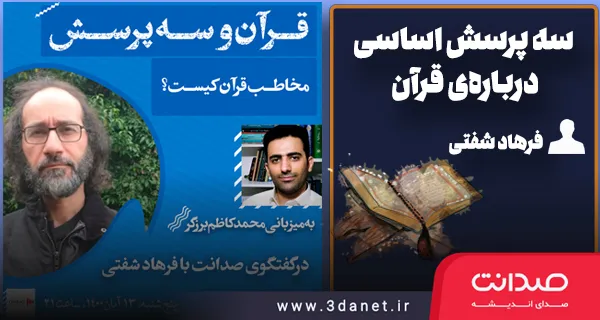
Title: The Quran and Three Questions
Detailed Title: A Lecture Series in Search of Answers to Three Fundamental Questions about the Quran:
1_ Who is the Quran's audience? 2_ Is the Quran exclusivist or pluralist? 3_ What use is the Quran to us today?
.
.
1_ Who is the Quran's audience?
.
Session One - Thursday, November 4, 2021
Listen to the audio on Anchor | Spotify | Castbox
Download the audio directly | from Telegram
.
Session Two - Thursday, November 11, 2021
Listen to the audio on Anchor | Spotify | Castbox
Download the audio directly | from Telegram
.
The Completion of Proof: The Quran's Narrative and Historical Documentation
A Brief Supplement to the Discussion on the Completion of Proof in the Second Session
In the second session of the lecture series "The Quran and Three Fundamental Questions," I attempted to depict the Quran's narrative of the completion of proof. According to this narrative, the message of revelation was conveyed with such clarity to the Quran's direct audience—those who lived in the time and place of revelation—that its rejection was not due to negligence or lack of conviction, but out of arrogance, in the specific Quranic sense of the term. Based on the Quran's narrative of the divine tradition in sending prophets, after the completion of proof, those who arrogantly denied the message of revelation faced not only otherworldly punishment but also worldly punishment. This worldly punishment took the form of natural disasters or was carried out by the followers of the prophets as an initiatory jihad. In fact, in the words of Amin Ahsan Islahi (d. 1997), during the time of revelation and for the land of revelation, a miniature Hereafter was established in this very world. I explained that on this basis, many religious rulings and commands that appear authoritarian and aggressive are not part of the Sharia, but rather, based on this same divine tradition, were specific to the time and place of revelation.
I emphasized the phrase "the Quran's narrative" because this is not a historical discussion but a reading of the text to grasp its discourse and narrative. The Quran's narrative is that the completion of proof was accomplished for its direct audience. Whether, from a historical perspective, the proof was actually completed for the Prophet's direct audience or not has little bearing on the purpose and conclusion of this discussion. I believe we do not have sufficient historical evidence to prove or refute such a claim. It is neither appropriate for those devoted to the Quran to be reproached for believing this claim, nor is it rational to deny skeptics the opportunity to speak.
The purpose of this discussion, however, is to understand which of the Quran's commands and propositions were solely for its direct audience. Knowing this is important for two reasons:
First, after grasping the Quran's primary purpose for its direct audience, we can better reflect on its more comprehensive purpose and, consequently, its role for Muslims today.
Second, in the contemporary era, despite certain dogmatisms, many efforts have been made by thinkers and followers of various religious schools to establish a theoretical barrier between those seemingly authoritarian-aggressive commands and the modern world. Among some Shia scholars, the absence of the Infallible Imam, and among some Sunni scholars, the lack of suitable conditions, have been proposed as that theoretical barrier. Sometimes, the discussion of avoiding bringing Islam into disrepute has also been invoked. Among neo-thinkers and religious intellectuals, discussions such as the primacy of ethics over Sharia and the role of power in the establishment of religion have emerged. While I believe in the primacy of ethics over Sharia, my claim is that the theoretical barrier preventing the extension of certain seemingly authoritarian-aggressive religious rulings and commands to the contemporary era is precisely this Quranic narrative of the 'completion of proof' (itmām al-ḥujjah). This narrative is, in fact, another expression of the primacy of ethics over Sharia, but an expression that appears more explicitly in the Quran.
Farhad Shafti
.
.
2_ Is the Quran Exclusivist or Pluralist?
.
Session Three - Thursday, November 18, 2021
Listen to the audio on Anchor | Spotify | Castbox
Download the audio directly | from Telegram
Articles referenced in this session:
Article "Investigative Exclusivism in the Realm of Religion" by Arash Naraghi
Farhad Shafti's Critique of Arash Naraghi's View; "Pluralism or Investigative Exclusivism?"
Article by Farhad Shafti titled "The Quran, Exclusivist or Pluralist?"
.
Session Four - Thursday, November 25, 2021
Listen to the audio on Anchor | Spotify | Castbox
Download the audio directly | from Telegram
.
.
3_ What Use is the Quran to Us Today?
.
Session Five - Thursday, December 2, 2021
Watch the video on Aparat
Listen to the audio on Anchor | Spotify | Castbox
Download the audio directly | from Telegram
.
.
Telegram session on "The Quran and Three Questions" with Farhad Shafti
Thursday, 18 Azar 1400
.
Transcribed and edited text of all sessions:
A Report on the Sessions on the Quran and Three Fundamental Questions; Part 1 of 4
A Report on the Sessions on the Quran and Three Fundamental Questions; Part 2 of 4
A Report on the Sessions on the Quran and Three Fundamental Questions; Part 3 of 4
A Report on the Sessions on the Quran and Three Fundamental Questions; Part 4 of 4
.
These sessions were held on Sedanet's Instagram.
.
.


Discussion1 comments
مخآطب قرآن الناس است بعبارت دیگر هر انسان آزاد وعاقل مکلف جواب سوال دوم با توجه به سوال اول مشخص است جواب سوم هدایت برای کسانی که دغدغه آینده بمعنای وسیع آن دارند