Religion
A Report on the “Quran and Three Fundamental Questions” Sessions; Part 1 of 4
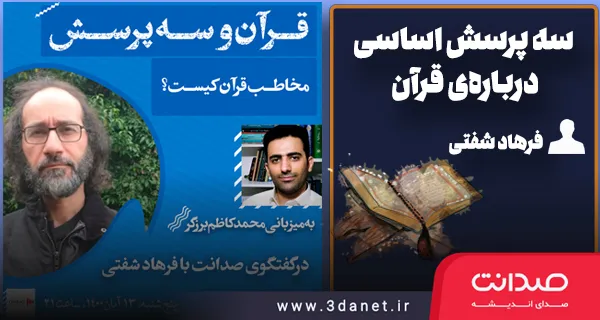
Farhad Shafti, in a series of talks for Sedanet, raises three questions about the Quran: who is its audience, is it exclusivist or pluralist, and what is its function today. The first part, by categorising the audience into specific direct, indirect, and general groups, lays the groundwork for answering the main question.

Mahdi Iranmanesh
AuthorA Report by Mehdi Iranmanesh on the Views of Farhad Shafti Presented in the Series of Sessions “The Quran and Three Fundamental Questions”; Part One: Who Is the Audience of the Quran?
For the PDF file, please refer to the end of the page
First Question: Who Is the Audience of the Quran?
A Note from Farhad Shafti: I am grateful to Sedanet and my dear friend, Mehdi Iranmanesh, for their efforts in producing a written report of the five sessions on “The Quran and Three Fundamental Questions” held at Sedanet, as presented in the text below, in a very short time. I am also grateful that they gave me the opportunity to revise it before publication, although this caused a delay in the release of this text. In the review, I tried to enhance the coherence and clarity of this text, which was originally spoken and dialogic, while preserving its oral nature, with some editing, and in some cases, rearranging and, rarely, adding some explanations.
As stated in the text, the main question is, in fact, what use the Quran is to us today. To explain my answer to this question, however, I had to pass through the bottleneck of two other fundamental questions: first, who is the audience of the Quran, and second, whether the Quran has a pluralistic view of religion or an exclusivist one. After answering these two questions, one can address the question of the Quran, today, and us with a more refined perspective.
I would like to explain two points in this note. First, the discussions of these three questions are interdependent. The answer to the third question is based on the answers to the first and second questions. For this reason, reading the final parts of this text without at least a review of the initial and middle sections may obscure the basis and logic of the argument. The second point is that, in answering these three questions, as appropriate to the subject, the flow of thought gradually moves toward the intended destination. I believe that the understanding and conviction I have presented on various topics only become clear as one approaches the final discussions.
Introduction
In this series of articles, I have tried to summarize the thoughts of Farhad Shafti — one of the Quranic researchers — which were recently presented in five sessions with Sedanet, without any interference in the content or personal commentary, in order to make them available for study by other researchers and enthusiasts. This series of articles is presented in four parts. In the first three parts, one of the three questions under discussion is addressed, and the fourth part is a collection of questions and answers raised at the end of the sessions. The video and audio files of this series of talks, hosted by Mohammad Kazem Barzegar, are accessible from this website. For a better explanation of the material, the initial edited text was sent to Mr. Farhad Shafti and revised by him, although the oral nature of the text has still been preserved.
First of all, it is necessary to briefly introduce him:
“Farhad Shafti holds a PhD in Islamic Studies from the School of Divinity at the University of Edinburgh in Scotland and also has seminary education in Tehran up to the intermediate level. To complete his doctorate on contemporary intra-religious approaches to understanding the Quran, he focused on the thoughts of Hamid al-Din Farahi, Amin Ahsan Islahi, and his students in the field of Quranic coherence (Nazm) and interpreting the Quran by the Quran. Much of this work is available online and is also accessible through the Telegram channel ‘Farhad Shafti’. The subject of most of these works is in the field of the conceptual coherence of the Quran, the application of the Quran for today, religious pluralism, and spirituality and ethics.
Among his latest writings in Persian, one can mention ‘The Quran, Exclusivist or Pluralist’, ‘We and the Mysterious God of the Quran’, and “An Easy and Difficult Question about Religion and Spirituality (Negah-e Aftab Quarterly, No. 4)”. Some of the latest talks and conversations: “The Theology of Sorrow (Din Online)”, “The Quran and Modern Man (Kheymeh Monthly, No. 140)”, and a conversation about religion and spirituality in the podcast series “Narasideh be Derakht”.
Based on his other doctorate in the field of operational research, he is an associate professor at the University of Glasgow in Scotland.”
He presents what he claims and for which he provides various intra-textual evidence merely as his own observation of the Quran. The three fundamental questions he has examined are:
. Who is the addressee of the Quran?
. Is the Quran exclusivist or pluralist?
. What use is the Quran to us today?
In fact, the main question is “What use is the Quran to us today?” But answering the first two questions properly provides a context in which the main question can be better addressed. Therefore, we need to know who the addressees of the Quran are. What is the Quran’s account in this regard? In other words, what does the Quran say about itself? For this purpose, concepts and topics such as religion, the purpose of religion, salvation, God, and different religions in the Quran are considered.
Then we must discuss whether the Quran is closer to religious exclusivism or religious pluralism. In his words, the first question is, in fact, a kind of plowing the pasture of thought. The second question is sowing a seed in this pasture, and the third question is harvesting the crop. He uses the metaphor of plowing because the first question is not a very new discussion and is more a reminder of and attention to points that have been discussed before.
1- Who is the addressee of the Quran?
The answer to this question is given in the following four main sections:
0 Clarifying the question
0 A few examples from Quranic verses to understand the importance and approach the subject
0 Clarifying the answer based on the local nature of the addresses
0 Clarifying the answer based on the primary purpose of the Quran
1-1- Clarifying the question
Although to clarify this issue and understand who the addressee of the Quran is, it is necessary to pay attention to verses that contain forms of address, such as “O you who believe” and “O mankind,” here we broaden the discussion and address the question more generally: on interaction with which addressee is the main burden of the Quran’s discourse based? The Quran has different addressees; the discussion is not about limiting the addressees of the Quran but about knowing their types and benefiting from the consequences of distinguishing them. The types of Quranic addressees can be categorized as follows:
- Direct specific addressee
- Indirect specific addressee
- General addressee
By direct specific addressee, we mean Muslims and non-Muslims who lived during the Prophet’s lifetime in the Arabian Peninsula, particularly in specific locations (such as Mecca and Medina). For example, verses concerning the Battle of Uhud pertain to the direct specific addressee among Muslims, those who lived at the time of the Battle of Uhud. Verses dealing with the reaction of the Jews and Christians to the Prophet pertain to the direct specific addressee among the People of the Book, those who lived during the Prophet’s time in the Arabian Peninsula, especially in Medina and its surroundings. Verses warning the polytheists against stubbornness and enmity pertain to the direct specific addressee among the polytheists of the Prophet’s time in Arabia, especially in Mecca and its surroundings. This category of addressee can be briefly called the direct addressee, because all the direct addressees of the Quran were the specific intended focus of this book’s guidance.
The second category is the indirect specific addressees. Believers or Muslims after the Prophet’s era fall into this category. They are specific because they are Muslims and the specific intended focus of the Quran, and they are indirect because they were not present at the time and necessarily the place of revelation. Verses such as “Successful indeed are the believers” include indirect specific addressees and, of course, direct specific addressees among Muslims.
The general audience consists of all human beings in the world. For example, in verses such as “O mankind, what has deceived you concerning your Lord, the Generous” and “By time, indeed mankind is in loss,” a universal address to all human beings is observed, which includes the direct specific audience, the indirect specific audience, and the general audience. In these verses, it appears that the Quran is speaking to all of humanity. Although even in these cases, a less famous exegetical opinion has been put forward that what is meant by “mankind” in some of these verses is specifically the tribe of Quraysh. Here, however, we look only at the wording and content of the verses and say that it can be said the intended audience is the general audience. In fact, we try, by carefully examining the wording of the verse and its contextual indicators, to see how far its audience can be broadened. We cannot broaden the audience of some verses, such as the verse about the Battle of Uhud, but for instance, when the word “believers” is used, the audience here can be broader than the direct specific audience, unless contextual indicators and content prevent it. Likewise, we can generalize the word “mankind” to all human beings, unless the contextual indicators before and after the verse prevent it. Verses that address the People of the Book in general also fall into this category, because the People of the Book—for reasons that will be explained in the answer to the question of pluralism—were not specifically intended by the Quran.
Now, in this discussion, which is in fact an intra-religious and intra-textual discussion, the main purpose is to find out upon which of these three audiences the primary discourse of the Quran is based. In other words, the main purpose is to determine which audience predominates in the Quran’s narrative.
His claim is that the Quran’s discourse is based on the “direct specific audience.” That is, the audience that lived in the era of the Prophet and in the same location as the Prophet (the Arabian Peninsula). This, however, does not mean that others are not the Quran’s audience or that they cannot derive any benefit from the Quran; in fact, understanding the Quran’s address to the direct specific audience will help us reach a clearer understanding of the Quran’s address and its application for other audiences. This discussion is oriented in this direction and for achieving such a benefit.
This claim is examined from two perspectives: “the local nature of the Quran’s address” and “the local nature of the Quran’s primary purpose.”
2-1—A Few Examples from Quranic Verses to Understand the Importance and Approach the Subject
Before presenting reasons based on Quranic evidence that show the Quran’s discourse is based on addressing the “direct specific audience,” let us first see what destructive effects and consequences not accepting this claim can have.
We have often heard and been advised that when you read the Quran, read it as if the Quran is speaking to you now. In his view, this advice is very good advice if our intention is to gain a kind of spiritual and mystical experience and a tasteful reception from reading the Quran. But it is very bad advice if our goal is to understand the Quran. That is, if we suppose that all the verses are speaking to us, then we might arrive at the understanding that groups like the disbelievers and polytheists whom the Quran mentions are the very ones we consider disbelievers or polytheists in this era. Then this is very bad advice and leads to strange, tragic, and sometimes dangerous consequences, and this is also one of the reasons for fundamentalism (takfiri groups). Numerous examples can be cited from Quranic verses that demonstrate these strange and sometimes dangerous results:
For example, see verse 116 of Surah An-Nisa and its similar verse, 48 of the same Surah:
“Indeed, Allah does not forgive association with Him, but He forgives what is less than that for whom He wills. And he who associates others with Allah has certainly gone far astray.”
The content of the verse is that God does not forgive polytheism, but He may forgive anything short of that. Now, if a Muslim today considers someone a polytheist (for example, a Hindu) and extends this verse to them as well, they will naturally imagine that person's ultimate fate to be hell. Let us assume that Hindu is indeed a polytheist—though, depending on the sect and belief, this is a questionable assumption. Now, if that Hindu, who was born into a Hindu family, were given an opportunity in the Hereafter and said, "Lord, I am a polytheist for the same reason that a Muslim became a monotheist and consequently is in paradise, and that reason is my being born among polytheists and his being born among monotheists. Who decreed this fate, that he should be there and I here? Was it not You Yourself who decreed this fate? So how is it that in the Quran, on one hand, You say, 'لَا یظْلَمُونَ فَتِیلًا'—He will not wrong you even by a hair on a date stone—and on the other hand, based on 'إِنَّ اللَّهَ لَا یغْفِرُ أَنْ یشْرَكَ بِهِ,' You cast me into hell?!"
How is such a conception compatible with God's justice? This example was one instance showing what conclusions we are led to if we do not accept that the primary and predominant intent and address of the Quran is a specific, direct audience, and if we generalize the Quran's meaning to a universal audience.
Another example: Surah Al-Ma'idah, verse 82:
"لَتَجِدَنَّ أَشَدَّ النَّاسِ عَدَاوَةً لِلَّذِینَ آمَنُوا الْیهُودَ وَالَّذِینَ أَشْرَكُوا وَلَتَجِدَنَّ أَقْرَبَهُمْ مَوَدَّةً لِلَّذِینَ آمَنُوا الَّذِینَ قَالُوا إِنَّا نَصَارَى ذَلِكَ بِأَنَّ مِنْهُمْ قِسِّیسِینَ وَرُهْبَانًا وَأَنَّهُمْ لَا یسْتَكْبِرُونَ"
(You will surely find the most intense of people in animosity toward the believers to be the Jews and those who associate others with God; and you will surely find the nearest of them in affection to the believers to be those who say, "We are Christians." That is because among them are priests and monks and because they are not arrogant.)
If we say the verse refers to the polytheists, Jews, and Christians of the Prophet's time, and that "you" refers to the Prophet and the Muslims of early Islam, then this aligns with historical documentation. But what happens if we universalize it? The verse does not say the most hostile to you is the Jewish state, for example Israel, but rather speaks of ordinary Jewish people. Can it truly be said that today, or as a principle for all time, that, for instance, the religious minorities of Jews and those Hindus we consider polytheists are the most hostile to the entire Muslim community, and the most friendly to them are, say, the Christians? Such a presupposition does not correspond with reality and also yields many destructive consequences.
Some of the narrations fabricated in anti-Semitism may have arisen from such an understanding of the Quran, like the narration that says at the end of the world, a Jew will hide behind a tree, and the tree will cry out, "O Muslim, a Jew is hiding here, come and kill him!"
Another example:
Surah Al-Ma'idah, verse 49: "وَإِنَّ كَثِیرًا مِنَ النَّاسِ لَفَاسِقُونَ" (And indeed, many among the people are defiantly disobedient).
If the verse said most are astray or do not have correct faith, we might be able to conceive of it as universal, but it is difficult to say the Quran has stated that the majority of all people in the world, for all eternity, are defiantly disobedient. "Fasiq" is a weighty word. Therefore, if we understand "the people" here as a specific audience, it aligns with the rest of the Quran.
Another example:
In the early verses of Surah At-Tawbah, we have the command to kill the polytheists and fight the People of the Book. Some fundamentalists, reasoning from this very verse, say yes, in this time too, polytheists must be killed and the People of the Book must be fought. This is the very conclusion that ISIS draws, and in practice, amidst those horrifying images of their crimes, we would sometimes see them holding these verses up to the camera to claim that their actions are based on the Quran.
Here the importance of precision in this matter becomes clear. These groups and these expressions are often highly local; even the word al-nās (people) is used locally in many verses, referring to the people of that place and time. Even the word arḍ (earth/land) is local in some instances. Titles such as “People of the Book,” “those who have believed,” “those who disbelieved,” or “polytheists” are in many cases local. Even in many instances where “People of the Book” appears to be mentioned generally, the intent is still to convey something to the local People of the Book.
3-1. Explaining the Answer Based on the Local Nature of the Addresses
Throughout the Quran we see verbal or implicit addresses that are local, and if we assume them to be universal we encounter contradictions within the Quran itself. Moreover, we would also run into problems with contemporary experience and reason. This point is by no means a new one. Some traditional exegetes, in commentaries such as those of al-Ṭabarī, al-Rāzī, and Majmaʿ al-Bayān, have in many cases turned to the occasion of revelation (shaʾn al-nuzūl) for explanation. We know that occasions of revelation have been transmitted for roughly a quarter of the verses, and many of the remaining three-quarters are connected to that quarter.
In al-Mīzān, in the commentary on the first verse of the Quran in its present order in which the expression “those who disbelieved” appears—namely, verse 6 of Sūrat al-Baqara—ʿAllāma Ṭabāṭabāʾī writes:
“Wherever in the Quran the expression ‘those who disbelieved’ occurs, what is meant is the disbelievers of Mecca, who opposed the religious call in the early days of the Prophet’s mission, unless there is an indication in the discourse that conveys the contrary. This is similar to the expression ‘those who have believed,’ concerning which we shall soon say: wherever it occurs in the Quran absolutely and without an indication, what is meant by it is the Muslims of Mecca—that is, the first group of Muslims—who were honored with this particular form of address, unless an indication in the discourse proves the contrary. (Translation)”
In the Quran we find no reference to any religious group outside the Arabia of that time. We have the Jews, the Christians, and one brief reference to the Magians—and that because they were neighbors or because some of them resided in Arabia. No reference is made to other religious groups. Even regarding those same Jews and Christians, the reference is to the sects that existed in Arabia.
Likewise, the Quran had no atheist or non-believer-in-God as its addressee. All of the Quran’s addressees, including the polytheists, were believers in God: “We do not worship them except that they may bring us closer to God” (39:3). For this reason, the Quran’s discourse does not encompass atheism. Therefore, even the faith (īmān) of which the Quran speaks does not mean “believe that God exists.” Those addressees believed in God. Faith in the Quran meant strengthening this belief and fulfilling its due, so that such faith would guard against polytheism (in the case of the polytheists) and disobedience to divine commands (in the case of some People of the Book at the site of revelation). If we accept that all of the Quran’s direct addressees believed in God, we arrive at the conclusion that all of the Quran’s propositions concerning the conditions of salvation were also premised on belief in God, unless an indication proves the contrary. For instance, the condition of faith for the salvation of one who does righteous deeds (as in al-Nisāʾ 124) does not mean stipulating belief in God, but rather stipulating the fulfillment of the due of this belief by remaining monotheistic and obeying divine commands.
In the same vein, we find no reference in the Quran to other nations and lands in the era of the Prophet. In the one instance where the war between Rome and Persia is mentioned, this war was important to the Arabs. The polytheists of Quraysh wanted the Persians to win, while it was politically advantageous for the Muslims that Rome should prevail.
Paying attention to the fact that, as Allameh Tabatabai says, the groups the Quran speaks of (in the absence of any contextual indication) are the local groups of that time, is important from several perspectives. For instance, if we accept that the Quran's dominant discourse is directed at a direct specific audience, then if we want to consider the religious law that came for them as eternal and also extend it to other lands and places, the least we can say is that this act itself requires ijtihad—that is, ijtihad on whether the religious law can and should be extended beyond the scope of the Quran's direct audience. This does not mean it should not be done, but rather emphasizes paying attention to the process of universalizing the Quran's addresses in establishing religious law. This, of course, is not related to the discussion of this series of talks.
In summary, the Quran's addresses are predominantly local addresses, and it was noted that by address we do not mean only verbal address, such as "O you who believe," but rather the Quran's intent and discourse is what is meant.
The Quran's discourse could have been based on a general audience, and addresses like "O mankind, what has deceived you concerning your Lord, the Generous?" or "Indeed, mankind is in loss" could have been more frequent. The propositions could have been more universal and general. That is, if the Quran were in general address like a large part of the current Gospels, and alongside that had local references and concerns, we might be able to say the Quran's discourse is based on a general audience, but it is not so.
The Quran's discourse could have been based on an indirect specific audience. God, the All-Knowing and All-Wise, could have, alongside addressing what the direct audience was afflicted with, dealt more extensively with the less time-bound collective concerns of Muslims and dedicated most of the book's discussions to them, and even raised some very important time-bound future concerns more extensively. But the Quran did not do this either.
Although the Quran addresses all three groups, the emphasis and predominance of the Quran's discourse is on the direct specific audience. Why and for what reason this is so, I believe part of it goes back to the discussion of the nature of revelation and is beyond this discussion. Another part, however, relates to the next topic, namely the primary purpose of the Quran.
So far, the locality in terms of the Quran's addresses has been considered. Now we will consider the locality of the Quran's primary purpose. To enter this discussion, we raise three sets of questions to provide a suitable intellectual starting point for addressing the continuation of the discussion on the Quran's addresses:
-First, why should the Quran's address be based on a direct specific audience? Why, while addressing the needs of this group of audiences, did the Quran not base itself on an indirect specific audience or a general audience?
-Second, it might be pointed out that although a verse was for a specific audience, if the components of that verse can be generalized, then it can be said that this verse also applies to other times and other audiences. For example, in Surah At-Tawbah, verse four, after the command of disavowal, states: "Except those of the polytheists with whom you have a treaty and who have not subsequently failed you in anything and have not supported anyone against you." Can we not draw the general inference from this verse that a treaty and covenant are so important that they must be honored under all circumstances, even if with polytheists and enemies? In this case, it can be said that yes, such a generalization can be made, but is the reverse also true? That is, if there were polytheists who broke their treaty with the Muslims, can it be said, based on generalizing the verses of Surah At-Tawbah, that the Quran has asked Muslims to destroy such polytheists? Let us give another example: verse 29 of the same Surah, which says to fight those of the People of the Book who do not have correct faith until they pay the jizya to you with humility—can this also be generalized? In making these generalizations, we encounter moral problems.
- Third, even for that direct audience, especially those who had not believed, why does the Qur’an speak to them so harshly in many verses and why does it promise them horrific and eternal punishments? Many in today’s generation raise this question: why do they perceive the face of the Qur’an as harsh, and why are there so many verses about punishment and hell? And although verses about paradise appear alongside them, in the opinion of these friends, such extremely harsh verses still constitute the dominant face of the Qur’an. Why are there so many stories of the punishment of past peoples?
In the discussion of the local nature of the Qur’an’s primary purpose, an attempt will be made to answer these questions.
4-1. The Local Nature of the Qur’an’s Primary Purpose
This section is presented in four parts:
0 A look at the story of creation
0 Six observations in the Qur’an
0 Formulating the primary purpose of the Qur’an
0 The salvation of the Qur’an’s indirect audience
The first two parts lead us to the formulation of the Qur’an’s primary purpose in the third part.
1-4-1. A Look at the Story of Creation
The intention here is not to claim any special characteristic for the Qur’an; we accept that belief in many such characteristics depends on one’s perspective. He emphasizes that he is only explaining his observation here, which is that there is a profound conceptual order in the verses of the Qur’an. One set of concepts that aids in understanding the Qur’an is the story of creation and its various scenes. The concepts that can be derived from the story of creation help in grasping certain other Qur’anic concepts. Here, only one scene from the story of creation is mentioned. In Surah Sad, verse 75, after Iblis refuses to prostrate to Adam, God asks him, “O Iblis, what prevented you from prostrating to that which I created with My own hands? Were you arrogant, or were you among the exalted?” Then He says, did you act arrogantly, or are you truly of such high rank that you should not prostrate? We have a similar verse in Al-Baqarah 34, where Iblis did not prostrate, and the verse says, “He refused and was arrogant,” he refused to prostrate and acted arrogantly, and immediately says, “and he became of the disbelievers,” meaning that as soon as he acted arrogantly, the verse says he became of the disbelievers.
A point that can be drawn from this Qur’anic narrative is that the theme of arrogance is an important theme in the Qur’an, and it creates an interest in searching the Qur’an’s references to arrogance, disbelief, and divine punishment. Here, this discussion is limited to the text of the Qur’an; in later discussions, we will also adopt an extra-textual perspective.
In the verses mentioned, it was stated that Iblis acted arrogantly and became of the disbelievers. In Surah Az-Zumar, verse 59, it is said about the people of Hell: “Yes, My verses came to you, but you denied them and were arrogant, and you were of the disbelievers.” Again, this formula of arrogance and becoming a disbeliever is repeated. In the previous verses, it was said about Iblis; here it is said about the people of Hell in general. In Surah Nuh, verse 7, Nuh says, O Lord, these people will not be guided, and my continued preaching is of no use: “And indeed, whenever I invited them that You might forgive them, they put their fingers in their ears, covered themselves with their garments, persisted, and were arrogant, with extreme arrogance.” He says that whenever I invite them so that You may forgive them, they put their fingers in their ears, draw their garments over themselves, persist, and act arrogantly, with great arrogance. In Surah Al-Muddaththir, verse 23, it says about the disbeliever: “Then he turned back and was arrogant,” he turned his back and acted arrogantly.
Reviewing these verses and other similar ones, we see a relationship between arrogance, disbelief, and divine punishment. Surah An-Nahl, verse 29, "So enter the gates of Hell to abide eternally therein, and how wretched is the residence of the arrogant," says that Hell is a terrible abode for the arrogant. Only in one verse is this connection between arrogance and going to Hell not mentioned. Surah Al-A'raf, verse 7, "But those who deny Our verses and are arrogant toward them – those are the companions of the Fire; they will abide therein eternally." Surah Az-Zumar, verse 60, "Is not Hell the residence for the arrogant?", Az-Zumar, 72, "It will be said, 'Enter the gates of Hell to abide eternally therein, and wretched is the residence of the arrogant,'" Ghafir, verse 60, "Indeed, those who are too arrogant to worship Me will enter Hell in humiliation." In all these verses and similar ones, there is a strong connection between arrogance and Hell. The arrogance meant in these verses is not the kind that can be easily attributed to individuals, such as not returning a greeting or acting self-important. Something more fundamental is meant. What is meant is that a person does not accept the truth, not because they have not encountered it or have not been convinced, but out of arrogance. According to the Quran, arrogance preventing the acceptance of truth takes two forms: either the person knows the truth but denies it out of arrogance, or their arrogance is such that they do not even allow themselves the opportunity to properly hear the word of truth (like the verse mentioned about the people of Noah). It is beyond the scope of this discussion, but one can argue with the help of Quranic verses that it seems the People of the Book residing in Medina and its surroundings, who were directly addressed by the Prophet, mostly suffered from the first form of arrogance (for example, see "and you know" – in Al-Baqarah 42 and Aal-e-Imran 71), while the polytheists addressed by the Prophet and other prophets mostly suffered from the second form (like verse 7 of Surah Nuh, which was mentioned).
The definition of a disbeliever (kafir) is also related to this. Kafir literally means one who covers up, and based on the verses mentioned and similar ones, we understand that in the Quranic discourse, a kafir is one who covers up the truth. It is important to note that, based on what was discussed in the first part and what will follow in more detail, after the era of the Prophet, no one can or should be labeled a kafir.
From this part of the creation story and then the verses that refer to the reactions of the prophets' audiences, one can understand the following: The Quran has introduced a rule to the effect that what causes disbelief and warrants punishment, both for Iblis and for the audiences of the prophets, is not the failure to accept the truth, but the failure to accept the truth out of arrogance. We will return to this rule later in the discussion.
2-4-1 – Toward Formulating the Primary Purpose of the Quran
Here, by observing various categories of Quranic verses, we want to see what this important matter, namely the primary purpose of the Quran, could be. And of course, we emphasize the word "primary." For this purpose, six observations can be presented, and wherever you open the Quran, you will usually encounter the theme of one of these six observations. It should also be emphasized that in these observations, we are only looking at the Quran's narrative and are not concerned with the extent to which this narrative corresponds with history:
First observation:
The Quran says the Prophet came as a warner. ... Indeed, We have sent you as a witness, a bearer of good tidings, and a warner. (33:45) Twice in the Quran, it states that We sent you to warn the Mother of Cities and those around it (6:92, 42:7), meaning the mother of cities, which is Mecca, and its surroundings. The Prophet's mission was to warn the people of that land, especially the polytheists. From other Quranic verses, such as "And there was no nation but that a warner had passed among them," we understand that the mission of other prophets was also to warn.
Second observation:
The Quran repeatedly speaks of the nations of the past Abrahamic religions, and in almost all cases, punishment was sent down upon them. This story—that a prophet came to them, they rejected the prophet, and then punishment descended—is repeated many times. Regarding the people of Hud, Surah Al-Ahqaf, verse 27: "وَلَقَدْ أَهْلَكْنَا مَا حَوْلَكُمْ مِنَ الْقُرَى وَصَرَّفْنَا الْآیاتِ لَعَلَّهُمْ یرْجِعُونَ", (And certainly We destroyed the towns around you, and We have diversified the signs, so that they might return.) Or a more general reference, Surah Ghafir, verse 21, "أَوَلَمْ یسِیرُوا فِی الْأَرْضِ فَینْظُرُوا كَیفَ كَانَ عَاقِبَةُ الَّذِینَ كَانُوا مِنْ قَبْلِهِمْ كَانُوا هُمْ أَشَدَّ مِنْهُمْ قُوَّةً وَآثَارًا فِی الْأَرْضِ فَأَخَذَهُمُ اللَّهُ بِذُنُوبِهِمْ وَمَا كَانَ لَهُمْ مِنَ اللَّهِ مِنْ وَاقٍ", (Have they not traveled through the earth and observed how was the end of those before them? They were greater than them in strength and in impression on the earth, but Allah seized them for their sins, and they had not from Allah any protector.). Many verses of the Quran have come regarding this; Surah Al-A'raf, from verse 59 to more than 30 verses thereafter, is in line with this observation.
Third observation:
The punishment that the Quran mentions regarding the direct addressees of the prophets is not only the punishment of the Hereafter, but also includes worldly punishment. This third observation is also derived from the same verses related to the second observation. A few more explicit examples: Surah Ar-Ra'd, verse 34, "لَهُمْ عَذَابٌ فِی الْحَیاةِ الدُّنْیا وَلَعَذَابُ الْآخِرَةِ أَشَقُّ وَمَا لَهُمْ مِنَ اللَّهِ مِنْ وَاقٍ" (For them is punishment in the life of this world, and the punishment of the Hereafter is more severe. And they will not have from Allah any protector.). Surah At-Tawbah, verse 74, "یحْلِفُونَ بِاللَّهِ مَا قَالُوا وَلَقَدْ قَالُوا كَلِمَةَ الْكُفْرِ وَكَفَرُوا بَعْدَ إِسْلَامِهِمْ وَهَمُّوا بِمَا لَمْ ینَالُوا وَمَا نَقَمُوا إِلَّا أَنْ أَغْنَاهُمُ اللَّهُ وَرَسُولُهُ مِنْ فَضْلِهِ فَإِنْ یتُوبُوا یكُ خَیرًا لَهُمْ وَإِنْ یتَوَلَّوْا یعَذِّبْهُمُ اللَّهُ عَذَابًا أَلِیمًا فِی الدُّنْیا وَالْآخِرَةِ وَمَا لَهُمْ فِی الْأَرْضِ مِنْ وَلِی وَلَا نَصِیرٍ", (They swear by Allah that they did not say [it], while they had certainly uttered the word of disbelief and disbelieved after their [pretense of] Islam and planned that which they were not to attain. And they were resentful only because Allah and His Messenger had enriched them of His bounty. So if they repent, it is better for them; but if they turn away, Allah will punish them with a painful punishment in this world and the Hereafter. And there will not be for them on earth any protector or helper."). Fussilat, verse 16: "فَأَرْسَلْنا عَلَیهِمْ ریحاً صَرْصَراً فی أَیامٍ نَحِساتٍ لِنُذیقَهُمْ عَذابَ الْخِزْی فِی الْحَیاةِ الدُّنْیا وَ لَعَذابُ الْآخِرَةِ أَخْزى وَ هُمْ لا ینْصَرُون", (So We sent upon them a screaming wind during days of misfortune to make them taste the punishment of disgrace in the worldly life; and the punishment of the Hereafter is more disgracing, and they will not be helped.) This is the same punishment that, according to the Quranic narrative, only befalls a people after a warning prophet has been sent to them: "وَ ما أَهْلَكْنا مِنْ قَرْیةٍ إِلاَّ لَها مُنْذِرُون - 26:208, And We did not destroy any city except that it had warners). Some commentators, in interpreting certain verses that say the punishment is near, hold that what is meant in these verses is not the punishment of the Hereafter but worldly punishment.
Fourth observation:
In the Quran, by my count, the Prophet is told 18 times to be patient in his mission. In some of these verses, the recommendation of patience is not only for enduring hardships and harassment. In these verses, the recommendation of patience is for the fulfillment of the divine promise in this very world, meaning the victory of the Prophet and his companions and worldly punishment for those who opposed his mission:
فَاصْبِرْ لِحُكْمِ رَبِّكَ وَلَا تَكُنْ كَصَاحِبِ الْحُوتِ إِذْ نَادَى وَهُوَ مَكْظُومٌ (68:48)
(So be patient for the decision of your Lord, and do not be like the companion of the fish - Jonah - when he called out while he was distressed).
Yunus imagined that the people within the scope of his mission had reached that stage of arrogance, in the sense that was mentioned, where they are in the abode of disbelief and deserving of punishment. So, before the divine command, he abandoned his people and found himself in trouble.
Or in Surah Al-Ahqaf, it says:
فَاصْبِرْ كَمَا صَبَرَ أُولُو الْعَزْمِ مِنَ الرُّسُلِ وَلَا تَسْتَعْجِلْ لَهُمْ كَأَنَّهُمْ یوْمَ یرَوْنَ مَا یوعَدُونَ لَمْ یلْبَثُوا إِلَّا سَاعَةً مِنْ نَهَارٍ ... (46:35)
So be patient, as the resolute among the messengers were patient, and do not be impatient for them—for the punishment. The Day they see what they are promised, it will be as if they had not remained [in the world] except an hour of a day...
The point is not merely that 'We know you are being tormented, but be patient.' For it says, "وَلَا تَسْتَعْجِلْ لَهُمْ" (and do not be impatient for them).
- A pause to return to the story of creation:
What does the reference to haste signify? It means: do not hasten to request worldly punishment for them. Why? Because they still have an opportunity to return, and there is still room for further propagation of the truth and warning. Worldly punishment comes upon them when there is no word left to be said, and the truth is so clearly accessible to the audience that their rejection of it is not out of ignorance or lack of conviction, but out of arrogance. Regarding the Prophet's direct addressees in particular, numerous verses of the Quran indicate that the People of the Book addressed by the Prophet knew the truthfulness of his message, and that the polytheists opposed the Prophet out of spiteful malice.
It is here that these observations connect to the story of creation I mentioned at the beginning. There, it was said that arrogance leads to deeming others as disbelievers and becoming deserving of punishment. In observations one through four, we see this same concept unfolding in the mission of the prophets. This is the very principle we pointed to in the discussion of the creation story. According to the Quran's account, the very thing that made Iblis a disbeliever—namely, arrogance—can also make the direct addressees of the prophets disbelievers. The prophets continue their propagation and warning until no excuse or argument remains for their direct addressees, and their standing against the truth is solely out of arrogance. "رُسُلاً مُبَشِّرینَ وَ مُنْذِرینَ لِئَلاَّ یكُونَ لِلنَّاسِ عَلَى اللَّهِ حُجَّةٌ بَعْدَ الرُّسُل" 4:165, (Messengers who were bearers of good tidings and warners, so that mankind would have no argument against God after the messengers). In this way, the story of creation and the Quran's account of the prophets' mission form a complete circle and loop.
Observation Five:
Now, it might be asked: did worldly punishment also come upon the people of the Prophet? The answer is yes, or more precisely, the process of divine punishment began for them, although it was not completed because they came to faith. In Surah At-Tawbah, the believers are commanded not just to fight, but to kill:
فَاقْتُلُوا الْمُشْرِكِینَ حَیثُ وَجَدْتُمُوهُمْ وَخُذُوهُمْ وَاحْصُرُوهُمْ وَاقْعُدُوا لَهُمْ كُلَّ مَرْصَدٍ فَإِنْ تَابُوا وَأَقَامُوا الصَّلَاةَ وَآتَوُا الزَّكَاةَ فَخَلُّوا سَبِیلَهُمْ إِنَّ اللَّهَ غَفُورٌ رَحِیمٌ (9:5)
(Kill the polytheists wherever you find them, and capture them, and besiege them, and sit in wait for them at every place of ambush. But if they repent, establish prayer, and give zakah, let them go their way. Indeed, God is Forgiving and Merciful.)
And then it comes:
قَاتِلُوهُمْ یعَذِّبْهُمُ اللَّهُ بِأَیدِیكُمْ وَیخْزِهِمْ ...(9:14)
(Fight them; God will punish them by your hands and will disgrace them ...)
Also, in verse 52 of Surah At-Tawbah, it says:
قُلْ هَلْ تَرَبَّصُونَ بِنَا إِلَّا إِحْدَى الْحُسْنَیینِ وَنَحْنُ نَتَرَبَّصُ بِكُمْ أَنْ یصِیبَكُمُ اللَّهُ بِعَذَابٍ مِنْ عِنْدِهِ أَوْ بِأَیدِینَا فَتَرَبَّصُوا إِنَّا مَعَكُمْ مُتَرَبِّصُونَ
(Say, "Do you expect for us except one of the two best things? But we expect that God will afflict you with a punishment from Himself or at our hands. So wait; we too are waiting with you.")
That is, you are waiting for something to happen to us? Whatever happens to us is one of the two best things. Either we will be victorious, or if you kill us, we will become martyrs. But what we are waiting for is for you to be punished. How? مِنْ عِنْدِهِ أَوْ بِأَیدِینَا. By His own hand or by our hands.
Of course, it should be noted that this command to go and kill was never carried out. When the Muslims entered Mecca with the intention of war, they [the Meccans] believed; that is, these warnings achieved their result.
What has been said so far should bring our minds closer to the discussion of "the exhaustion of excuses" (itmām al-ḥujjah).
Among those who have worked well in this area is one of the exegetes of the Quran, who is originally Indian, named "Amin Ahsan Islahi." He was a contemporary of Allameh Tabatabai. Allameh also raised this discussion, but not in as much detail as Amin Ahsan Islahi. He says this worldly punishment was of two kinds: either natural (heavenly) punishments or at the hands of the prophets' companions. According to Amin Ahsan Islahi's interpretation, when the number of a prophet's companions is large, then this punishment can also be carried out by the hands of the prophet's companions. Based on this interpretation, the reason for many narrations about Moses in the Quran becomes clear. He, too, like the Prophet, had many companions and, according to the accounts in the Quran and the Torah, was, like the Prophet, commanded to fight against certain peoples to inflict divine punishment upon them.
Sixth Observation:
It is stated in the Quran that God wants the true believers, the strivers, and the patient to be distinguished from others:
وَلَنَبْلُوَنَّكُمْ حَتَّى نَعْلَمَ الْمُجَاهِدِینَ مِنْكُمْ وَالصَّابِرِینَ وَنَبْلُوَ أَخْبَارَكُمْ (47:31)
(And We will surely test you until We make evident those who strive among you and the patient, and We will test your affairs.)
In Surah An-Nur, He tells the Prophet and his companions that you will achieve victory:
وَعَدَ اللَّهُ الَّذِینَ آمَنُوا مِنْكُمْ وَعَمِلُوا الصَّالِحَاتِ لَیسْتَخْلِفَنَّهُمْ فِی الْأَرْضِ كَمَا اسْتَخْلَفَ الَّذِینَ مِنْ قَبْلِهِمْ وَلَیمَكِّنَنَّ لَهُمْ دِینَهُمُ الَّذِی ارْتَضَى لَهُمْ وَلَیبَدِّلَنَّهُمْ مِنْ بَعْدِ خَوْفِهِمْ أَمْنًا یعْبُدُونَنِی لَا یشْرِكُونَ بِی شَیئًا وَمَنْ كَفَرَ بَعْدَ ذَلِكَ فَأُولَئِكَ هُمُ الْفَاسِقُونَ(24:55)
(God has promised those who have believed among you and done righteous deeds that He will surely grant them succession [to authority] upon the earth just as He granted it to those before them, and that He will surely establish for them their religion which He has preferred for them, and that He will surely substitute for them, after their fear, security. They worship Me, not associating anything with Me. But whoever disbelieves after that – then those are the defiantly disobedient.)
In this verse, as I understand it, what is meant by "لَیسْتَخْلِفَنَّهُمْ فِی الْأَرْضِ" is the Arabia of that time, particularly the very region we saw in the first observation, namely "Umm al-Qura and those around it."
3-4-1 – Formulation of the Quran's Primary Objective:
In sum, from these six observations that are clearly found and repeated in the Quran, a formulation of the Quran's primary objective emerges, the summary of which we see in the following two verses:
وَلِكُلِّ أُمَّةٍ رَسُولٌ فَإِذَا جَاءَ رَسُولُهُمْ قُضِی بَینَهُمْ بِالْقِسْطِ وَهُمْ لَا یظْلَمُونَ(10:47)
(And for every nation is a messenger. So when their messenger comes, it will be judged between them in justice, and they will not be wronged.)
Whether all nations have had prophets or not will be discussed in response to the second fundamental question, concerning pluralism.
ذَلِكَ أَنْ لَمْ یكُنْ رَبُّكَ مُهْلِكَ الْقُرَى بِظُلْمٍ وَأَهْلُهَا غَافِلُونَ (6:131)
(This sending of the prophets is because your Lord would never destroy cities unjustly while their people were unaware.)
Now, by superimposing these six observations, let us see what the primary purpose of the Quran is. The formulation we offer based on these observations incidentally aligns with the understanding of many exegetes. The Quran contains a narrative of God's sunnah in the Abrahamic religions. According to this narrative, God sent messengers to their communities. The role of these messengers was to warn (indhār) their direct audience and caution them against punishment. This punishment was not only otherworldly but also worldly. What these prophets did, according to the Quran's narrative, was to preach until the truth became completely clear to their audience and the proof was established against them. According to this narrative, once the truth became completely clear, the prophets' direct audience divided into two groups:
White and black (or black and white, to avoid a racist expression), believer and disbeliever. The Quran calls this second group kāfir because they did not accept the truth out of arrogance. They either heard, recognized, and did not accept, or were so arrogant that they did not even want to hear.
According to the Quran's narrative, this warning is completed by the role of the prophet and prophets as witnesses. The meaning is that the prophet, with the help of revelation, clarifies the truth to such an extent that he can bear witness: "I made the truth clear, but they refused out of arrogance."
Look at the numerous verses of the Quran that refer to the role of prophets as witnesses, including verse 8 of Surah Al-Fath and verse 15 of Surah Al-Muzzammil. According to the Quran's narrative, worldly punishment descends upon the disbelievers (the arrogant ones in the time of the prophets). This punishment descends upon them either at the hands of the prophets' followers or in a natural (heavenly) form. Also, according to the Quran's narrative, the believers who remain take the place of those disbelievers and live well and happily in the land where they are.
So, the primary purpose of the Quran for its direct audience is the establishment of proof[1].
Understanding this point is very important because it answers many questions about the verses of warning and punishment.
At the end of the discussion on the local nature of the Quran's address, section 1-3, three questions were raised:
- First, why should the Quran's address be based on a specific direct audience.
- Second, whether the components of a verse that has a specific audience can be generalized so that the verse's content holds true for other times and other audiences.
- Third, even for that same direct audience, especially those who did not believe, why does the Quran speak to them so harshly in many verses, and why does it promise them horrific and eternal punishments?
A brief answer to the first and third questions becomes clear by knowing the primary purpose of the Quran for its direct audience.
The Quran's address is based on its direct audience because, according to the sunnah of the Abrahamic religions, the Quran's purpose was to warn them and establish the proof against them. The apparently harsh tone of some Quranic verses was also for this purpose.
Regarding the second question, which is practically the more important one, the answer will be that where this primary purpose is involved, the Quranic components for specific audiences cannot be generalized. For example, all the rulings mentioned in the Quran regarding the People of the Book, and even some jurisprudential rulings you traditionally read about non-Muslims, are all rulings concerning that black-and-white situation of the Prophet's time. For instance, we have in some jurisprudential rulings that a kāfir does not inherit, or a kāfir should not bear witness. Or do not pray for a disbeliever or polytheist.
The nature of these rulings depends on the school of jurisprudence, but some jurisprudential schools have generalized these, and when they say kāfir, they think any non-Muslim is a kāfir, and when they say People of the Book, they think it refers to the Christians and Jews of this time. All these rulings pertain to the black-and-white scene of that time during the Prophet's era.
Even when the Quran says not to befriend the People of the Book, it means do not befriend those particular People of the Book in that particular era, and we cannot generalize it to the present time.
Generalizing such rulings, commands, and judgments to the time after the Prophet's era, based on the discussion of the completion of the proof as narrated from the Quran, is incorrect.
Even the issue of Dar al-Harb (the Abode of War), which some jurists have applied to any land other than Muslim lands, emerged from this kind of generalization. Likewise, the jurisprudential rulings that seem to prescribe very harsh treatment of non-Muslims arise from this. Many strange historical fatwas have such origins. These are the result of the incorrect generalization of the characteristics of that black-and-white atmosphere of the era of the completion of the proof, revelation, and the Prophet's presence, to the present time—a time when no prophet is accessible, nor is revelation, and the atmosphere is not black and white but full of chiaroscuro.
4-4-1 — The Quran's Account of Salvation for the Indirect Addressee
To complete this section, we will briefly discuss the Quran's account of salvation for the indirect addressee.
In Surah Al-Ma'idah, verses 116 to 119, there is a beautiful dialogue:
وَإِذْ قَالَ اللَّهُ یا عِیسَى ابْنَ مَرْیمَ أَأَنْتَ قُلْتَ لِلنَّاسِ اتَّخِذُونِی وَأُمِّی إِلَهَینِ مِنْ دُونِ اللَّهِ قَالَ سُبْحَانَكَ مَا یكُونُ لِی أَنْ أَقُولَ مَا لَیسَ لِی بِحَقٍّ إِنْ كُنْتُ قُلْتُهُ فَقَدْ عَلِمْتَهُ تَعْلَمُ مَا فِی نَفْسِی وَلَا أَعْلَمُ مَا فِی نَفْسِكَ إِنَّكَ أَنْتَ عَلَّامُ الْغُیوبِ (مائده -116)
God says to Jesus:
(O Jesus, son of Mary, did you say to the people, 'Take me and my mother as two deities besides Allah?' He said, 'Exalted are You! It was not for me to say that to which I have no right. Had I said it, You would have known it. You know what is within myself, and I do not know what is within Yourself. Indeed, it is You who is Knower of the unseen.)
Then he says:
إِنْ تُعَذِّبْهُمْ فَإِنَّهُمْ عِبَادُكَ وَإِنْ تَغْفِرْ لَهُمْ فَإِنَّكَ أَنْتَ الْعَزِیزُ الْحَكِیمُ (118)
(If You should punish them, indeed they are Your servants; but if You forgive them, indeed it is You who is the Exalted in Might, the Wise.)
That is, he expresses a kind of intercession very respectfully.
In response, God says:
قَالَ اللَّهُ هَذَا یوْمُ ینْفَعُ الصَّادِقِینَ صِدْقُهُمْ لَهُمْ جَنَّاتٌ تَجْرِی مِنْ تَحْتِهَا الْأَنْهَارُ خَالِدِینَ فِیهَا أَبَدًا رَضِی اللَّهُ عَنْهُمْ وَرَضُوا عَنْهُ ذَلِكَ الْفَوْزُ الْعَظِیمُ (119)
(God will say, 'This is the Day when the truthful will benefit from their truthfulness.' For them are gardens beneath which rivers flow, wherein they will abide forever, Allah being pleased with them and they with Him. That is the great attainment.)
That is, if you, as a Christian, made such a mistake with sincerity and without arrogance, this very sincerity is accepted from you, and it speaks of a great salvation for them.
In Surah Al-Baqarah, verse 81:
بَلَى مَنْ كَسَبَ سَیئَةً وَأَحَاطَتْ بِهِ خَطِیئَتُهُ فَأُولَئِكَ أَصْحَابُ النَّارِ هُمْ فِیهَا خَالِدُونَ
(Yes, whoever earns evil and his sin has encompassed him — those are the companions of the Fire; they will abide therein eternally.)
One who internalizes evil and is overcome by error—meaning, for example, he is not merely a liar but becomes the very symbol of falsehood. Not just one who commits injustice, but becomes injustice incarnate—such a person is of the Fire.
These verses and similar ones are among the general verses of the Quran. According to this narrative of the Quran, in the time of twilight—where, unlike the time of black and white, there is no ultimatum—what determines your fate in the hereafter (in whatever sense you take it) is not whether you accepted or rejected the Messenger's word. What determines your fate is whether you acted with truthfulness and sincerity, based on the best moral and behavioral understanding, or whether you acquired evil and wrongdoing and strayed from sincerity. This, too, is not necessarily related to your belief.
Moreover, you are not tasked with what is beyond your capacity.
The verse "God does not burden any soul beyond its capacity" (لَا یكَلِّفُ اللَّهُ نَفْسًا إِلَّا وُسْعَهَا) states a principle, and that principle is: God expects nothing from you beyond your ability.
Let us also note that the Quran's narrative of the punishment of indirect addressees is the other side of the narrative of the punishment of direct addressees and does not contradict it. The disbeliever's rejection of the truth is not out of sincerity but out of arrogance, and it is this, according to the Quran's narrative, that makes them deserving of punishment. In this narrative, sincerity and
arrogance are placed in opposition to one another.
Summary and Conclusion
The local nature of the Quran's primary addresses and the local nature of the Quran's primary purpose were explained. Through six Quranic observations, we formulated the Quran's primary purpose and concluded that not all components found in the Quran's verses can be generalized. Furthermore, we grasped the importance of sincerity and action and behavior based on the best moral understanding, which is not necessarily dependent on belief.
Answer to the first fundamental question: Who is the Quran's addressee?
Based on the discussion presented, the Quran has a specific direct addressee, a specific indirect addressee, and a general addressee, but the Quran's discourse is based on the specific direct addressees. These were the people who were present at the time and place of revelation.
The focus of this discourse on this group of addressees was because, according to the tradition of Abrahamic religions, the Prophet had to deliver the ultimatum to them with the aid of revelation, through explaining the truth and warning. In this process, the believer and the non-believer among the specific direct addressees gradually become separated from one another, and reward and punishment are meted out to them in this very world.
The Quran's references and addresses to various religious and social groups were specific to the people who were present at the time and place of revelation, unless proven otherwise by contextual evidence. Accepting this narrative is highly effective in understanding which commands, judgments, and recommendations in the Quran are generalizable to the post-revelation era and which are specific to that era.
In the next part, we will discuss pluralism in the Quran and will, among other things, address the question of what the duty is of other communities who apparently had no prophet.
.
[1] His discussion with Dr. Soroush regarding the theory of religion and power was also that he argued the reality seen as a display of power in the Quran was related to the delivery of the ultimatum, and not the exercise of power to establish religion, as Dr. Soroush had stated.
Dr. Farhad Shafti's Telegram channel:
.
PDF: A Report on the Quran and Three Fundamental Questions Sessions; Part 1 of 4
PDF: A Report on the Quran and Three Fundamental Questions Sessions; All Parts
.

Discussion0 comments
No comments yet; let yours be the first voice.