Political Science
In Defence of Rebellion
Morteza Mardiha writes that debating the necessity of reform or revolt without considering its feasibility is a mistake; as long as the Iranian government has the will and capacity to suppress, revolt will not lead to revolution, and warning the government of a popular uprising is a laughable error.
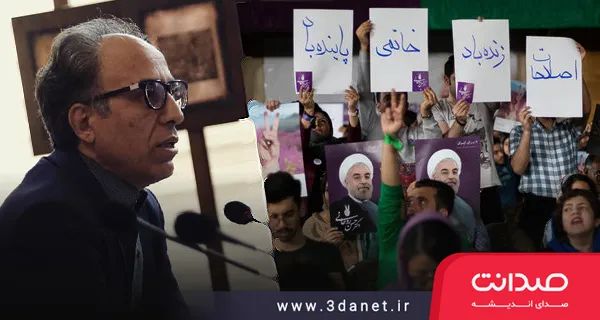
Morteza Mardiha: The history of the debate over the usefulness or futility of reformism in Iranian politics is as old as reformism itself. However, in these weeks following the Dey protests, given the somewhat unexpected positions of the reformists themselves and the entry of certain non-political opposition figures (including Mr. Makhmalbaf and Mr. Soroush) into the dispute over its usefulness or harmfulness, it seems a review of the main lines of these arguments, shedding light on some narrow and overlooked angles, and drawing attention to some prominent, visible, yet unpleasant aspects of it would aid in a better understanding of the issues. Especially since in these discussions and debates (including by Mr. Tajzadeh), there have been indirect references to some of my writings on revolutionary change.
The hard core of the opponents' claim against reforms, for which they provide much evidence and many reasons, is that the Islamic Republic is fundamentally not a reformable system, and because it is irreformable, efforts to reform it are futile. Their supplementary claim is that the issue is not merely futility, but that this approach is harmful and damaging because it further stabilizes the regime and postpones the day of change and a new beginning.
At the same time, opponents of reformism sometimes do not deal clearly enough with the assessment of violent actions. On the one hand, they occasionally state that they are not advocates of foreign attack or civil war and the so-called "Syrianization" of Iran, and on the other hand, because they do not consider serious change in Iranian politics possible through reformism, they not only defend protests that inevitably lead to violence and call for their expansion and prevalence to the point of turning into a revolution, but sometimes, in the midst of their words, they do not entirely block the path of foreign pressure either.
The reformists are in a similar situation regarding falling into contradiction and ambiguity. On the one hand, they know that their only trump card is public opinion, and in this respect, they must defend the people's protest demands, and on the other hand, they know that by doing so, even their current breathing space will become tighter; depending on how much they defend the protests or encourage their expansion, their fate will be either a security case and possibly prison, or further restrictions on their appearance and expression. For this reason, they issue abrogating and abrogated statements. On the one hand, they affirm the right to protest, and on the other, they warn against violence, and sometimes, to demarcate their boundary from external opponents, they also hurl insults at foreign hands.
Up to this point in the story, it is clear to everyone. What I want to say, and of course, the major part of it is not something no one knows, but for reasons we perhaps do not like to bring these truths to our own attention, is this.
The choice between calling upon the dissatisfied people to express opposition, striving for its expansion, and subsequently pursuing it to the brink of a revolution and regime change, and/or calling upon world powers for effective and possibly violent pressure to push back or subdue the government, on the one hand, and the continued stumbling, faltering, and trembling of reformism as narrated over the past twenty years, is not a choice that depends on discussion and scrutiny regarding the correctness or incorrectness, and the benefit or harm of each of these cases. There is a proverb that says a guest has a thousand thoughts in their heart, not one of which is in the host's heart. One must first think about the possibility of something and then discuss its necessity. It is as if the presupposition of the opponents of reformism is that the people, on the one hand, and the great powers, on the other, are waiting for the signal of agreement from the political opposition to embark on revolution or attack. The supplementary presupposition is that following such a hypothetical revolution or attack, with a reasonable amount of cost, the situation will be prepared for the creation of a developmentalist democratic government. There has been much discussion on this latter point; I will address the first case. Many of the arguments for and against focus on whether regime change through rebellion and ultimately revolution is a moral, necessary, and especially effective act, and whether it leads to the desired outcome of replacement with a democratic system or not. Whereas what is more important in its details is whether such a thing is even possible.
As far as recorded history shows, the world has been full of rebellion and the suppression of rebellion, but not of revolution. Because rebelling is not a very difficult task and, at the outset, requires nothing but the will of the rebel. But rebellions are usually suppressed, and as long as the established power has 1) the capacity and 2) the will for effective suppression, no rebellion expands enough to reach the threshold of revolution, let alone succeed and bring about a change of government. It seems that the existence of these two elements—the will and the ability to stop rebellions—in the Iranian government is clearer than the sun; it has been declared many times and acted upon.
Regardless of whether revolution, even a political and not a social revolution, achieves its claimed positive goals or not, our problem is not that we should not make a revolution because we might end up like Syria; we should not make a revolution because it might entail heavy costs. In our country, due to the pervasive and efficient power of control, the possibility of protest demonstrations and then rebellions becoming widespread simply does not exist. Of course, one can, by relying on certain superstitions, myths, and epics, belittle the adversary, speak of the power of the people, deem the regime's grandeur hollow, and compare it to cases like the Shah or certain toppled Arab rulers, but this is not the work of thoughtful and meticulous people, nor of those who feel a sense of responsibility for the consequences of what they say. There are important differences at play, the perception and understanding of which do not require great intelligence.
Of course, the debate for and against whether rebellions like the one that occurred in Dey should be welcomed and fueled, or warned against, may not be related to the discussion of regime change. Some believe that welcoming these movements is necessary because it conveys the people's voice to the government and warns them. If the purpose of this warning and its result is, for example, that gasoline prices should not rise—which is not worth the blood and bloodshed—and if the purpose is that the government should reflect and seriously reconsider some of its undemocratic behaviors out of caution, the probability is extremely slim.
I am very surprised that prominent figures still utter this soft threat and warn the government that if it continues its actions further, the people will rise against them, and then it will be too late for awareness and learning a lesson. If these words are merely to avoid having nothing to say, it is of no concern, but such statements are not expected from intelligent and realistic people. Nearly forty years have passed with this approach; why does the government not have the right to think to itself that if that warning has not been realized so far, it probably will not be in the future either, or at least there is still time—if forty years, yes, why not sixty or eighty?
The Iranian ruling establishment is better aware than all its opponents of what it is doing and of the people's opinion and reaction to it. Addressing it as if we are facing a government steeped in negligence and unawareness is, I think, a laughable mistake. Could it have been clearer than the recent Assembly of Experts election in Tehran and then the selection of the new chairman of this assembly, the extent to which the people and the government are consciously signaling to each other?
The reality is that the words we hear are all cries of pain; no one has a remedy or cure up their sleeve. A cry of pain, no matter how much it is accompanied by citing sources and evidence and pointing to a multitude of astonishing inefficiencies, injustices, and corruptions, at most proves that the situation is very bad. Granted; but what then? The reformists are not actually claiming that they have chosen a good path that will lead to a result; no other course of action is feasible. I am not saying that other course of action is good but not feasible; I am saying that because it is not feasible, debating its goodness or badness may have theoretical value, but it does not untie the current knot. The very limited amount of work that the reformists have managed to accomplish has not been much due to the backing of the force they have (?), but has been more due to the expediency considerations of the hard core of power, the network of a spectrum of relationships, and certain inevitabilities in administrative matters. The reformist side does not have many cards to play. Appealing to the people to come to the streets or to international organizations to exert pressure and tip the scales in negotiations will lead to their complete disappearance and the loss of even this small weight in the equations.
Some may say, if only it could happen, so much the better! In their view, the presence of reformists in the parliament and government lends legitimacy to the regime. In practice, they are unpaid and unsalaried servants. If they were to withdraw, they would confront the regime with a crisis of efficacy and a crisis of legitimacy, and in this way the regime would fall. I, again setting aside the question of whether the fall of the regime is a good or a bad thing, say solely from a technical perspective that there is no evidence for the validity of such a notion. That the regime, by becoming monolithic, will face a crisis in managing the country is certain, and that the crisis of legitimacy will also find new dimensions is certain, but it is by no means certain that this will lead to regime change. Indeed, there is even a possibility that things will become tighter and harder for the people and their livelihoods without the anticipated result materializing. Not to mention that this very withdrawal of the reformists, which is in principle feasible, in practice has many ifs and buts; let us not overlook the assumption that individuals and tendencies within this not-so-unified and united grouping may, for various reasons ranging from opportunism to principled opposition, refuse to do so. Let us suppose Mr. Tajzadeh accepts Mr. Makhmalbaf's argument and, based on it, resigns from reformism; what would happen? Probably a portion of his like-minded colleagues would follow him, and another portion would stand against it.
Inefficacy and illegitimacy, a severe financial and economic crisis, and international political and economic encirclement—none of these can guarantee the overthrow of a regime with the characteristics of the Iranian regime; an established and experienced regime, reliant on various powerful and battle-hardened security forces, possessing a believing or at least dependent minority, having not insignificant financial resources, having allies among powerful countries, and so on. On the contrary, sometimes the tightening of the supposed encirclement may cause its defending minority to draw even closer to the regime and, for the sake of their own interests, defend it more fiercely and draw a stronger safety ring around it.
Without any intention of comparison, merely to reinforce the above claim, I ask: is there any regime in the entire world that has a more bizarre situation than North Korea by any evaluative criterion? This regime has endured; so endurance under very difficult conditions is also possible. Therefore, even assuming the acceptance of many uncertain premises of these notions that if we do such-and-such, such-and-such will happen, it is more indicative of a weary and afflicted spirit than a planning and strategic mind.
Let us not say we are different from North Korea; of course we are, and vastly so. But (an important 'but') sometimes factors intervene in an equation before which many differences lose their effect and function. Against a magnitude 7 earthquake, a mud hut and a steel-frame building differ, but against an 8 or 9 magnitude quake, what then? It is well known that in Paris '68, de Gaulle ordered a crackdown on the demonstrators. He was informed that several globally renowned, important scientific figures were at the forefront of the students. De Gaulle immediately ordered the security forces to withdraw. This is a case where the element of difference (here, the presence or absence of important figures) operates, but it is not like this everywhere. Sometimes great differences are rendered ineffective by the entry of a powerful factor. And in this respect, there is great potential in our country.
The relationship of the reformists with the hard core of the regime is not a relationship of two powers sitting across a negotiating table. The reformists are practically a part of the regime's functionaries who sometimes also present a petition or a proposal. And they are easily, and perhaps often, told no. As simple as that! Pride and sulking can also hand the country back to the situation of '84 to '92, which, as someone said, was not corruption but plunder.
It seems that if we distance ourselves from passion, rage, disillusionment, the feeling that something must finally be said and done, and from mythical slogans like “oppression will not last” or the famous clichés of collapse due to illegitimacy and elite disunity and the like, there is no way but to hope that the faltering hardware development which, despite astronomical corruption, irrational behaviors, rights violations, etc., has existed in recent decades, will gradually strengthen its corresponding software, as it has done. Human beings, of course, in spiritual blessings as in material ones, the more they obtain, the more they demand; but what fair-minded person would not accept that the political, cultural, and economic situation of Iran, with all its sky-high evils, is slightly better than the 1980s and 1990s? It is certainly not satisfactory, but what is the alternative? What is the practical solution? We imagine that by projecting loftier horizons of demands, we are demonstrating magnanimity, intelligence, courage, and morality. The task is difficult.
I expect that the reaction of reasonable people to this writing will not be that I have made an invincible myth out of the established order. What I said is based on conventional calculations; otherwise, apart from our arguments, which are inevitably confined to our limited and hastily gathered information, anything is always possible. Few things in this world are secure. In addition to what has been said being in the short term, the path to separating one's way from the world is narrowing every day. The JCPOA is the best evidence. Nor was I seeking to assert that the right to protest should not be defended. I merely wanted to recall some of the difficulties, contradictions, and impasses. I have tried to write this piece from the perspective of a supposedly neutral observer.

Discussion5 comments
آقای مردیها هیچ چیز در این عالم پایدار نیست حتی اتحاد جماهیر شوروی با آن عظمتش از هم پاشید
سلام. یه کتابی هست به نام "گابریلا ،گل میخک دارچین دار" بخشی از داستان برمیگردد به مردی جوان و تحصلکرده که سودای تغییر فضای سنتی شهر به جایی مدرن را دارد و در این بین پیرمردی که تعلق به گذشته داردودر فضای گذشته مانده است چنین سودایی را برنمی تابد ، او یارانی دارد که سخت به او وفادارند و تا هرکجا که پیش بیاید با او خواهند بود. تحلیل جناب مردیها ناظر به اون پیرمرد و یاران وفادارش می باشد .
بله استااااااد یه تحلیل استمرار طلبانه خیلی خوب ارایه کردند ابتدا توصیه کردند اما و اگر نکنید سپس خودشان با اما و اگر بحث رو رسوندند به انجایی که میخواستند.
بسیار دقیق و منطقی و در عین حال با زبان ساده
از استاد انتظار میرفت نکته راهگشایی را عرضه نمایند اما فقط بر ابهام ها افزودند.