Psychology
Introducing The Better Angels of Our Nature by Steven Pinker, translated by Morteza Mardiha
The Better Angels of Our Nature argues that violence has declined throughout history and that life today is the most peaceful era of human existence. Drawing on data and psychology, Pinker explains the role of civilization in reducing violence and improving our nature.

The book The Better Angels of Our Nature is about a subject that may be the most important event in all of history. Believe it or not—and I know most people do not—violence has declined over long stretches of time, and our lives today are the most peaceful in the history of human habitation on Earth. There is no doubt that the decline of violence has not been constant, will never reach zero, and its continued reduction is not guaranteed. But it is an undeniable progress, visible on every scale, from millennia to single years, from warfare to the corporal punishment of children.
No dimension of life has been untouched by the retreat of violence. Ordinary life takes on a different hue if it is constantly accompanied by the dread of being abducted, raped, or killed, and it is difficult to make progress in art, science, and commerce if the institutions providing these services are plundered or set ablaze as quickly as they are built.

The historical trajectory of violence has affected not only how humanity lives but also how it understands itself. What could be more important in grasping the meaning and purpose of existence than answering the question of whether the struggles of humankind have, over time, made our condition better or worse? Furthermore, how can we have a coherent understanding of modernity—of how the institutions of family, tribe, tradition, and religion have been eroded with the help of individualism, cosmopolitanism, reason, and science? Much depends on our perception of the legacy of these transformations: whether we see the world around us as a nightmare of terrorist crimes, genocide, and war, or as an era that, by historical standards, is blessed with an unprecedented degree of peaceful coexistence.
The question of whether violence has followed a positive or negative trend also relates to our understanding of human nature. Although theories of human nature rooted in biology often consider violence our inescapable fate, and the theory that presents the mind as a blank slate believes in the progress of violence, I believe the story is exactly the opposite. How should we make sense of the natural state of life when our species first emerged and at the dawn of history? A belief in increasing violence says the world we have built has afflicted us with a contamination that is difficult to remedy. A belief in its decline says we had an unpleasant start, but the skills and inventions of civilization have guided us onto an honorable path, for whose continuation we hold great hope.
This is a large book; and it must be. Initially, knowing that such a belief is met with skepticism, incredulity, and sometimes anger, I intend to convince you that violence has steadily declined throughout history. Our cognitive features predispose us to believe we live in a violent age, especially when the media stirs people up with the tactic of "if it bleeds, it leads." The human mind tends to estimate the probability of events by means of what it sees with its own eyes, and news of scenes of slaughter is more likely to be broadcast into our homes and seared into our memories than to allow for a calculation of the dead of the distant past. No matter how low the percentage of victims of violence is, whatever the number, it is always enough to fill the evening news. Thus, people's perception of violence will be apart from its actual scale.
Furthermore, distorting scenes of danger is our moral psychology. No one signs up on the roster of social activists by declaring that things are improving, and bearers of good news are often advised to hold their tongues lest it become a lullaby for sleep and afflict people with the plague of complacency. Also, a great achievement of intellectual culture is an aversion to admitting the existence of anything good about civilization, modernity, and Western society. But perhaps the main cause of the perception that violence is now greater than ever is one of the forces that, in the first place, has reduced violence. The decline in violent behavior has been paralleled by a decline in deeds and beliefs that sanctioned or glorified violence, which is why statements of this sort make news. On the standard scale of the horrific cruelties of human history, injecting poison into a murderer in Texas or the fanatical murders occasionally committed by a member of a minority called hooligans are excessively labeled. But thanks to the modern era, we see them as signs of worsening behavior rather than rising standards.
While caught in the grip of these presuppositions, I want to interest you in numbers; numbers handpicked from datasets and displayed in graphs. In every single case, I will explain where the numbers came from and will try very hard to interpret them so that they seem reasonable. The issue I intend to make sense of is the decline of violence on multiple scales—in the family, in the neighborhood, among ethnicities and armed minorities, and among nations and major states. If each of these had a unique trajectory in the history of violence, each would be a book. But to my repeated astonishment, I observed that the global trend in the vast majority of them has been toward improvement. This necessitates seeing the diverse currents of violence within the framework of a single process and, considering their commonalities, seeking an answer to when, how, and why their decline occurred.
I hope I can convince you that many types of violence have followed a single path, as if a kind of symmetry existed among them, and this suggests that we need a single explanation for all of them. It is natural to want to recount the history of violence like a moral epic—a heroic struggle between justice and evil—but my starting point is not here. My approach is scientific, in the broad sense of seeking an explanation for why events happen. We may discover that some activities of moral agents and their movements played a role in pacifying the world, but we might also find that explaining this matter brings in other factors such as changes in technology, governance, commerce, or science. Nor can we consider the decline of violence an unstoppable force that will lead us to the ultimate end of perfect peace. It is a set of statistical trends concerning the behavior of human groups in different ages, and accordingly requires an explanation in terms of psychology and history: how the human mind copes with changing conditions.
A large part of the book is devoted to exploring the psychology of violence and nonviolence. The theory of mind I invoke is a synthesis of cognitive science, affective and cognitive neuroscience, social psychology, evolutionary psychology, and other sciences concerned with understanding human nature, which I have presented in the books How the Mind Works, The Blank Slate, and The Stuff of Thought. According to this view, the mind is a composite system of cognitive and emotional faculties that are instantiated in the brain, and whose basic structure owes itself to the process of biological evolution. Some of these faculties incline us toward various types of violence. Other faculties—what Abraham Lincoln called "the better angels of our nature"—draw us toward empathy and peace. The way to explain the decline of violence is to identify the changes in our culture and material environment that have given our peaceful motives the upper hand.
In the end, I want to show how much our history is a product of our psychology. In human affairs, everything is connected to everything else, and this is especially true of violence. In every time and place, the more peaceable societies are, the wealthier, healthier, more literate, better governed, more faithful to their treaties and pacts, and the more honored their women are. One cannot simply say with which of these agreeable features the cycle of virtue began and which rode on the shoulders of the other, and of course it is tempting to invoke the fruitless cycle that: because violence has decreased in the culture, violence has decreased. Sociologists distinguish between “endogenous” and “exogenous” variables: “endogenous” variables are those that are inside the system, that is, where they might be influenced by the very phenomenon they are supposed to explain, and “exogenous” variables are those that are pushed up and down by forces from the outside. “Exogenous” forces must arise from the practical sphere, such as changes in technology, demography, and the mechanisms of trade and governance. But these forces can also arise from the intellectual sphere, just as new ideas are born and spread from within other ideas and have a life of their own, self-sustaining. The most convincing account of a historical change is one that identifies an exogenous trigger as its cause. To the extent that the data allow, I will try to identify the exogenous forces that have acted upon our mental faculties in different ways and at different times, and in this way have brought about the decline of violence.
.
.
Professor Pinker's Introduction to the Persian Translation of The Better Angels of Our Nature:
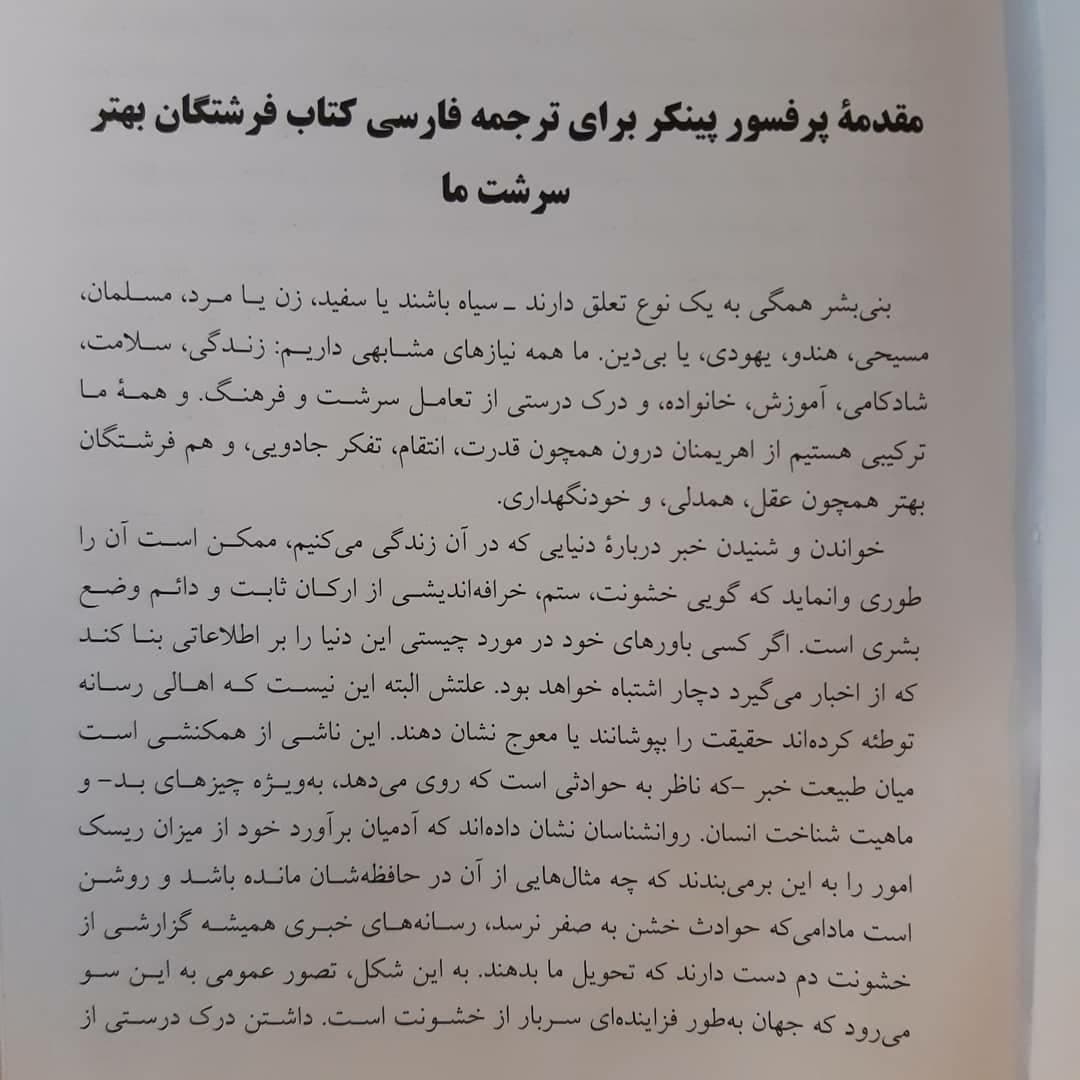
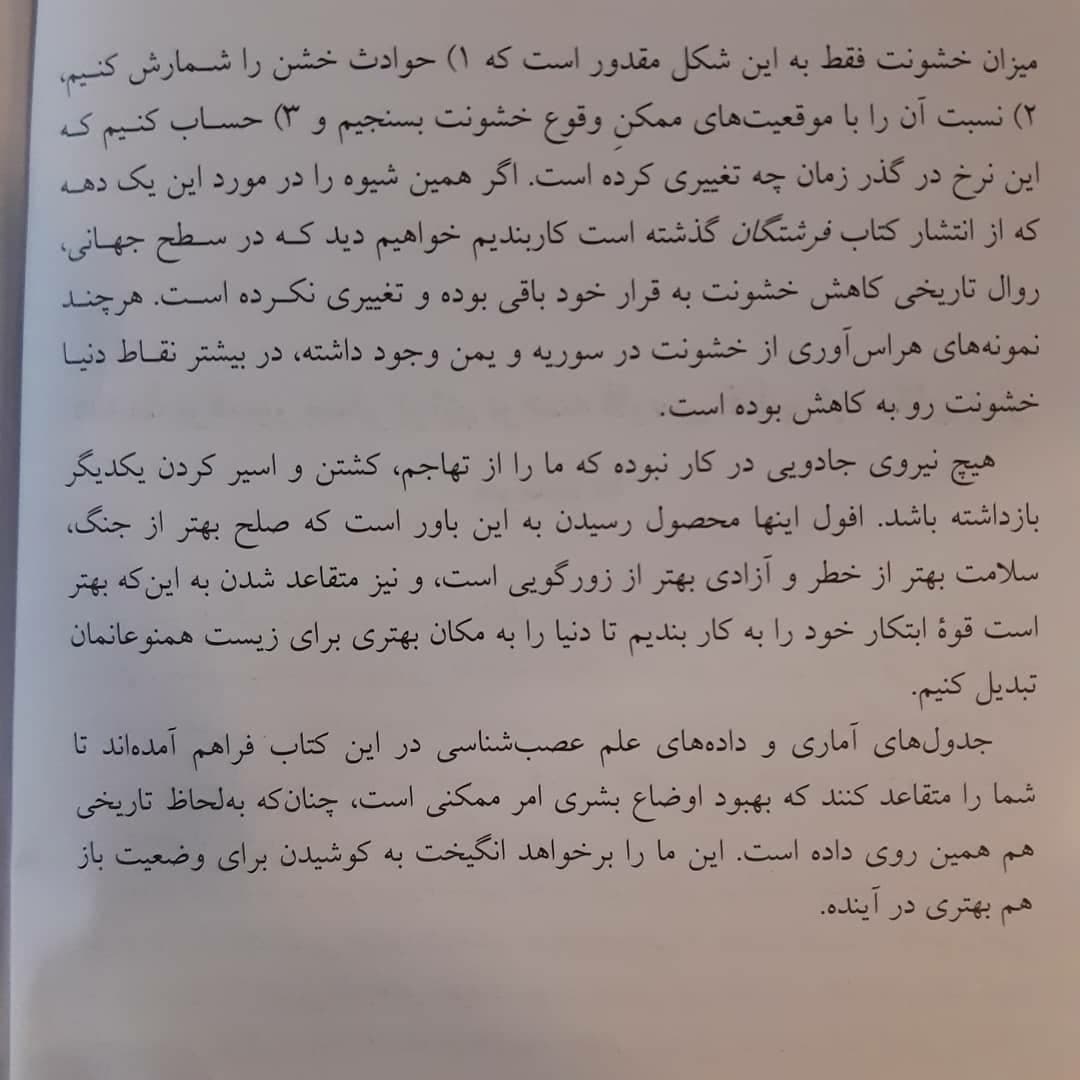
Table of Contents of The Better Angels of Our Nature:
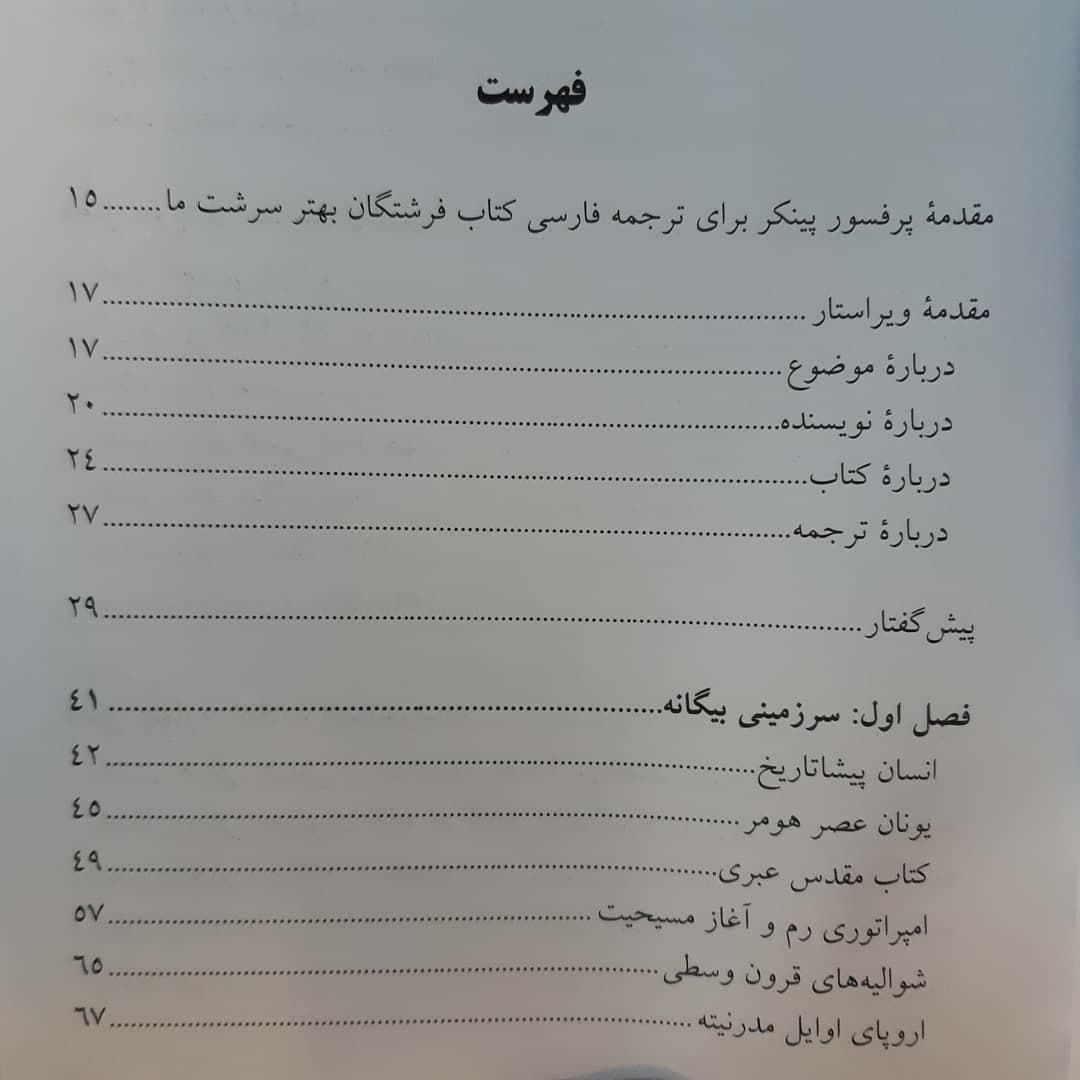
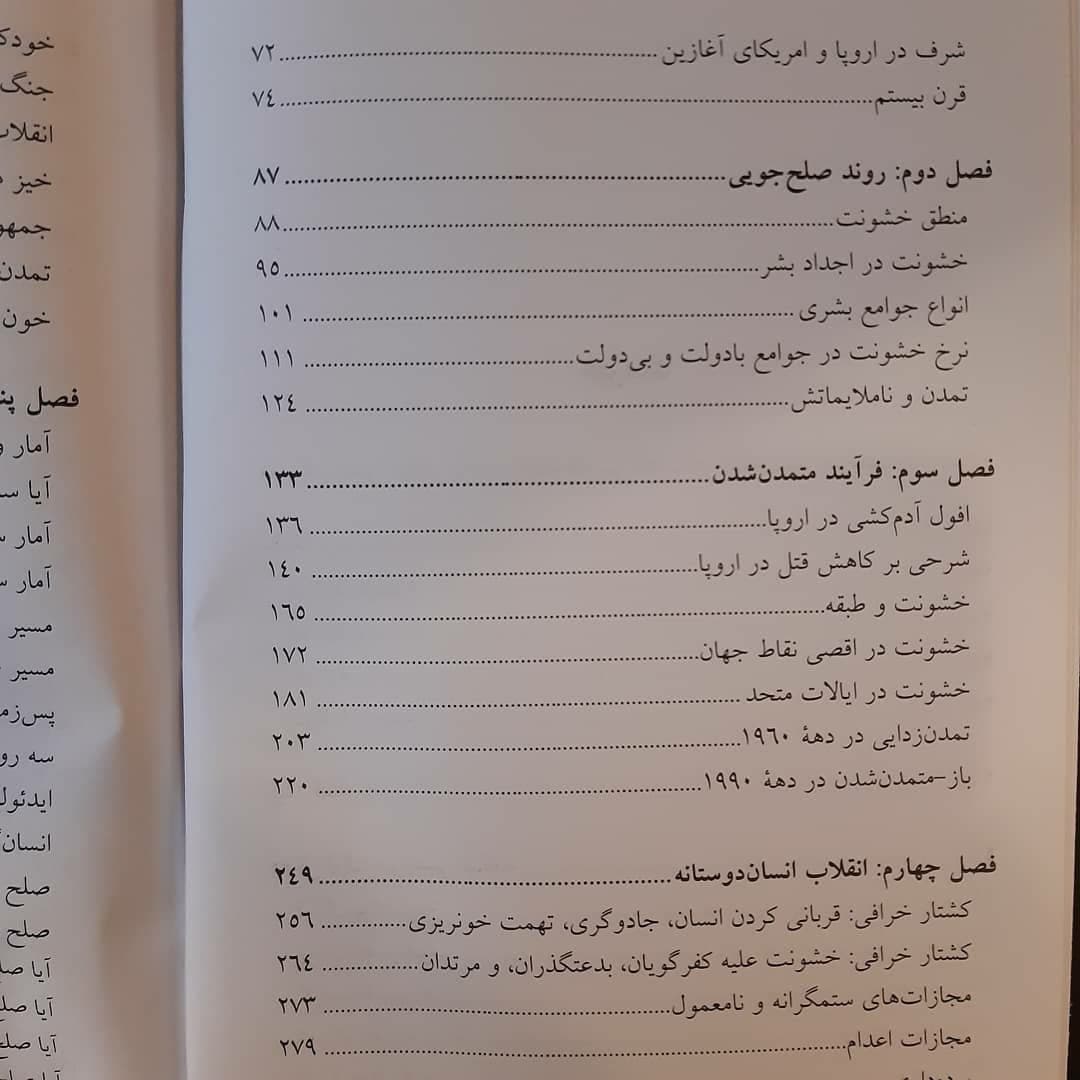

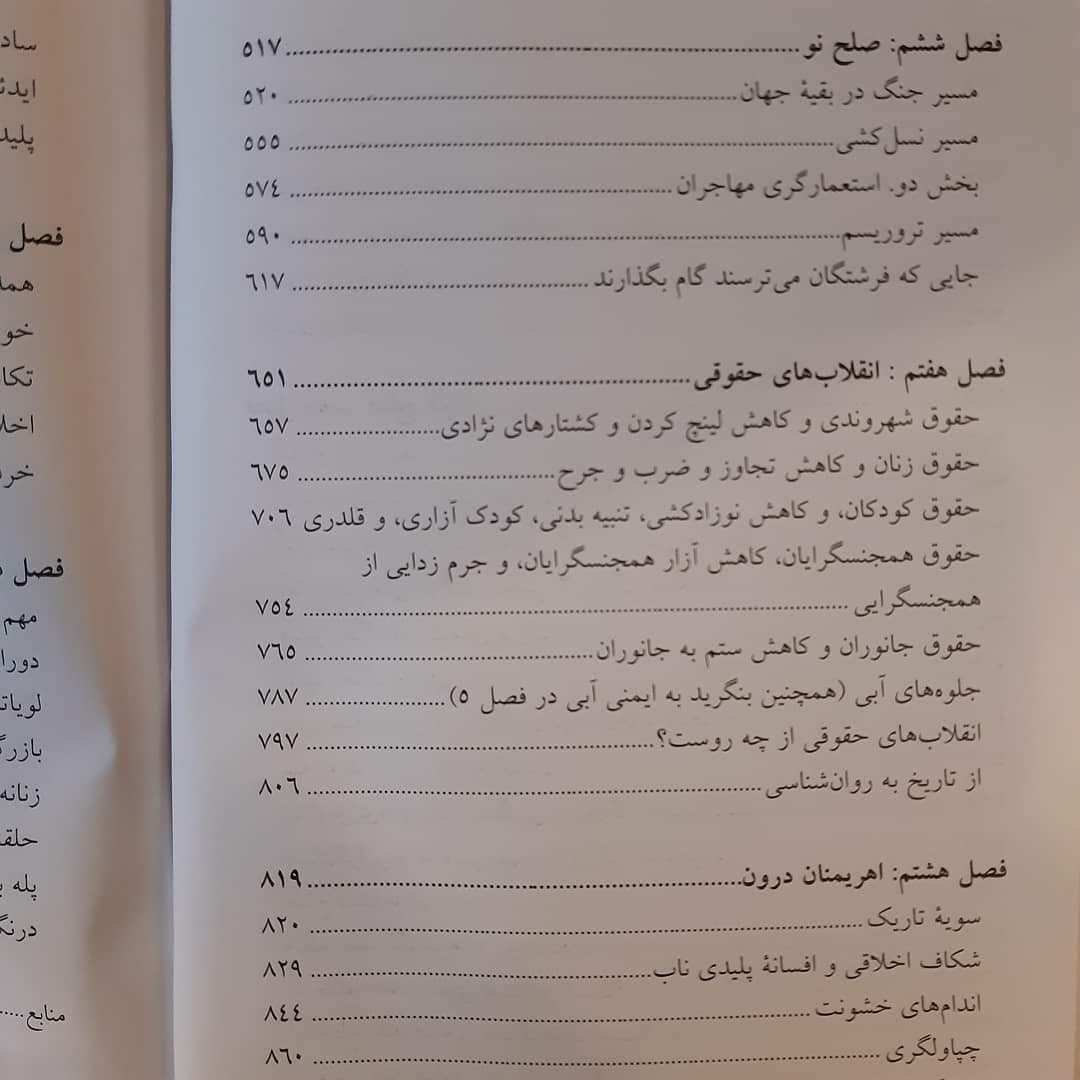
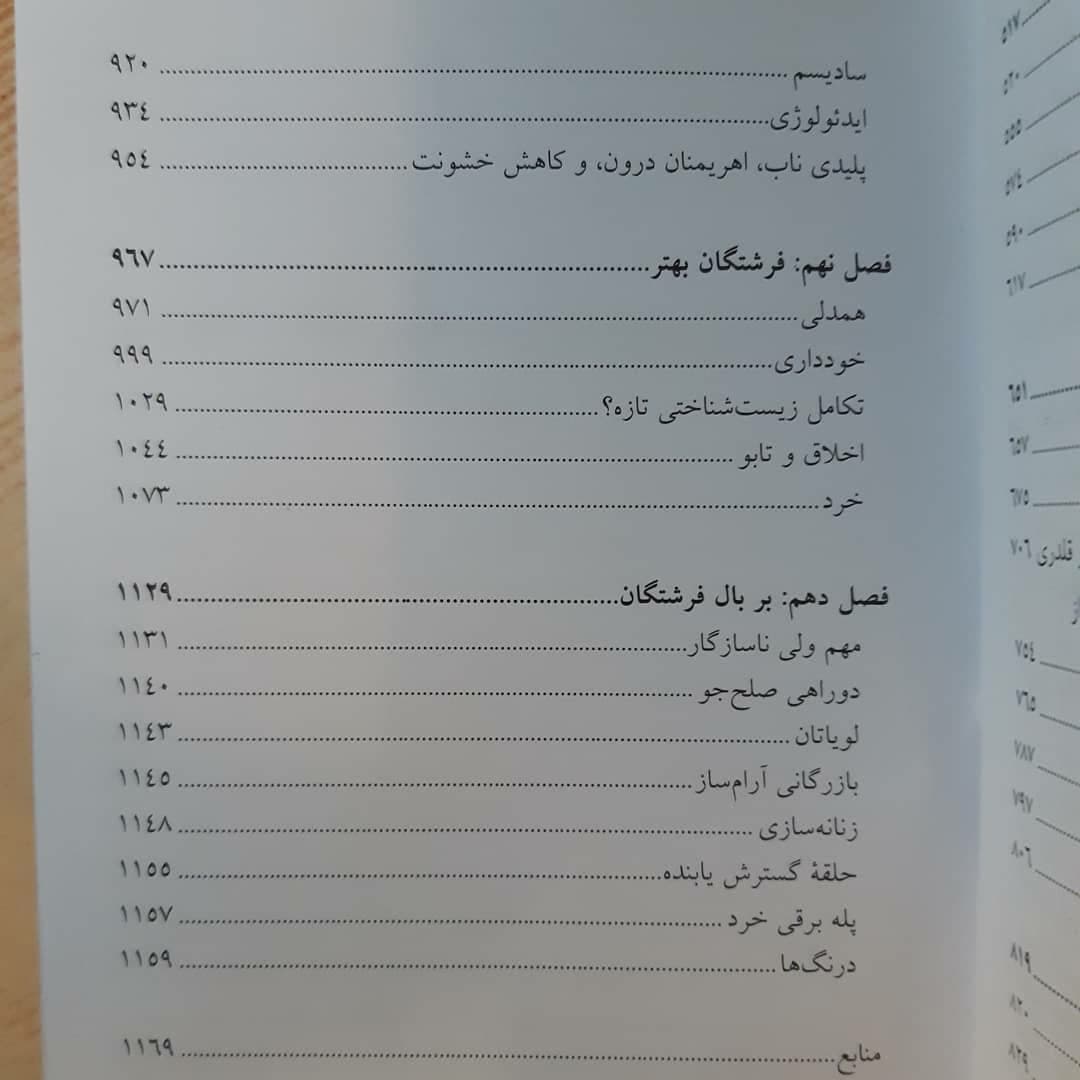
.
.
The Better Angels of Our Nature, Preface, pages 29 to 33
Nashr-e Elm and Entesharat-e Tamaddon-e Elmi
.
.





Discussion0 comments
No comments yet; let yours be the first voice.