Political Science
Introducing the Book Foundations of the Critique of Political Thought by Morteza Mardiha
Modern political philosophy established assumptions whose erroneous and damaging consequences are now evident; Morteza Mardiha's Foundations of the Critique of Political Thought seeks out the origins of this deviation and explores alternative approaches.
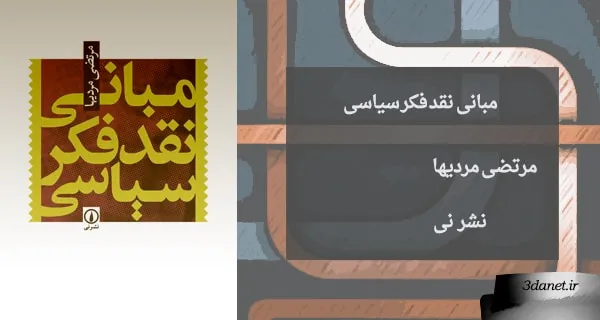
Among intellectual endeavors, the role of political philosophy and political philosophers has had greater prominence and perhaps greater influence. It was with modern political thought that the concentration of power in absolute monarchy culminated in its distribution in constitutionalism or republicanism, and it was with this same thought that liberalism, socialism, anarchism, communism, etc., by raising topics and issues such as freedom/equality, wealth/poverty, nation/state, homeland/foreigner, third world/imperialism, etc., became colossal preoccupations. But at the same time, important parts of modern political philosophy, in the form of intellectual traditions, established certain conceptions as the standard conception, which, despite their reasonable and self-evident appearance and their widespread acceptance in intellectual circles and among the public, their erroneous and damaging streaks are observable; now that the crushing weight of this discourse on thought and action has, over the past two or three decades, somewhat lessened, searching for the origins of this deviation, demonstrating its damages, and alternative methods to avoid its consequences seems necessary. The book Foundations of the Critique of Political Thought, to the extent of its capacity, harbors such an ambition.
Table of Contents of the Book "Foundations of the Critique of Political Thought":
Chapter One: The State Hidden Anarchism Epistemological Roots Romanticism and the Blank Slate Class Antagonism The Intellectual Tradition
Chapter Two: Revolution Revolution, and the Intellectual Tradition The Nature of Revolution Necessary and Sufficient Condition An Important Factor In the Absence of Revolution Symmetry and History The Function of Revolutionary Transformation
Chapter Three: Reform The New Intellectual Tradition Epistemological Roots Realism and the Gray Slate Class Reconciliation The Requirements of Reform
Chapter Four: The Foreigner Anarchism and Colonialism The Blank Slate of the South The Essence of Power International Democracy
Chapter Five: Homeland Patriotism Psychological Roots Ethnic and Civic Nationalism Denationalization Homogeneity and Solidarity Identity and Function
Chapter Six: The World National Independence Intellectuals Against Globalization Globalization and the Migration of Elites Future Prospects
.
.
Download the Introduction to the Book Foundations of the Critique of Political Thought
.
.
Mardiha, Morteza (2006) Foundations of the Critique of Political Thought, Tehran: Ney Publishing.
.
.



Discussion0 comments
No comments yet; let yours be the first voice.