Iran Newspaper's Conversation with Mostafa Malekian on Children's and Young Adult Books
Mostafa Malekian discusses the children's and young adult books published by Aseman-e Khial, speaking about writing introductions to guide parents and laying out the theoretical foundations. His focus is on the content of the works and their educational message, not on the artistic aspects, which lie outside his expertise.
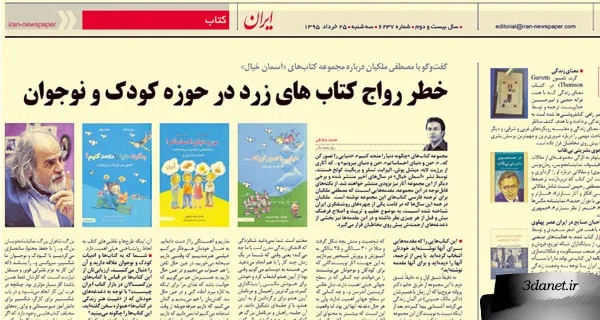
The book series “How to Unite the World,” “Imagine a World Where…,” “Me and My World of Feelings,” “Me and My Outer World,” and others—works by Brigitte Labbé, Michel Puech, Élisabeth Tessler, and Brigitte Kölch—have been published by Asman-e Khial Publications in recent years, and other titles in the series will be published soon. Among the noteworthy aspects of this series are the introductions that Mostafa Malekian has written for the Persian translations of these books. Throughout all these years, during which he has been recognized as one of the figures of Iranian intellectualism, Malekian has been concerned with the subject of education and cultural reform above and before all else, and in these introductions, a portion of his estimable concerns is laid before the audience.
Did you choose these books for which you have written introductions yourself, or did you see them after they were translated and then write introductions for them? Not exactly the first option and not exactly the second. I became acquainted with this series through Dr. Parvaneh Oroujnia, who was living in Germany at the time with her husband (Dr. Malek Hosseini). After I gained knowledge about the authors of this series, I myself encouraged that more books from this series be translated. Because some of these books were translated from French and some from German, I did not undertake the editing of these books, but since this project was very important to me, I committed to both the translators and the publisher to write an introduction for each volume. This introduction-writing seemed necessary to me for two reasons. One was that; the fathers and mothers of these children and young adults need to know certain things in order to better grasp the work that these particular books do with their children. Secondly, it seemed necessary to write a theoretical foundation for these books. So, for these two reasons, first to guide fathers and mothers, and second, the necessity of outlining the theoretical foundations regarding the presented content, I suggested that material be written, and I myself began to write. So far, some volumes of this series have been published, and two more volumes are currently in press. One translated by Ms. Bita Aziminejadan (Philo's World) and the other translated by Ms. Marjan Hejazifar (Me and My Inner World), for which I have also written introductions. Do you deal with children's and young adult literature? That is, are you familiar with this field? My interest in children's and young adult literature is very great, and at least since the year 2001, I was telling my dear friend Dr. Saeed Naji that it is necessary to pay more attention to children's and young adult books, and even before 2001, I had an interest in and attention to children's and young adult literature. For this reason, because I thought we must start from childhood, not when a child's personality and character are formed and, for example, at the age of 30 or 35, we address the person's education and upbringing. For this reason, I would read the works of authors who wrote for children and young adults. Both those who are very important on a global level, like Hans Christian Andersen and others, and those who are not important on a global level but, in any case, had this concern. But the reality is that I paid more attention to the content of these works because works written for children and young adults also possess a form, which is an artistic form. I do not have the competence in this area regarding at what age and what kind of illustrations we should use, which colors we should use more in the illustrations, what relation and proportion the text and illustration should have with each other, and so on... These are a series of very technical and complex matters of which I have no knowledge. Therefore, I did not engage with the aesthetic aspect of form, appearance, and shape. I always read the text and story written for children and young adults in terms of understanding what it says to the child and young adult. That is, I paid attention to the book in terms of content and message, and I still view it the same way now. Sometimes a publisher asks me, 'Do you think this illustration is suitable?' And I reply that I honestly don't know. My wife—Ms. Simin Saleh—has translated a book containing the teachings of Eckhart Tolle for children and young adults, which Hermes Publishing will publish. This book also has illustrations; I myself cannot understand whether these illustrations are proportionate to the text or not. Of course, they trust the German publisher or the English publisher, but when I look closely myself, I cannot really understand whether these illustrations are suitable for such content or not. But when I look at the content and see that if a child learns to slow down and knows what immense pressure haste, in the precise sense of the word, exerts on our body, mind, and psyche (that is, when we do several things at once), this is valuable. You do not know what haste, which is a requirement of modern life, does to us; that is, when you do several things at the same time. I always tell my friends that when Buddha broke away from Hinduism and founded his own school, the greatest monks and ascetics of Hinduism held a meeting with him to bring him back to Hinduism. In that meeting, each of the great monks and ascetics presented a skill. One said, 'I walk on water,' another said, 'I can traverse the earth instantly,' another said, 'I can see behind the wall,' another said, 'I can move objects with my gaze,' and so on...
Then, addressing the Buddha, they said, “Master, what do you do?” They wanted him to have nothing to say and then ask, “What kind of talk is this you speak?” The Buddha said, “I do something none of you can do.” He said, “When I eat, I just eat. When I speak, I just speak. When I sleep, I just sleep.” The Buddha had understood correctly, and in my opinion, this is more important than all those other tasks, but we are not like this. To put it in simple, conventional terms, we lack heartfelt presence in any task because we do not attend to one thing at a single time. We cannot now have even one-thousandth of the Buddha’s way in our own lives because we are constantly doing n number of things. This causes our bodies to suffer from premature aging and a thousand other unsuitable conditions, the most important of which is premature aging. Our mind and psyche are being damaged, and now when Eckhart Tolle tells our teenager how one should live, I judge that content, and if I approve, I promote that book, but not in artistic directions. I wish we had people who could, with attention to child and adolescent psychology, work better on works published for children and adolescents from an aesthetic perspective (which is very important). I do not know if you have read the book Slowness by Milan Kundera. There, Kundera shows that we lack slowness and have lost slowness. In our own minds, we think we are very skillful when, while eating breakfast, we also answer the phone, and at the same time tell our spouse to be careful to prepare our food to take to the office, and simultaneously tie our shoelaces, and we suppose we are using time economically, but we do not know what we are doing to ourselves. Kundera, of course, has shown this in Slowness in a shallower way than what the Buddha said. Although Kundera’s books have not been translated into Persian very well or completely. In summary, can you explain the importance of the books translated in this series (and for children and adolescents)? I think there are three points in the books you mentioned. One is that, of the fields necessary for teaching children and adolescents, at least three have been the focus of the authors of these books: the field of philosophy, the field of psychology, and the field of ethics. These are not the only necessary fields, but these authors, as far as I have seen their works, pay attention to philosophy, psychology, and ethics. The second point, which is very important to me, is that these books are absolutely not ideological. That is, you see, while they say everything, we do not see the author taking a position; they provide the possibility of reflection for the child themselves. For example, one of the books is about social issues; children at school discuss democratic decision-making with each other, but they do not give a final word at the end. It leaves it open, and the child and adolescent must reflect on whether democracy is preferable or not, or anything else. Regarding ugliness and beauty, regarding oppression and justice, and so on, and regarding everything, I consider this leaving things open to be important. Not drawing a definitive conclusion and not being ideological in these books is very important. The third point I will say quoting others (experts), and that is that the designs and illustrations of the book are very important from a psychological perspective. You, who are interested in and follow children’s and young adult books and literature, what is your assessment of these books in comparison to adult books in the Iranian book market? Considering your own concerns, as you have always spoken of the “absence of the art of living in books,” how do you see these books? I have no doubt that our children’s and young adult literature is better than our adult literature. That is, the percentage of books that teach the art of living is far higher in children’s and young adult books than in adult books. But a danger also threatens children’s and young adult literature, because when children decide they want a book, their fathers and mothers will definitely buy that book for them. Therefore, the publisher who publishes these books is assured of the sale of what they produce. Adults evaluate a book and purchase it, but when a child wants a book, their mother or father usually does not object. For this reason, the investment risk in producing these books is low, and this means that if there is not a high work conscience, worthless books can also be published because they know they will sell anyway.I want to say that there is a danger posed by the existence of yellow (pulp) books in this field. In my opinion, if the Institute for the Intellectual Development of Children and Young Adults had continued its former methods, I think our children and young adults would be different from the situation we see now. The best works I have read in the field of children's and young adult literature (in Persian) are the very books published 40 years ago and earlier by the Institute for the Intellectual Development of Children and Young Adults. The *Payk* publications of that time, published by the Ministry of Culture, were also good periodicals. If we could simplify world literature and make it available to children and young adults—that is, if we simplified the works of great novelists, great short story writers, great poets, great playwrights, and so on, while preserving the content, so that our children and young adults could become acquainted with Shakespeare, Cervantes, and others (which requires the resolve of strong and independent publishers whose sole task is this)—it would be a very effective endeavor. Just as this is done in the West, where there are books on Shakespeare for the worker, Shakespeare for the high school student, and for various levels, if we could also do such things, it would be very effective. In the past, the book *Les Misérables* was translated by Hosseingholi Mosta'an (in two volumes), and at the same time, several abridged and simplified versions were also translated and published for young adults so they could grasp Victor Hugo's message in a charming story. I remember that Gevorgis Aghasi also translated and abridged *Les Misérables*, which was excellent and had a great impact on me. I was in the first year of high school then; I would give the book to my friends, and I remember with what regret they would return the book to me because at that time it was not very common for people to buy books. Then I would give the book to other classmates, and I remember that they all loved the book. At that time, the book *The Hunchback of Notre-Dame* was also translated and abridged, and although it seems not very comprehensible for children and young adults, it too was translated into Persian. We need world literature, whether novels, poetry, or otherwise. Recently, Mr. Mohammadreza Parsayar has also translated *Les Misérables*, which is a very good translation. If our young people patiently read *Les Misérables*, it would be very valuable and impactful for them because it contains life lessons from various dimensions. Both the stories and the digressions in this book contain important points. For example, when the story speaks of Javert's strictness in legalism, in a chapter it also discusses to what extent we should or should not adhere to the law. These very texts that emerge from the story (the digressions) are truly, on their own, a deeply instructive book.
.
.
PDF file of Iran Newspaper's Conversation with Mostafa Malekian on Children's and Young Adult Books
Download from Server 1 | Download from Server 2
.
.
Conversation with Mostafa Malekian about the "Aseman-e Khial" Book Series
The Danger of the Proliferation of Yellow Books in the Field of Children and Young Adults
Iran Newspaper, Tuesday, June 14, 2016, Page 12
Mohammad Sadeghi | Journalist
.
.

Discussion1 comments
عالیه آقا. من دو تای اول رو خونده ام و شایسته می بینم که همه ی بزرگسالان اول بخونندشون و بعد هم برای بچه هاشون باز تعریف شون کنند یا بخونند یا بدن دست شون. اگر کتاب های بعدی هم از این دست باشند، چه عالی تر. ای کاش! ای کاش، مدارس ما به جای اوون خوراک های جناب حداد، این خوراک های ناب رو با بچه هامون به بحث می گذاشتند، کاش! کاشی که کاشته می شه، اما سبز بشو نخواهد بود!