Sociology
Iran Newspaper's Interview with Kourosh Safavi: 'The Condition of Us Iranians Through the Eyes of a Linguist'
Linguist Kourosh Safavi argues that the psychological traits of a society can be discerned through linguistic analysis. Pointing to aggression and haste, he stresses the need for a plan to reform linguistic culture.
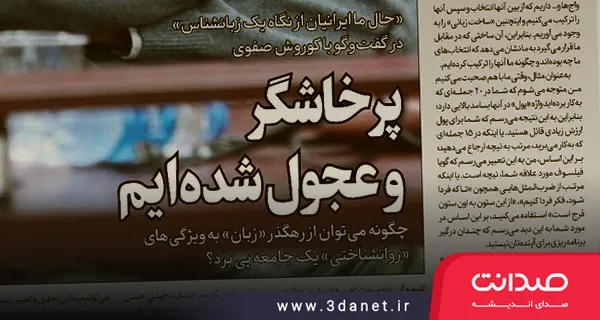
Iran Newspaper's Interview with Kourosh Safavi
The Condition of Us Iranians Through the Eyes of a Linguist
We Have Become Aggressive and Hasty
How can one discern the "psychological" characteristics of a society through "language"?
Reporter: Mahsa Ramezani
Source: Iran Newspaper | 13 January 2020
Some time ago, in a conversation we had with sociologist Maghsoud Farasatkhah about "the place of love in the Iranian lifeworld," he spoke of the distortion of society's emotional structure and believes that "language" is one of the manifestations of this distortion. Farasatkhah referred to research that, citing three dictionaries—"Amid," "Moin," and "Contemporary"—revealed that in the Persian language, the number of words with an "emotional" charge is far greater than those with a "cognitive" charge, and even among these, the number of words with a "negative" emotional charge is greater than those with a "positive" emotional charge. Based on this, Farasatkhah, as a sociologist, concluded that "we are an emotional society, and these emotions also carry a mostly negative charge." The raising of this point by Farasatkhah and the question of "How can one discern the psychological characteristics of a society through language?" became the reason for our conversation with Kourosh Safavi. He is a distinguished linguist and professor at Allameh Tabataba'i University who, alongside linguistics, also pays special attention to philosophy and has endeavored, while specializing in his field of study, to enter other domains with an interdisciplinary perspective. Safavi has a prolific record in authorship and translation; among his works, one can point to books such as "Narrative," "Metaphor from Another Perspective," "Wandering in the Philosophy of Literature," "An Introduction to Semantics," "Languages of the World," and "An Introduction to Writing Systems," and among the books that have been clothed in Persian through his efforts, one can name "Structuralist Poetics," "Language and Thought," and "The Circle of Silent Philosophers."
Mr. Safavi, can one discern the psychological characteristics of a society by studying its language?
When we study language within the framework of "language structure," it means we have a linguistic system with a set of units, including words, syllables, phonemes, etc., from which we select and then combine them, thus creating a "linguistic structure." Therefore, the structure that confronts us shows us what our choices have been and how we have combined them.
For example, when we talk to each other, I notice that in the 20 sentences you have used, the word "money" has a high frequency; therefore, I conclude that you place great value on money. Or, in the 15 sentences you use, you constantly refer to Nietzsche; based on this, I arrive at the interpretation that your favorite philosopher is apparently Nietzsche. Or you constantly use proverbs such as "Let's think about tomorrow when tomorrow comes," "There is relief from this pillar to that pillar"; based on this, I come to the view regarding you that you are not very involved in planning for your future.
In this respect, it can be said that through "language" we are able to examine a set of behaviors in a society; if a society's language is good, we can evaluate the society's behavior as satisfactory, and if we do not diagnose a society's linguistic behavior as good, we can sound the alarm and say, for example, that people have become liars, aggressive, or hopeless. In this way, one can discern the psychological characteristics of a society from the analysis of its language.
What help does arriving at such a linguistic and behavioral analysis in a society provide us? Is a society's language or behavior programmable so that, by diagnosing its flaws, we can once again guide the society's language and behavior onto the right path?
A society must plan for the future and should not merely settle for the data that people have become liars, aggressive, or hopeless.
When it is announced that women cannot go to the stadium because men use foul language there, we must examine why such harsh behavior arises from the men of our society so that we can undertake the necessary planning for it. Let me clarify and explain my point with an example:
In the period after the Civil War in America, the southern states fought against the northern states. After the end of the Civil War and Abraham Lincoln's victory, the northerners defeated the southerners, and the people of the southern regions, including Texas and the areas reaching toward Mexico, were very "foul-mouthed." The reason for their foul language was their association with slaves, and one of the ways they imposed themselves on the slaves was through speaking harshly, and this verbal violence had become a habit for them. For example, instead of saying, "Sir, please dig here," they would say, "Dig, you wretch." In the north of the country, they called this type of person who spoke with such language a "Texan." For nearly 50 years, the U.S. Department of Culture planned to elevate the culture and linguistic behavior of the people in the southern states, and through this planning, conditions improved. Therefore, I believe a series of language planning initiatives is necessary so that we can work on the linguistic and behavioral culture of society and guide it toward positive changes.
As a linguist, analyzing the language of our current generation, how would you describe the condition of Iranians?
The changes that occur in language must be examined generation by generation. Therefore, I cannot say that from one day to the next, people have become more deceitful, more violent, or more hopeful. Such an analysis can be reached more quickly through individual behaviors, which are examined by a psychologist. When we put individual behaviors together and view them as "social behavior," a sociologist can arrive at an analysis of the psychological state of society.
Thus, to examine the psychological characteristics of a society, first the "psychologist" reaches an analysis, because they deal with people one by one; the next rank is the "sociologist," who, by studying the whole society, arrives at the psychological characteristics of a society; and finally, it is the "linguist" who can offer such an analysis, because the function of language is a time-consuming matter.
A linguist can say, based on conjecture, that, for example, our people have become more violent or more indifferent toward one another. For this reason, if someone asks me, "What reason do you have for the claim that 'people have become liars, violent, and indifferent'?" I must say, wait 50 years for me to give my reason; because a linguist must examine the frequency with which the words used today will occur in the future. Therefore, even within the field of linguistics, "psycholinguistics" discerns the psychological state of society sooner, then "sociolinguistics" arrives at these psychological characteristics, and finally, "theoretical linguistics" reaches an analysis.
With all this, I can say that, based on the form of language use in the current generation, I suspect the condition of our people is as follows:
First, everything is unimportant to us. Second, we have little hope for the future. Third, we lie a great deal. Fourth, we have become very violent. These are a warning sign; because this trajectory has been continuing for three or four generations, and people have steadily become more hopeless, more violent, and more indifferent.
If I had asked someone 40 years ago, "What are you going to do in the next ten years?" in a gathering of about a hundred people, almost everyone had a plan for the next ten years; for example, they wanted to become a pilot, a ship captain, a teacher, a writer, a merchant, and so on. But if you pose this question to people today, out of every hundred, eighty will say, "Oh, come on!" For a linguist, "Oh, come on" means that I have no plan for the future and am not even very optimistic about it.
Suppose we enter a society and conduct a field study of its language, and then the results of the field research tell us that a high percentage of people, when speaking, swear profusely; to the point where even when we ask someone, "What time is it?" they reply, "Wallah, it's eight," or, for example, when we ask someone, "Where is such-and-such street?" they reply, "By God, I don't know." The interesting thing here is that based on how much value that statement holds, the oaths also become stronger; for example, when we go to a car showroom and ask, "Sir, hasn't this car been repainted?" the person responds, "May I shroud both my children with my own hands, it hasn't been repainted." By examining these sentences and others like them, we find that individuals, based on the value of the statement they are making, employ an oath that holds higher value.
We Iranians swear by everything; our father, mother, blessings, our children... This data, for a linguist working in the field of "sociology of language," means that this society tells many lies and individuals constantly try to exonerate themselves from the common practice of lying by "swearing oaths."
Therefore, based on linguistic structures, we can arrive at this analysis and interpretation of whether the people of a society lie or not. In this regard, numerous examples can be given; consider a person throwing a bag of trash from the third floor of an apartment building into the street. When you object, instead of apologizing, they say to you, "Well, what's the big deal?"
Or another example is that in an apartment complex, neighbors pass by each other but do not greet one another. When we put together these behaviors and the sentences exchanged during these interactions, we realize how much interaction in our society has weakened.
Certainly, a sociologist or psychologist considers certain coordinates to describe and explain the behavior of a society, but a linguist arrives at an analysis and interpretation of their society's psychological state through "language." How many times people apologize to each other in a conversation, how many times they greet each other, when they greet, how much they want this interaction to continue—all of these are indicative of a society's temperament, which can be grasped through the "study of language."
For example, when someone wants a relationship to continue, after exchanging pleasantries, they repeatedly say, "What else is new?", "What else?", "Tell me more," but when they have no desire to continue the interaction, they use phrases like, "Do you have any other business?", "Well, please let us know how we can be of service," and so on, to make the other party understand that they do not want the interaction to continue. It seems our people use this latter type, meaning the "termination of relationship" structure, more often. A linguist obtains this point from studying the linguistic structure of a society, but a sociologist might detect people's reluctance to form connections in their behavior at a party; in the sense that individuals, rather than having a desire to converse, occupy themselves with their phones or their dogs and cats.
From these remarks, I want to arrive at this point that it is as if we have deeply internalized a "culture of distance." Anywhere in the world, if two people from Burkina Faso see each other, they go to one another and socialize. But we Iranians abroad, when we see two people speaking Persian in a supermarket, not only do we not acknowledge it, we even try to get as far away from there as possible! It seems this "distance" is part of our culture; meaning individuals use "silence" instead of "language."
This "culture" differs from "cultural heritage"; the fact that we set up a Haft-Sin for Nowruz, or that we have Persepolis, and so on... these are our cultural heritage and have nothing to do with the social behaviors of our people. We have had this heritage. But when we refer to the social behaviors of today's society, we encounter an aggressive culture in which "lying" and "violence" have a high frequency. When sociologists, psychologists, and linguists encounter these signs, they sound the alarm that people have become violent and do not refrain from lying. This is while in our cultural heritage, we continually emphasize that "the liar is the enemy of God," but we do not have the proposition that the murderer, the criminal, and the fraudster are the enemy of God; why? Because when we read our literary texts, it is said that corruption begins with lying and progresses, so the birth of corruption is created through lying. And this process is completely recognizable and identifiable in the language of a society. For example, we take words that are chained together through lies and use other words. Suppose a person has a cousin in a certain bank, takes a loan of 100 billion tomans from there, and registers his two-year-old son's name as the CEO of a company. This person is a thief, but people call him "clever"! That is, instead of the word "thief," they use the word "clever" for him; instead of the word "fraudster," they say "capitalist." That is, they use words with a positive emotional charge instead of words with a negative emotional charge for this person. What has happened here from a linguistic perspective? Our "cultural heritage" asks me to use the word with a negative emotional charge; that is, to say he is a thief. But our "culture" suggests a word with a positive emotional charge for us to use; don't say "thief," say "capitalist." When we increase or decrease the units whose emotional charge must be precisely defined, we cause different interpretations of that same linguistic unit to arise, and based on our usage of that linguistic unit, we assign an emotional charge.
You mentioned that the US Department of Culture put programs on its agenda to improve the culture and linguistic behavior of the people and was largely successful. In your opinion, by improving the culture and linguistic behavior of the people, how much can we help improve the moral and psychological condition of society?
As I speak with you now, I am a linguist; but when I leave this room and enter the street, I am just another member of my society. I mean that I myself may have become more violent compared to thirty or forty years ago. For example, if a motorcyclist bumped into me on the sidewalk before, I would be surprised why the motorcycle entered the sidewalk, and if he bumped into me, I would ultimately be astonished why he behaved so unreasonably. But today, when such an incident happens, not only am I not astonished, but I also curse at him! As if I myself have become more aggressive. I see this violence in myself as well. The reality is that we have communicating vessels; one issue becomes a pretext for other issues; issues present themselves to us in a chain. Therefore, we are not just dealing with a single phenomenon that has a single, simple solution. For example, to say, "Your fingertip is wounded, put a bandage on your fingertip." Temporary treatments may be effective, but they are not lasting. Conditions must be such that the people themselves distance themselves from violence, indifference, despair, and lying. In this regard, social, economic, and political conditions are more influential than "language"; because social, economic, and political conditions govern all our behavior.
Does language affect our thinking, or is it thinking that shapes our linguistic structure and characteristics?
There are two different theories: whether the mind influences the type of language, or whether language influences the way of thinking. What I believe is that we first receive information from the external world, and then, when social conditions are ready, we use language. Therefore, the brain tells me what structure my language should have. We believe that language is a conventional category. But on the very first day, with what language did early humans want to establish a convention? Everything was natural. The human brain progressed with the limitations of human perception. We were limited to human perception. Therefore, first our brain had to make selections and combinations; one of the types of these combinations took the form of language. Thus, first comes the 'psyche,' and then 'language' emerges.
If we accept that language is influenced by the psychological characteristics of a society, when the death of a language is discussed, what psychological issues in that society should we be concerned about?
As long as a language has speakers, it does not die. Therefore, from a linguist's perspective, no language is in danger, unless no human being speaks that language.
For example, there was a language called Tajrishi in Tehran, and those who came from the city of Rey had no understanding of this language. The Syriac language, and so on... these are considered dead languages. But why is no one worried about them? Because there is no longer anyone who speaks these languages. Therefore, no language is in danger. Languages are inevitably forced to adapt themselves to the technologies advancing in the world of technology. For instance, when we send a text message to a friend, we are compelled to convey the message in a short form so that it fits in one text. Hence, many times instead of 'it is not worth it' we prefer to write a shortened, colloquial form. I, as an editor sitting on the sidelines, say to myself, 'Oh dear! This style of writing has endangered the Persian language!' While from my perspective as a linguist, the reality is that the Persian language itself emerged through these very transformations, and if my words as an editor in the Achaemenid period had been so influential that everyone spoke as I did, we would not have this modern Persian today. In essence, modern Persian is the incorrect and corrupted form of Middle Persian used in the Sassanian period, and a much more corrupted form of Old Persian used in the Achaemenid period.
Therefore, from a linguist's perspective, language does not change through our speaking incorrectly; rather, language adapts to its temporal and spatial context; like water that we pour into a rectangular container and it takes a rectangular shape, and when we pour it into a spherical container, it takes the shape of a sphere. This is while no water has been lost; it has only changed according to its container. Language also adapts itself to its container. When the speed of communication increases and we become involved with technology, naturally, language also becomes involved with technology, and changes occur in it. This does not mean the death of the language, or as some say that the Persian language is endangered; from a linguist's perspective, this assertion is not very consistent with reality. Now we have electricity in all our homes; before Edison, people did not have electricity. Therefore, a power outage did not harm them because they did not even know what electricity was. But now that electricity has been invented, a part of our life has become contingent and dependent on it. When the power goes out, we feel our life is paralyzed. Language is the same. With the speed at which technology advances, we simply do not have time to find equivalents and coin words. For example, consider the word 'helicopter'; by the time we hold a meeting and reach a consensus on its equivalent, whether it should be 'balgard' or 'charkh-bal,' many other technologies have entered our society for which we must find equivalents.
The concern of many editors stems from the idea that loanwords damage the language. But in my opinion as a linguist, this is not the case. Clothing, language, behavior, and so on... these are coordinates that distinguish generations from one another. How can we force the generation after us to dress and behave like us? Language is the same, and we cannot ask today's generation to speak exactly like their grandmothers and grandfathers. We must know that this linguistic change in the new generation in no way leads to the death of the language and does not endanger it.
You spoke about the impact of technology on linguistic structure. Very often, instead of expressing our feelings, we use "emojis" in written conversation; it's as if we can't be bothered to use language to express our states. Can such uses of language, or what we witness in virtual spaces, pose risks to the Persian language and our standard language?
Let me explain this with an example. When you have passed the university entrance exam and you message your friend, "I passed the entrance exam," and then put a smiley emoji after it, you no longer need to explain that you are happy about it. But consider a situation where you and I have agreed that if you don't pass the entrance exam, I will send you to Paris to continue your studies. In this situation, you message me, "I passed the entrance exam," and then send a sad emoji; meaning, my trip to Paris is now canceled! Here, all the promises we had made to each other are activated in my mind by a single sad emoji from you.
As you pointed out, these stickers and emojis essentially do the work of a set of sentences for us. When I am supposed to declare my love to someone, I might have to use, say, 15 consecutive sentences for them to understand that I love them. Whereas, instead of those 15 sentences, I can send a rose and convey the same meaning to them much faster. Therefore, the use of these emojis has no negative impact on our language, except that we are using another sign system alongside formal language. You might sometimes say that when I use these emojis, my sentence structure becomes incorrect or my communication is disrupted, but if that is not the case, there is no problem. So, as long as our intended meaning is correctly conveyed to the other party in this way, from my perspective as a linguist, language has been used correctly and is not at all endangered.
In fact, do these emojis function like body language?
Body language itself is fundamentally one of the sign systems that has always assisted language. Now, alongside it, other sign systems have been added today, and these are all aids and in no way disrupt the function of language.
You mentioned that one of the uses of emojis is the speed of conveying concepts through them. To what extent does the use of these stickers relate to the dominance of the "culture of haste" in us, that we are in a hurry to convey the concept and can't be bothered to use language?
Yes, that's right. The reality is that these are all interconnected vessels; incidentally, this haste is also a part of that same violence. When someone cannot tolerate waiting behind another car for 5 minutes, even though 20 hours of their 24-hour day are spent idly, and they just lean on the horn, it somehow evokes the same violence that manifests itself in haste. This is while we have a cultural heritage that condemns haste, saying, "Haste is the work of the devil." If we collect these proverbs and place them before us, we conclude that Iranian culture progresses with tolerance, reflection, and patience. We take great pride in this saying, but what do we do in practice? Many times, coming down from Jordan Street, I encounter a vast array of Snapp delivery riders, fast-food couriers, etc., riding motorcycles on the sidewalk at high speed. Once, I said to one of them, a hundred meters back, you had thrust your motorcycle's handlebar into my kidney and were moving on the sidewalk at such speed that I thought you were carrying a pill, medicine, or bandage for someone in critical condition. But now, after all that rushing, you're sitting and smoking? What was all that haste for? He looked at me and said, to get there sooner! And I asked again, get to what? These are the kinds of cultural issues whose reasons must be analyzed with the help of psychologists and sociologists.
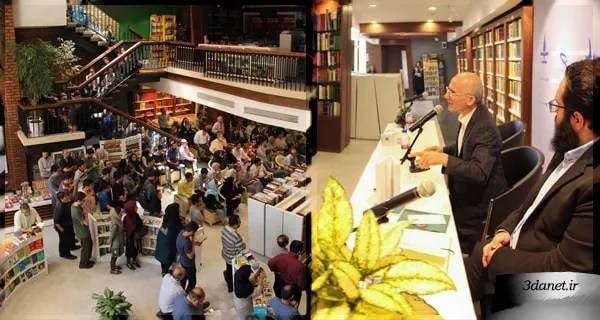
In a session recently held for the unveiling of your book 'Narrative,' you spoke about philosophy, considered it the mother of sciences, and said that in whatever field we study, we must arrive at a perspective, and philosophy can help us reach this perspective. How does philosophy help a linguist?
Philosophy is like a mother to whom all sciences are children. It teaches us how to think. Therefore, whatever our academic discipline or field of study, it does not make us needless of philosophy. We must learn 'how to think' from philosophy, and it is through thinking that we find our roadmap in our own academic discipline or field of study.
Philosophy and philosophers provide us with all kinds and manners of thinking. Now, let us do an exercise together; of course, this exercise is proposed by Kant. Imagine an island where there is no living creature. In other words, there is no ear at all; there is no human, no dog, no cat, nothing at all. On this island, a dried-up tree falls to the ground and breaks. In your opinion, does this tree, falling to the ground, make a sound or not?
It makes a sound...
You believe it makes a sound, but a number of philosophers believe we define sound based on the 'ear.' Therefore, when there is no ear, there is no sound at all. However, others believe that sound exerts its pressure there and produces a wave. Thus, the absence of an ear is not a reason for the absence of sound. If there were an ear, it would hear the sound. Neither of these two propositions is problematic. But when we look, we see that you and I have a difference of opinion about this island; one says there is a sound, and the other says there is no sound. Consider this same atmosphere regarding a research project; each group might arrive at an answer through a different path and method. Philosophy teaches us these paths and methods of thinking, and this is why I believe philosophy prevents dogmatism. Dogmatic and radical people are those who do not read history and philosophy. A study has been conducted showing that among Europeans who became involved with ISIS, out of every 100 of them, 60 had technical or medical educations; but no philosopher was among them. This is because in technical fields, individuals are only engaged with that specific technique, but those who read history and philosophy understand that this is merely their own word and opinion, while thousands of other viewpoints and perspectives also exist. In fact, what I mean is that philosophy teaches us that not all truth resides with us, and this perspective can elevate our spirit of tolerance and develop our power of thinking. It is for this reason that I believe philosophy must be taken seriously, and no one is needless of philosophy, not even a linguist.

Discussion4 comments
با آرزوی تندرستی برای استاد ارجمندم جناب دکتر صفوی
سلام و تشکر از مقاله خوب و عالی شما
عالی بود
درود بر شما عالی بود و اثر گذار موفق باشید