Sociology
Etemad Newspaper Interview with Maghsoud Farasatkhah: “Migration; A Driver of Socio-Political Development”
Maghsoud Farasatkhah views elite emigration not as brain drain but as a driver of Iran's socio-political development, outlining models of circulation, acquisition, and diaspora. He stresses the importance of enabling migration to internationalize citizens.
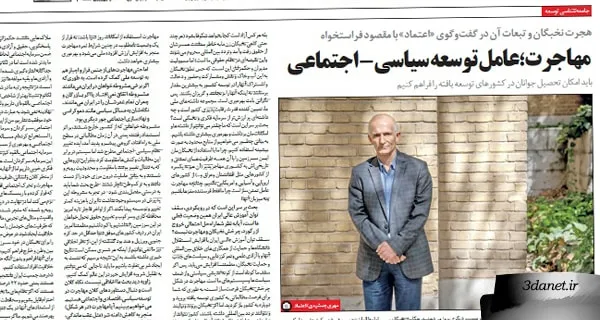
Bamdad Lajevardi: Elite migration is not solely an Iranian issue and has become a global phenomenon; today, experts in the fields of social planning and sociology have designed various models to explain elite migration, such that a consensus has now emerged among them that the term “brain drain” is largely obsolete and no longer has the explanatory power to account for the migration of elites from developing to developed countries.
For this reason, in this interview, Maghsoud Farasatkhah recounts the recent models of elite migration and explains each of them with regard to the current state of elite migration in Iran. In his conversation, he named the elite circulation model, the elite acquisition model, and finally the diaspora model, and assessed the capability of each of these models to describe Iran’s current conditions.
He also, in his interview, by providing examples from Iran’s contemporary history and explanatory models in the world, evaluated the issue of elite migration throughout history and ultimately refers to elite migration as one of the serious factors in Iran’s development.
In summarizing his conversation, he noted: “Migration has definitively led to Iran’s political and social development throughout history. We must also have the development of migration now. We must facilitate the possibility of Iranians migrating to developed countries and create this opportunity for the country’s citizens to become international and interact with a pluralistic world.”
If we review the pattern of prominent contemporary migrations, one could propose the hypothesis that elite migration has caused socio-political development, and from a macro perspective, the country has not been harmed by these migrations. To what extent do you agree with this hypothesis?
We can compile a long list of elites who migrated in the contemporary era and then conclude that their presence and activity in developed countries not only did not harm Iran but also led to innovation, change, and development. If we consider the normal model of migration for education or work assignments, our prominent elites—from Mirza Saleh, Kamal-ol-Molk and Hekmat, Gholamhossein Rahnama, Seddiq, Siasi and Davar to Mosaddegh and Bazargan—migrated (in the 12th century alone, about a thousand Iranian elites went abroad for education). Both they and the elites who migrated out of political compulsion were among the most important agents of change in our contemporary history.
The data of those who migrated in the country’s contemporary history are valuable data, but it depends on how we interpret, construe, and deduce from this data and what conclusions we draw from it. In other words, data are hungry for meaning. It is neither appropriate nor logical to present incorrect and misleading interpretations of this valuable data. So we must exercise great sensitivity in making sense of them; because we might draw incorrect conclusions from correct premises, just as it is possible to draw correct conclusions from incorrect premises.
For example, with the Ptolemaic system, they sometimes predicted lunar and solar eclipses. When the prediction turned out to be correct, it was assumed that the Ptolemaic foundations were correct, but today there is a consensus that Ptolemy’s theory was theoretically problematic. So it is incorrect to claim the validity of premises merely because of useful practical results, nor is it always the case that we derive correct inferences from correct premises.
The experience of Iran and other countries shows that the complete elimination of elites is an extravagant fantasy. If restrictions are imposed on the path of elites, due to the high mobility capabilities they possess intellectually, epistemologically, motivationally, artistically, socially, and globally, sooner or later they will find an alternative path and manifest their capability and talent in another direction.
The story of elites is the same as the story of the beautiful-faced one who “cannot endure concealment, if you shut the door, they will peek out from the window,” meaning that the elite, by their very elite nature, refuses to submit to limitation and is in search of a crack and an opening for self-expression and the manifestation of their talent.
But one should not conclude from these premises that there is no problem in Iran called elite migration. Does not society have the right and the need to make optimal and maximum use of the elites it has nurtured in its bosom? It is therefore logically flawed to say that since elites, even if they leave this land, will eventually become a source of transformation, we should sit back and take it as a good omen, so that through various forms of harassment and driving them away, the means for their migration are provided, and we need not worry about their departure.
Today, the world's societies are in a state of intense competition with one another over the degree to which they benefit from human capital. The intellectual and communicative capital of elites is the wealth of a society and increases the enabling conditions for that society's development. Today, critics even in European countries debate why the rate of brain drain from their countries to Australia, America, and Canada is high.
Evidence shows that the connection of Iranian elites with developed countries has led to an increase in human capital at both the individual and national macro levels.
Traditionally, the Brain Drain model was used to explain elite migration. This pattern referred to elite migration as brain drain. Brain drain only explained part of the issue of elite migration, whereas the term brain drain could not express dimensions of the matter of elite migration. Therefore, the brain drain model needed improvement and development.
In this regard and in line with developing the brain drain model, the Brain Circulation model emerged. This model argued that the term 'drain' should not be used for brains. In this model, brains circulate around the world. This model explains that with the circulation of brains, an opportunity is provided for a territorial domain so that the brains that have left its territory can periodically come and go to the country, and their capacity can be utilized.
But the brain circulation model also could not adequately explain the process of elite mobility in the world. Consequently, the Brain Gain model, meaning the acquisition of brains, was proposed. This model sought to understand how elites could become a source of national added value. This model showed that elites, even if they do not return to their original territorial domain, would be able to contribute to national added value.
In this model, instead of emphasizing the elite's place of residence and physical presence, the emphasis is on the impact of their productions, knowledge, thought, art, and meanings on their country's national added value, provided, of course, that their sense of national belonging remains. Therefore, proponents of this model evaluate countries based on how much elites have been able to contribute to national added value; regardless of which geographical point or country they live in, they can become a factor in gaining national added value benefits for their country.
But empirical studies determined that even the brain gain model is incapable of explaining certain dimensions of the matter. For this reason, a more developed form of this model was articulated, and thus another concept under the title of Diasporas, meaning dispersed national identity, was introduced.
This concept refers to elites who belong to a land but are scattered in other parts of the world. One of the largest dispersions of elites relates to China, such that today China, or India, and the Jews have a dispersed identity in the world, and through them, they gain political and economic credibility and influence in the world.
The focus of this model is on how talents and elites are managed, such that in this model, if talent management exists in the country, the presence of that country's elites in more developed regions can bring about achievements.
If you were to explain the diaspora model regarding Iranian migrants, how would it be?
The diaspora model tells us that Iranians, even if they are not present within the geography of Iran, are still considered Iran's intellectual, human, and social capital and can increase Iran's competitiveness capacity and be influential at various junctures and even play a political role.
For example, several years ago when challenges arose over the name of the Persian Gulf, to the detriment of Iran's national identity, Iranians abroad reacted much sooner than Iranians inside the country. This action by Iranians abroad is understandable through the diaspora model. The diaspora model states that brains have been influential wherever they have been.
But what is important is the "sense of belonging of the elites" to their homeland. If a sense of belonging to the homeland exists among the elites, and they maintain the necessary constructive interaction, participation, and connection with their country's governance, managerial, technical, economic, social, and civic systems, the dispersion of elites across different geographical points will not only not be a threat but will become an advantage.
However, the decisive point is that policymakers should provide platforms and remove obstacles so that the country can derive the maximum benefit from the dispersion of elites around the world, and so that their sense of belonging remains alive wherever they are. So, the important thing is not that an elite migrates, but rather whether the possibility of their free-spirited, lawful, peaceful, and respectful participation in Iran's economic, scientific, technical, social, political, and cultural development exists or not?
Elites have creativity wherever they are. When we analyze at the individual level, we say that elites have creativity wherever they are and cannot be limited. But this analysis is at the micro level; however, if we look at the matter at the macro level, the share of good governance in utilizing the capacities of elites becomes decisive. At this level of analysis, the determining variable is social systems and good governance. Some say that every evil in the world brings some good in its wake, but this cannot be a basis for us not to be concerned.
I do not have a good-and-evil view of the matter, but my question is, where does the concern lie? It is natural for a person to go from a developing country to a developed country and increase their human capital.
Yes, everyone is free to choose where they want to flourish (although sometimes even our female elites are deprived of the right to international travel and movement due to their husband's prohibition, and this is a deficiency in our legal system), but the responsibility of managers and governors is to maximize the elites' sense of belonging to this land and their role, participation, presence, involvement, and sharing in the country's development, not to alienate them and make them flee.
So the concern is about productivity. Our total national assets determine the country's competitiveness, and what asset is more valuable than intellectual and elite capital? The discussion is about how much we can draw from and have greater productivity from our assets and possibilities.
In other words, how do we want to make maximum use of limited resources? Why, by utilizing our elites, do we not turn this land, with all its civilizational and historical capacities, into a country that attracts immigrants (and not solely from countries like Afghanistan and Iraq, but...) from European, Asian, and American countries? If migration is a civilization-building factor, why are we only a sender of brains and not a host to them!
The discussion is that, in one approach, the ceiling of Iran's higher education capability is this current situation of ours; in your opinion, isn't the possible solution for exiting stagnation the circulation of elites and migration?
The ceiling of Iran's higher education capability will certainly increase with the increased autonomy of universities, support for their creative international collaborations, academic freedom, decentralization, and policies for attracting and supporting elites. So, if our ceiling is low, it is due to policy short-sightedness and the weakness of our policies and systems.
Migration in the form of elite circulation is opportunity-creating; such that you go to a developed country for a sabbatical and then return to the country. But if elites leave and do not return, and cannot have international mobility, and the country cannot utilize their productions, participation, thought, and innovation, then elite circulation has practically not occurred.
For example, Dr. Samii has been the source of many beneficial works; Samii gives lectures and provides treatment here, and these facilities and exchanges have created multicultural and international possibilities. Possibilities on a global scale that have been created for our territorial domain through his presence abroad. When we lose a portion of our elite capital, our soil will erode to the same extent, the intelligence quotient of Iranians will be diluted, and the genetic reservoir of society will diminish.
A report was recently published pointing out that the rate of elite migration in Iran is low compared to educated individuals within the country. This means the claim that the intelligence quotient of Iranians has been diluted is questionable.
Let us assume we do not enter into statistical disputes, and I will be lenient with you. Now, let us imagine two territories from which an equal number of individuals and elites have migrated, but depending on the type of their social systems and the degree of these actors' sense of belonging to their national identity, the productivity derived from these actors will differ. For example, in a country with good governance, elites typically come and go, and even if they do not return, they maintain positive virtual connections, and the country of origin, in turn, benefits from the added value of their economic, intellectual, scientific, and artistic activities.
Does geography still matter in an era where cyberspace has gained power? Anyone can receive the text and image of a lecture online or shortly after it is delivered, and even participate online in classes taught by professors abroad.
Today, discussions about the "Death of Distance" have been raised; but we must have a perspective based on human rights. Everyone has the right to travel from their country, return to their country, and have freedom of thought, expression, and communication. Many Iranian intellectuals must be able to travel to and from the country. Each of these restrictions harms national possibilities and deprives the national community of the opportunity to connect with these assets.
But whether they are in the country or not, their influence on the country's intellectual atmosphere will exist. On the other hand, many intellectuals who have migrated have had their horizons broadened there, and their view of issues has fundamentally changed.
According to research conducted, one of the civilization-building factors is migration. Nevertheless, human beings who have been forced into compulsory migration have suffered physically, mentally, and socially in conditions of separation from family and homeland, and have incurred unwanted costs, and this is reprehensible from an ethical and human perspective.
Even if we believe that migration is like an evil that may bring some good in its wake, this same migration can be lawful; that is, instead of taking the form of flight, it could be based on the desire and will of the migrants under suitable psychological conditions, and the motivation for migration could be to utilize the world's modern facilities, not to flee an undesirable situation. Under such conditions, the fruit of migration leads to an increase in national added value and will have greater productivity.
But even migrations of the flight and compulsion type have contributed to national development, such that if some constitutionalists had remained in Iran, the Constitutional Revolution would not have happened, or if Bazargan and Chamran had spent their entire lives in Iran, their view of political issues like democracy and social institution-building would have been different.
The constitutionalists who left the country did so because of tyranny; that is, at that time, demands arose on a national level, a vanguard group emerged, the idea of changing the socio-political system was raised, but the system resisted these demands and actions.
Therefore, the forces seeking change faced resistance and restriction, and in a sense, lost their agency within the borders and were compelled to leave their homeland—the framing of your discussion must be properly articulated—in the Constitutional experience, this acceptance did not exist within the system for Iran to change and develop at a lower cost.
If from the late Qajar era until today we had not had, or had less, conservatism, repression, and the violation of the rights of reformists in this land, Iran would certainly be among the successful countries of the world today, at least on par with South Korea, Brazil, and India. Apart from this, from a moral standpoint, we cannot conclude from the fact that any evil may have good consequences that we should be indifferent to the creation of evil. We must, as much as we can, help reduce evil and increase good in this world.
The angle of our discussion is not moral. It is a macro view, seeking the macro achievements of migration in political, economic, and social development. We want to see whether migration (in any form) has led to a reduction in the scope of evil (such as backwardness, poverty, despotism, etc.) or not!?
Three countries—Iran, Turkey, and Japan—began their development paths at the same point in time. The reforms of the Naseri period in Iran were contemporaneous with the Meiji period in Japan and the Ottoman reforms in Turkey. However, the degree of productivity derived from their changes and national assets differs, meaning Iran lags behind both Japan and Turkey in terms of global index rates.
Elites would flee the country due to inequality and repression and become creative individuals, but why did we not allow their creativity to be utilized in this very land? A large portion of talents were damaged due to the repressions of the Constitutional era. It is clear that if they had flourished here, we would have benefited from the results of their flourishing.
I have studied various models of reform. Abbas Mirza proposed sending students to advanced countries as an initiative. Abbas Mirza's view on sending elites abroad is not repressive, and Abbas Mirza does not force elites to leave their homeland to repress them. In fact, Abbas Mirza provides facilities for the country's elites so they can continue their education abroad. But after Abbas Mirza, we have also experienced another model.
This model was experienced during the premiership of Amir Kabir. After establishing Dar ul-Funun, Amir Kabir invited teachers and professors to Iran to teach at Dar ul-Funun, a decision that led to the training of a group of students, each of whom became influential figures in their own time. Generally, both models experienced during the periods of Abbas Mirza and Amir Kabir had positive results for the country's development.
The positive and high productivity of these models shows that we should not ignore the responsibility and prudence of governments in this regard. Good governance, prudence, and the government's accountability in discovering and managing talents are certainly effective. Experiences show that the lack of a satisfactory two-way relationship between Iranian elites residing abroad and the Iranian government is a national loss. We must reduce the gap between the state and the nation so that the territorial realm can make greater use of its elites, even if they are commuting or residing abroad.
In your opinion, why does Iran currently lack the ability to benefit from its human capital and emigrant elites?
One reason lies in the problem of social capital. Iran is a society with bewildered social capital. You have surely heard that Iran's social capital is in decline and that there are problems with social capital in Iran. I compared several international sources and saw that our social capital rate differs across various sources.
For example, there is an index called "social capital achievement." Iran ranks 110th out of 117 countries on this index, whereas in another source, for instance, the Legatum index, which has 9 pillars, one of which is social capital, Iran's social capital rank is 74th out of 149 countries. If we convert these ranks to a scale of one hundred, we rank 94th on the first index and 49th on the other.
I realized this difference in rankings is because in the first index, criteria such as good governance, quality of laws, accountability, rights and freedoms, and purchasing power parity were factored into social capital, and as a result our ranking worsened. However, in the Legatum index, since social capital is measured separately, and the quality of governance, freedoms, and other components are also calculated separately, our ranking in the Legatum social capital index is relatively better than the previous index. So we have potential social capital, but this social capital is not institutionalized. In other words, we are not successful in our social capital.
From this situation, I have extracted the concepts of wandering social capital and established social capital. Our problem is institutionalizing social capital and achieving productivity from social capital; we do not lack potential social capital, but a large part of this capital is wandering. Similarly, we have good human and intellectual capital, but we do not utilize them well.
From a macro and human perspective, the capacities for creativity in humans increase with migration and social mobility; for example, someone who has fled and is grappling with the risks of leaving their homeland, but ultimately finds themselves in a department with new facilities, which has led to an increase in their output. From this reality and empirical examples, we cannot conclude that we should limit our own capacities with the aim of generating creativity.
Instead, we can provide opportunities for creativity for elites within the homeland itself or through peaceful circulation between home and abroad; clearly providing them with the possibility of travel and utilizing individuals' creativity without violating anyone's rights.
5 percent of Iran's population are university students and 16.5 percent are school students, meaning about 22 percent of our society are talents. If our systems were elite-nurturing, and we respected elites and protected their rights, we would benefit from their talents in a fiercely competitive world. If we had talent management and human talent productivity systems and elite capacity systems, we could develop the country's human capital, and we would have more achievements.
During the Qajar era, the country moved towards elite nurturing and sending students abroad; the results of those policies show that sending students abroad and the migration of elites were in line with development.
During the Qajar era, some good policies by state reformists led to cultural and scientific flourishing. The plan for the Teacher Training College and the University of Tehran was pursued by individuals for whom the opportunity to travel to an advanced country had been created by the government, and they were able to experience the development of other countries firsthand and seek to emulate them.
This is why, when these individuals returned to Iran, they tried to lay the foundations for the university project in Iran. Such opportunities were provided for someone like Kamal-ol-Molk. Even when Kamal-ol-Molk established the School of Fine Arts, due to certain restrictions, he left in protest, and that school was deprived of Kamal-ol-Molk's capabilities and potential.
Analyze Dar ul-Funun; Dar ul-Funun could have been the agent of an Iranian renaissance. We could have experienced something like a renaissance in the late Qajar period, and if that had happened, we would be facing greater capacities today.
Overall, I cannot agree with the proposition that suppression is a fundamental factor for growth. Suppression and restriction reduce productivity and increase societal risk. Any kind of inefficiency in support and facilitation systems is detrimental. Our systems must be supportive, facilitative, and respectful of elites.
But during the Pahlavi era, models were sent abroad, but the expected result was not achieved.
It was during the second Pahlavi period that oil money suddenly entered the country without our productive and professional structures developing sufficiently, and without timely, satisfactory political development occurring; as a result, the creativity of the elites began to decline and weaken. The scent of oil rents numbed everyone. A portion of resources may destroy our creativity.
The capacity to utilize resources is more important than the resources themselves. I believe that wealth can only become a source of creativity in its own productive conditions. So much so that in the current situation, with the present state of management, even if our national income were to multiply several times over, the creativity of the elites would most likely diminish further. The discussion is about the unintended consequences of migration, and that one should not assume that the migration of elites will necessarily bring harmful results.
Migration has definitively led to the political and social development of Iran throughout history. We must still have the development of migration now. We must facilitate the possibility of Iranians migrating to developed countries and create this opportunity for the country's citizens to become international and to interact with a pluralistic world.
A world that is multicultural and whose members engage in cultural dialogue with one another, and the prerequisite for this is efficient education systems. The individuals whose migration you say becomes a source of Iran's development were educated in their childhood and adolescence in a way that made them self-regulating and self-directed, and they think about self-actualization.
But our current education system strips students of creativity and self-esteem and does not allow them to question or have self-belief. We must bring Iran out of isolation and the false knowledges that have come to dominate the minds of some, who also consider society their own backyard. An ordinary individual only harms their family.
But those who are in the position of policymakers, where the public sphere is influenced by their decisions and actions, and the manner of allocating and distributing public resources relies on their policies, their slightest negligence and error will create the greatest national losses. Certainly, interaction and connection with the world will cause us to have a global perspective instead of a limited, local one, and to reach the belief that an Iranian can think globally and also move about in the world, yet act in line with their own national interests.
.
.
PDF file of this interview in Etemad newspaper
.
.
Source: Etemad Newspaper - October 23, 2017 - Issue No. 3936
.
.


Discussion0 comments
No comments yet; let yours be the first voice.