Philosophy
Etemad Newspaper Interview with Abdolkarim Soroush: Science and Liberalism; Adjudication Is the Pillar of Democracy
In his first interview in twelve years, Soroush called determinism a 'great deviation' and identified divine dignity as the foundation of human rights. The conversation focuses on the conflict between the life sciences and free will, and a critique of liberalism.
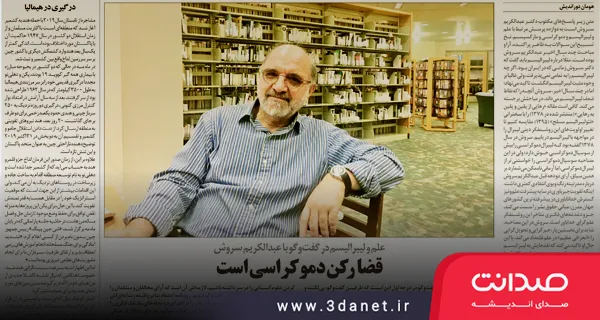
Science and Liberalism
Interview with Abdolkarim Soroush
Adjudication Is the Pillar of Democracy
Hooman Dorandish
Etemad Newspaper - Issue 4671 - Saturday, 31 Khordad 1399
Editor's Note: The primary requirement of dialogue is that the interlocutors express their views without stammering and without their words being taken as carrying political or ideological insinuations, and that they state their opinions on the matters at hand. The discussion of the humanities is also among those topics where dialogue has become intertwined with political approaches; consequently, the core and the periphery of the subject have become trapped behind a thick cloud of misunderstanding. If we harbor the ambition of Islamizing the humanities, it necessitates that we hear the views of opponents and critics in full and enter into dialogue with them. Etemad Newspaper, in accordance with its journalistic duty, considers it incumbent upon itself to facilitate dialogue on this matter and to summon various schools of thought to the arena of discussion and exchange of ideas. Perhaps through this path, we can contribute to the flourishing of the cultural and intellectual circles of our beloved Iran.
The text below comprises the written responses of Dr. Abdolkarim Soroush to twelve questions concerning science, liberalism, democracy, and Marxism. The common thread running through these seemingly disparate questions has been the views and discussions of Abdolkarim Soroush over the past several years. Regarding liberalism, for instance, it must be said that when Dr. Soroush was in Iran, although he did not entirely embrace liberalism, he often emphasized its positive aspects; however, in recent years, Soroush has highlighted what he considers the weaknesses of liberalism in his discussions. It suffices to compare the article "Deliverance from Certainty and Certainty of Deliverance" (published in 1999) with the lecture "Armed Neoliberalism" (2016) to grasp the shift in priorities of this liberal religious intellectual in his encounter with liberalism. In 1999, Soroush had said that he preferred liberal democracy over social democracy; yet in this interview, he considers social democracy more desirable than liberal democracy, but an impossible ideal. In a similar vein, Abdolkarim Soroush's views from two decades ago on modernity bore a less critical tone. The notion that the reinforcement of determinism in the shadow of scientific progress, as well as the spread of atheism in the most advanced countries of the modern world, undermines the foundations of human rights is among the later intellectual concerns of this science-oriented, theistic intellectual. In this interview, Soroush, perhaps for the first time, characterizes determinism and reductionism as a "great deviation" in science. Nevertheless, he emphasizes that his critiques of liberalism, modernity, and modern science do not signify his agreement with Marxism, anti-Westernism, or reactionism.
The written interview of Etemad Newspaper with Abdolkarim Soroush marks his first appearance in Iranian newspapers after nearly twelve years. The last interview of Etemad Newspaper with this popular religious intellectual was a conversation about a translation of the Quran, published in the second half of 2008.
You have always emphasized the necessity of scientific management and, of course, believe that "ought" does not arise from "is." Is not scientific management a kind of deduction of "ought" from "is"? If not, and if society is to be based on scientific management, should we consider the "oughts" derived from scientific management as "true oughts" (and not conventional ones)? If a conflict arises between the oughts of scientific management and ethical oughts, which side should the rulers of society take?
Yes, managerial oughts are not of a value-based nature; they are of a methodological nature and therefore do not contradict the rule of "non-deduction of ought from is." And if a conflict arises between a managerial ought and a value-based ought, values certainly take precedence. Consider this example: "To steal, one must climb over the wall of the house." This (methodological) ought conflicts with "one must not steal" (value-based), so the value must be prioritized.
You consider Darwinism to be the cause of the baselessness of human rights. If the basis of human rights is human dignity before God, will materialism and atheism, in the long run, prove detrimental to human rights?
Jacques Maritain, the French philosopher—who himself participated in drafting the Universal Declaration of Human Rights—says that when we were writing that declaration, no one asked anyone else, “For what reason is the human being respectable and dignified?” We knew that this question would lead to endless disputes. We proceeded on the basis, and agreed, that the human being is respectable and honored and has rights that must be respected. Therefore, the Universal Declaration of Human Rights is a consensus and an agreement based on an accepted and undemonstrated presupposition. Now that we wish to examine it philosophically after the conclusion of the contract, it is of course appropriate to ask: what caused that hidden presupposition to be accepted by all? The simplest answer is that costly and bloody wars had exhausted everyone. The wise among the people saw it fit to place the human being above all other considerations, to set aside religion, race, nationality, color, and history, to speak of his rights instead of his duties, and to invoke the golden rule of ethics: do not do unto others what you would not have done unto yourself. This answer only provides the practical benefit of that declaration and leaves its philosophical roots unspoken. Ultimately, the honored status of the human being is either a mere convention, or is rooted in human selfishness, or truly arises from a dignity that is inseparable from the human being. Now, if we believe in this inseparable dignity, we must go further back and see where the human being acquired it. Theistic religions believe this dignity is a divine gift (the Quran: “And We have certainly honored the children of Adam” / the Torah: “And God created man in His own image”), and that divine breath which the human being carries has made him so honored and esteemed and has made the observance of his rights obligatory. If pure naturalism and materialism were to pervade human society, there would be no way but to base human rights on mere convention, which would of course be very unstable and fragile.
In his book Sapiens, Harari says: “[Today] a huge gap has opened up between liberal humanism and the latest findings of the life sciences. Scientists argue that human behavior is determined by hormones, genes, and neural synapses, not by free will. Liberal political and judicial systems are struggling mightily to push such inconvenient findings aside.” What is your view on this conflict?
For a long time, I have been preoccupied with the concern that a strange contradiction has sickened modern society. On the one hand, in universities, students are taught and sold scientific determinism as the latest achievement of science, they dismiss free will and volition as a myth, and they regard the human being as a machine; on the other hand, they raise the cry of liberalism, human rights, and freedom. It is interesting that biology and neuroscience faculties stand alongside law faculties, where one is based on the unquestioned free will of the human being, and the other finds no place for free will in the brain and nerves and considers everything subject to the firing of neurons and the secretion of hormones. Volition must be brought back into the arena. And this is no easy task. If philosophers possess the resolve and seek to serve, let them begin. Let them water the withered sapling of volition. Whatever volition is, it is that thing which, if it did not exist, the judiciary, the police, punishment, reward, education, responsibility, rights, and so on… would all expire and become meaningless and invalid. Human dignity too, in whatever sense and on whatever basis, would suffer a fatal blow.
If scientific findings do not align with some principles of humanism and liberalism, should liberals abandon their principles? And furthermore, in your view, after weakening religion and pushing Marxism aside, is science gradually locking horns with liberalism?
Science cannot clash with humanism and liberalism. Humanism means human-centeredness and liberalism means rights-centeredness. And these are two unargued, non-scientific anthropological presuppositions that have now come to dominate the minds and intellects of people, and may in the future give way to other assumptions and accepted notions. Just as the duty-oriented view of humanity did not fall because of science, but rather fell because of the rights-oriented view, which was neither scientific nor anti-scientific (that is, it was not the product of any sensory experience). In Marxism, what collapsed were its “scientific” claims about history and economics, which came into conflict with other scientific claims; otherwise, Marxist humanism was and is no less than liberal humanism. Likewise, liberalism’s view of the innate goodness of human beings can conflict with historical anthropology, and it may become apparent, for instance, that humans have never been so very rational and benevolent (which indeed seems to be the case). Nevertheless, liberal rights-centeredness has no scientific opponent.
Four decades on from your critiques of Marxism, how do you view this ideology today?
Aside from the philosophical flaws of Marxism, a system built on historical determinism and offering no means of restraining power will ultimately prove to be misanthropic.
You once said that by democracy you meant “the absence of despotism.” Do you still consider only “minimal democracy” suitable for Iranian society?
Yes, at the current juncture and stage of Iranian society, I still consider minimal democracy and the absence of despotism to be desirable and achievable. The “Hafezian society,” as I have elaborated elsewhere, is also my ideal society in this era.
In your lecture “Armed Neoliberalism,” you criticized liberalism for “neglecting ethics.” But in your book *The Ethics of the Gods*, you stated that moral values are divided into two categories: servant and master, and that 99 percent of moral values are “servant and relative.” Is the ethical framing of lifestyle changes in Western societies not due to the fact that most moral values serve humans rather than master them?
The rights-centeredness of liberalism sometimes stands against traditional morality and deems many morally reprehensible behaviors permissible as a right. Unbridled capitalism also pours oil on this fire. Liberal capitalism has left no room for contentment, piety, patience, generosity, and forgiveness. The superficial see only illicit sexual relations and condemn them, while the corruption of this system is far greater than these. But the main and larger predicament is that no alternative is visible on the horizon for this system. Communism was an unsuccessful endeavor, and no new prospect is in sight. I should not leave unsaid that the emergence of this system has historical causes and did not sprout from the soil of history in vain. But besides causes, there are also reasons at work that have made it endure. There are admirable virtues in this system that cannot be ignored; such as empirical science, freedom of religions, the appointment, criticism, and dismissal of officials, and a strong and fair judiciary (within the limits of human capacity, possibility, and weaknesses). Were it not for these, there would be no allure or stability in this system, and it would have vacated the stage much sooner than its rival system. The judiciary is the strong point of this system, and democracy cannot take hold without it. Just as prayer is the pillar of being a Muslim, adjudication is the pillar of democracy, and reformists should seek its reform even more than elections.
Émile Durkheim said that today’s deviances are tomorrow’s morals. Is assuming in advance the necessity of observing “morals” by society not a conservative stance and contrary to the natural course of evolution?
No, not everything that comes to pass is welcome. Social change is not necessarily toward improvement. That is, there is no guarantee of it. In modern societies, fleeting intellectual and moral fashions have prevailed, which often have no roots and are not justifiable or worthy of being followed. The anchors and bastions of morality should not be easily and generously surrendered to the storm of trendy changes. Human felicity is too grave and immense to be left to the chaotic turbulences of the age.
Karl Popper believed that in the contemporary world a kind of "religion of pessimism toward modernity" has taken shape. Have years of continuous living in the West not made you, to some extent, affected by this religion of pessimism?
The scroll of modernity gradually unfolds further and further, becoming more historical, and its inner secrets become more apparent, and our understanding of it also becomes better and greater. On the one hand, Habermas says that modernity has not yet actualized all its potentials, so a bright future can await it. Adorno and Horkheimer, on the other hand, said that modernity has not kept its promises and has not created a human being on a new level. The Heideggerians, too, awaiting an imaginary utopia, negate and reject the whole of modernity and fix their eyes on the dispensation of history so that, like magicians, they might suddenly make a bird take flight from their empty handkerchief. The point is that no one knows the future. To know the past better than the present and to shed tears of regret for its return is also unwise. We have the present and today. Whatever we have in our power, we must use to plow the garden of our now. Let us leave the future to future generations. The worst thing is to do nothing. Some who negate modernity, development, and science are pessimists and anti-modernity. I am not like that, and as Popper says, when it rains, I take an umbrella, rather than harboring a desire to dry up the seas so that no cloud rises and no rain falls!
In "Armed Neoliberalism," in criticizing the performance of media in the Western world, you have said, "Never have human beings been more intellectually captive than they are now." Does this criticism not negate your previous defense of free media? Ultimately, in your view, do free media show the truth of society to the rulers, or do they subject people to intellectual captivity?
Freedom of the media is a good mixed with a necessary evil. The masses are captivated by the media and, like mosquitoes, go this way and that, deriving their likes and dislikes from the media's inductions and inculcations. But for the elite, free discussion and research is, of course, a heavenly and celestial blessing. The higher the level of people's awareness in society rises, the more the freedom of the media will help their growth.
Some critics consider religious intellectualism to be an advocate of social democracy. On the whole, are you more inclined toward social democracy or liberal democracy?
If only social democracy were feasible; alas, it is not. Therefore, one must be content with and committed to liberal democracy, with all its flaws and with efforts to remedy them.
You apparently do not accept any system of thought without criticism. Do you also have criticisms of modern science?
Modern science has become very deterministic and reductionist, and this is a great deviation. The greatest victim of the reductionism of modern science is human free will. Modern biology and neuroscience have reduced the human being to a bundle of electrical and biochemical communications, leaving no room for his free will. I have previously elaborated on this point. Also, the dominance of atomism has robbed science of holism. Nevertheless, science is progressing well in discovering the orders of nature, and with the help of mathematics, it accelerates its pace of advancement, presenting a clear and novel picture of the East and West and the past and present of the world before our eyes, which is highly commendable. The human sciences, for various reasons, have shackles and chains on their hands and feet that are not impossible to open, but they prove stubborn. The Islamization of the human sciences is a new chain that stems from unfamiliarity with scientific methodology and delays and halts the evolution of these sciences. These whims are the effect and product of that same anti-Westernism which, for several decades, has deemed the selective adoption of Western achievements as improper and impossible, and has now set upon the human sciences.
In Marxism, what collapsed were its "scientific" claims about history and economics, which came into conflict with other scientific claims; otherwise, Marxist humanism was and is no less than liberal humanism.
Apart from the philosophical problems of Marxism, a system that is built on historical determinism and offers no way to check power will ultimately turn out to be anti-human.
In modern societies, fleeting intellectual and moral fashions have gained dominance, which often lack roots and are neither justifiable nor worthy of emulation. The anchors and bulwarks of morality should not be surrendered so easily and generously to the storm of faddish transformations. Human felicity is too grave and immense to be left to the chaotic tumults of the age.
No one has news of the future. Nor is it wise to know the past better than the present and to shed tears of regret for its return. We are left with the now and today. Whatever is in our power we must employ to till the garden of our present. Let us leave the future to future generations. The worst deed is to do nothing.
Freedom of the media is a good mixed with a necessary evil. The masses become captive to the media and, like gnats, flit this way and that, deriving their likes and dislikes from the media's insinuations and indoctrinations.
If only social democracy were feasible; alas, it is not. Hence, one must be content with and committed to liberal democracy, with all its flaws, while striving to remedy them.
.
.
Download the PDF file of this interview from Etemad Newspaper
Download from Server 1 | Server 2
.
.

Discussion10 comments
باید می پرسیدند اگر سلمان رشدی رو از نزدیک ملاقات کنی چی کار می کنی؟
تناقض گویی روشن آقای دکتر سروش" " بلی، بایدهای مدیریتی جنس ارزشی ندارند و از جنس روشاند و لذا با قاعده «عدم استنتاج باید از است» منافات پیدا نمیکنند. " آقای دکتر سروش به گونه ای می فرماید که باید مدیریتی جنس ارزشی ندارد که گویی باید اخلاقی (طبق مغالطه های فلاسفه اخلاق) از چیزی بغیر از پراکسیس برخاسته است.
دادست خیار شیطان را دادار بدان رحمان را نادان نبود ازازیل جاهل بوده برهان را تهمت زده بر خدای عبث ساخته کیهان را خدا غنیست از غیرش امّا آفرید انسان را شیطان بوده پر غرور ز کبر گزید نیران را از خود پرست عالمان اینک ماندیم حیران ما
روزنامه اعتماد باید از دکتر سروش می پرسید جامعه حافظی چگونه جامعه ایست ؟! جامعه حافظی را توضیح دهید باید از دکتر سروش سوال میشد شما برچه اساسی میگویید که سوسیال دموکراسی شدنی نیست بعد از جامعه حافظی سخن میگویید ایا جامعه حافظی شدنی است ؟ مسلما خیر
تاکید بر کرامت انسان سه معنا دارد که دو تایش درست و یکی غلط است . معنای اول این است که هر انسانی بماهوانسانیت مکرم است ،صرفنظر از رنگ و نژاد و مذهب و غیره( که این درست است ) . معنای دوم آنست که انسان به سبب واجدیت "عقل و اخلاق " کرامت و برتری دارد بر حیوانات ( اینهم درست است ولی نه با توضیحی فراطبیعی ، بلکه با توضیحی کاملا طبیعی ) . معنای سوم اینست که انسان کرامت و امتیاز ویژه حقوقی دارد . این کاملا غلط و غیر اخلاقی است . یک گوسفند همان قدر صاحب حقوق است ( در ترازوی اخلاق ) که یک انسان . حال اگر نظام جهان کلا یک نظام شر و غیر اخلاقی است ، و ادامه حیات انسان جز با توحش و ظلم به دیگر موجودات نمی گذرد ، داستان دیگری است . لب کلام : اثبات کرامت انسان با توضیحی کاملا طبیعی ( ترازوی اخلاق ) ممکن است و نیازی به ادخال مفروضات فراطبیعی و یا قرارداد جمعی نیست .
عبدالكريم سروش: اخلاقيات ما به يك حافظ و ناقد احتياج دارد؛ تا با تسلط بر ريشههاي تاريخي به نقد آنها بپردازد حتا در سياست نيز بايد به نقد اخلاقي انديشيد. https://www.isna.ir/news/8305-08675/%D8%B9%D8%A8%D8%AF%D8%A7%D9%84%D9%83%D8%B1%D9%8A%D9%85-%D8%B3%D8%B1%D9%88%D8%B4-%D8%A7%D8%AE%D9%84%D8%A7%D9%82%D9%8A%D8%A7%D8%AA-%D9%85%D8%A7-%D8%A8%D9%87-%D9%8A%D9%83-%D8%AD%D8%A7%D9%81%D8%B8-%D9%88-%D9%86%D8%A7%D9%82%D8%AF-%D8%A7%D8%AD%D8%AA%D9%8A%D8%A7%D8%AC-%D8%AF%D8%A7%D8%B1%D8%AF
اگر جهان مکانیکی است، اگر دموکریتس درست می گفت که جهان جهان صرفا از اتم ها ساخته شده است، اگر جهان یک ماشین است پس اوبرمنش نیچه درست است که بلکه سوپرمن نیچه ای نیز درست نیست و بایست eugenics اصلاح نژادی علمی هیتلر صورت گیرد و سئوال من از فیلسوف ethics این است که در کل هستی دلیلی به من بده تا مثل گرگی دیگران را ندرم. این من نیستم که این را می گویم بنتام Bentham شاهد من است وقتی که گفت: "Man is a wolf". ساینتیسم و نگاه مکانیکس حاصلش رقابت بیرحمانه ای است که دو بار اروپا را از خواب غفلت بیدار کرد و باعث یأس نگاه های مغرور رنسانسی و نگاه فرانسیس بیکنی در جهت شکنجه طبیعت برای فراهم کردن سعادت مندی بشر شد. اما sophistry فلاسفه و فریبکاری راکفلر و کارنگی با تاباندن برق ثروت خود در چشم مهاجرین جویای فرصت در 1900settlement ایجاد شده در امریکا توانست در رقابت با روی دیگر دموکراسی یعنی فاشیسم موسیلینی و هیتلر mass demogogyرا به نتیجه برساند عقل طبقه کارگر را با برق طلای klondike و prospectors کور کند . اگر ما میمون هستیم و از common descend نشات گرفتیم پس اوبرمانش حکم عقل است و اخلاق همانگونه که نیچه این متفکر" صادق " فاشیست می گفت فریب طبقه ضعیف برای مقابله با اخلاق سروران و قدرتمندان است.
خیلی متشکر از سایت خوب صدانت که این مطالب رو منتشر می کنن. استفاده بردیم
عالی بود. تشکر
جناب دکتر سروش چه تعبیر زیبایی بکار بردند. (جامعه حافظی) به نظرم تشخیص ایشان , تشخیص زیبایی است. در جامعه حافظی ,, نه افراط هست و نه تفریط. یک جامعه متعادل و پویا و سرشار از شور و شعف..