Philosophy
Alireza Alavitabar's Article 'Democracy, Liberalism, and Religious New-Thinking'
In a critique of Arash Naraghi, Alavitabar examines the relationship of democracy and liberalism to human rights. He argues that the demands of liberalism are incompatible with socio-economic rights and that democracy cannot guarantee all dimensions of human rights.
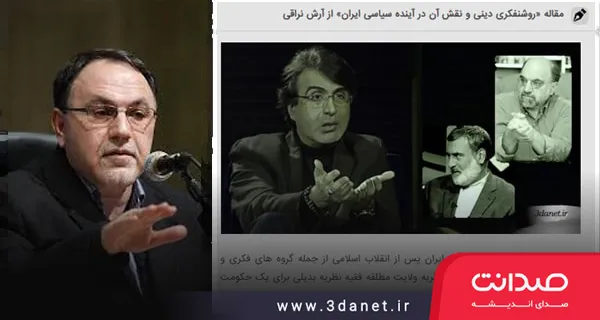
My dear friend and thinker Dr. Arash Naraghi, in a talk and writing entitled “Religious Intellectualism and Its Role in Iran's Political Future,” has endeavored to present a clear formulation of the views of two prominent contemporary Iranian religious new-thinkers (Dr. Abdolkarim Soroush and Dr. Mohsen Kadivar) regarding the ideal government. He has then attempted to determine the relationship of this ideal government with the theological perspectives of these two thinkers and to critique it from the angle of observing minority rights. Although his intellectual order, fairness, and extensive knowledge are evident in his effort, I believe there are significant ambiguities in the said writing that necessitate critique and examination. He has, of course, undertaken this critique and examination with epistemological and theological motivations, but he will allow me, as someone with political preoccupations, to take a look at his discussions. I must clarify that in this piece, I use the terms democracy and liberalism within the domain of political thought and systems, and set aside their applications in other domains.
First) His main concern in this talk (writing) revolves around “observing the rights of minorities in a government administered based on the vote of the Muslim majority.” To clarify the discussion, I draw his attention to a few points. First, a common conception of democracy must be reached. My assumption is that modern democracy rests on three main pillars: 1) Popular sovereignty (acceptance of the people's right to appoint, critique, and dismiss the government and to make decisions on public affairs). 2) Political equality of citizens (acceptance of the equal right of all citizens to hold political office, participate in public decision-making, and oversee the government). 3) Majority rule accompanied by respect for the fundamental rights of the minority (acting based on the majority's opinion in cases of disagreement without eliminating the possibility of the minority becoming the majority in subsequent stages). Democratic systems are more or less successful attempts to realize these principles within the framework of a specific society's conditions and possibilities.
Administering public affairs in modern societies requires the selection and implementation of public policies, and the more modern societies become, the more diverse options governments face during public policymaking, from which they must choose. The administration of public affairs and dealing with public issues and problems cannot be deferred to the consensus and agreement of everyone. One must, through a mechanism, legitimize one option among the choices and make it the basis for action. Apparently, the majority's opinion is the least harmful way to choose. The basis for action is inevitably the majority's opinion, and if a majority exists, a minority will certainly also exist. Whether the society is religious or non-religious, there is still no escape from accepting the majority vote in cases of disagreement. After the majority's opinion becomes law, everyone must have practical commitment to the law, even if they oppose it. Of course, as mentioned, the majority cannot, by relying on its vote, violate the fundamental rights of the minority.
Second) The concern evident throughout Dr. Naraghi's writing is the observance of human rights within the framework of a democratic system. Therefore, one must also reflect somewhat on the relationship between democracy and human rights. Based on a well-known classification, human rights can be divided into four groups:
Civil rights (the right to freedom of contract, property, organization, assembly, expression, and thought, etc.), political rights (the right to participate in political processes and political elections), socio-economic rights (the right to have basic needs such as food, clothing, housing, health, and minimum education met), and cultural rights (the right to benefit from new knowledge and to have a different lifestyle).
Historical experience has shown that the realization of democracy requires the observance of civil and political rights and freedoms, and without their observance one cannot speak of the existence of democracy and a democratic system. Human rights have a much broader basis than the rights necessary for democracy. Achieving democracy does not automatically lead to the establishment and protection of all dimensions of human rights. Democracy is a means to obtain more rights and freedoms, not equivalent to all of them. With the establishment of democracy, one can hope that through the efforts of civil society, other dimensions of human rights will gradually be attained and established. If we equate democracy with the establishment of all dimensions and components of human rights, firstly, no system in the world would be democratic, and secondly, we would find no starting point for establishing more human rights. The establishment of only a part of human rights is sufficient for a minimal democracy.
Third) It is inferred from Dr. Naraghi's remarks that he considers "liberal democracy" the best way to observe and establish the diverse rights of human beings. If this inference is correct, I must say that I do not agree with his view. My discussion is not about governments claiming to be liberal democracies, but about the requirements of the ideology of liberalism itself. To clarify the claim, we must speak a little about the concept of political liberalism. We know there are many disagreements in defining liberalism, but I believe if we set aside the points of difference, we can claim that liberalism is "a political paradigm with one ideal and two guidelines." The main ideal of liberalism, which determines the ultimate goal of every liberal in politics, is "achieving the maximum possible and responsible individual freedom and autonomy." Liberal freedom extends to the boundary of "possibility," meaning as far as it does not cause the collapse of society and the disappearance of collective life. Moreover, it is responsible freedom, meaning everyone has the right to decide for themselves but must also accept the moral and legal responsibility for the consequences of their decisions. To achieve this ultimate ideal, liberalism has two main guidelines. The first guideline is "the separation of the sphere of society from the sphere of government." From the beginning, liberalism has been an intellectual effort to define the private sphere (individual, familial, and economic) against government authority and to defend the sphere of civil society against the government. The second guideline is "limiting government power through law, individual rights, and freedoms." Other issues raised among liberals are all matters of dispute among themselves. I refer to issues such as the defense of private property, the priority of individual freedom over social equality, the separation and division of powers, tolerance and forbearance, etc. The important point is that accepting the two main guidelines of liberalism has specific logical consequences. One of them is the acceptance of the "minimal state," and another is the defense of "negative liberty." The observance of the economic and social rights of human beings and the observance of a part of their cultural rights (access to new knowledge) is incompatible and irreconcilable with these logical consequences. Accepting the enjoyment of basic needs as a "right" creates obligations for the government that differ from the obligations arising from the acceptance of civil and political rights. For the observance of civil and political rights, negative obligations are required, and for the observance of economic and social rights, positive obligations are necessary. Accepting any right creates duties for the government such as protection (of people from deprivation) and assistance (in case of deprivation), and the observance of these rights cannot be guaranteed merely by abstention (from depriving people). It is clear that a government that wants to establish and observe the economic and social rights of human beings will no longer be a "minimal state." The minimal state is limited both in terms of "authority" and in terms of "functions." Whereas economic and social rights and a part of cultural rights require a government whose "authority" is limited, but whose "functions" are more than a gendarme state (minimal state). The reason for neoliberals' resistance to accepting economic and social rights is precisely this: they know it will lead to the violation of their guidelines. Given what has been said, I believe a liberal government, in terms of its foundations, cannot lead to the realization of all human rights; unless we prioritize and give precedence to the realization of some rights (such as the rights of sexual minorities) over other rights (such as the rights of the poor and the excluded).
Fourth) The final point I wish to draw the esteemed thinker (Naraghi)'s attention to is that I believe almost all religious new-thinkers believe in the distinction between “shari'a rulings” and “positive laws.” In the works and writings of religious new-thinkers, this distinction has been demonstrated in several respects. First, in terms of the “mode of formation and change” of each. The derivation of shari'a rulings follows a specific logic; change, the process of understanding the text, and interpretation and correction of understanding are likewise. In positive laws, however, democratic processes and ultimately the majority view are central. The second distinction between the two lies in the realm of “guarantee of enforcement.” The guarantee of enforcement for shari'a rulings is “faith and conscience,” whereas the guarantee of enforcement for positive laws is the “coercive power of the government.” The third distinction is embedded in the “end” of each. Adherence to shari'a rulings aims at “gaining God's pleasure and entering into a life of faith,” while the goal of law is “social order and the realization of a conception of justice.” The fourth distinction is in the area of the “consequence of violating” them. Violating shari'a rulings is considered a “sin,” and violating positive laws a “crime.” Given these distinctions, I believe his concern regarding the realization of the ideal government of the two thinkers under examination is not a very justified concern.
In conclusion, contrary to the advice of my dear friend Dr. Naraghi, I believe that if religious new-thinkers and intellectuals are concerned about democracy and human rights and wish to be the voice of human beings whose voices reach no one (the poor and the marginalized toilers), they must strive to be in a position of “policy-making.” They must play a role in shaping policies, in implementing them, and in evaluating them in the form of “collective action.”
.
Democracy, Liberalism, and Religious New-Thinking
Author: Alireza Alavitabar
.

Discussion0 comments
No comments yet; let yours be the first voice.