Sociology
A Conversation with Mohammad Fazeli on the Socio-Political Voids Created by the Elimination of Mediators
Fazeli sees the elimination of intermediaries as a result of society’s polarization and an obstacle to dialogue, one that makes violence more likely. He identifies distrust as the cause of short-termism and warns that a society caught between the destruction of violence and the continuation of the status quo is a dangerous one.
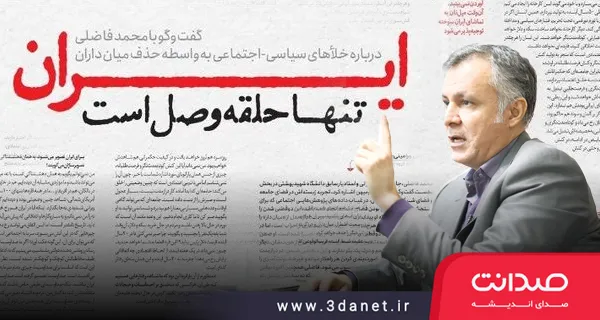
A Conversation with Mohammad Fazeli on the Socio-Political Voids Created by the Elimination of Mediators
Ali Varamini and Narges Kiani
Editorial Board of the Culture Group, Ham-Mihan Newspaper
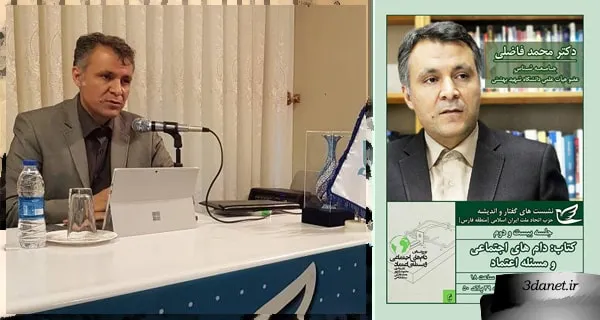
Mohammad Fazeli, an Iranian sociologist and former assistant professor at Shahid Beheshti University, noted in the first part of his conversation with Ham-Mihan newspaper that his lived experience in the social sphere and the space of social networks, in the absence of social research data conducted to measure the degree of polarization in society, confirms this polarization. He considered this a situation that gave rise to a word like "vasat-baz" (middle-player) instead of "miandar" (mediator), adding that although mediation is the essence of many political parties, in the current polarized state of Iranian society, it has become an insult. While confirming the polarization of society, he asserted that the two sides of this polarity, regardless of their identity, no longer have the capacity for dialogue and mutual understanding, and this polarization, in the long run, makes any possibility of mutual understanding, dialogue, and the formulation of any moderate and non-violent solution impossible, posing a danger to society. Fazeli also added that when speech is not conveyed and no action is taken, the group whose speech is not conveyed and whose problem remains unsolved naturally moves towards acts of violence, becomes a protester, and then transforms into a street protester. The crux of Fazeli's remarks in the first part was when he said that the moment society decides between probable destruction, resulting from the violence it inflicts itself, and certain destruction, resulting from the continuation of the existing trend, is a very dangerous moment and recalls the absence of "effective" mediators. Read the rest of this conversation below.
What comes to my mind from your words is whether we can say that one of our maladies is a collective affliction with paranoia? In the sense that, along the lines of the proposition "you're either with us or against us," we consider anything that does not conform to us and does not represent our agitated feelings, emotions, and excitements as a conspiracy against us.
Since I am not knowledgeable in psychology, I do not grasp this collective paranoia and therefore cannot comment on it. I do not see a need to necessarily attribute the existing situation to a psychological matter in order to explain it. The existing phenomenon, in my view, is social, and I consider it to stem from distrust, and I have pointed out what happens in such a situation. Moreover, I must note that a distrustful person also becomes short-sighted. Consider an economic action. A trusting person in, say, the Swedish economy, if they have capital, will build a factory and tell themselves, I will establish this factory so I can engage in production for the next 50 years. If this same person lives in an economy with double-digit inflation, under sanctions, political pressures, and government intervention, they will no longer build a factory; they will buy gold coins and dollars and, in other words, become short-sighted. No matter how much you give this person moral advice, it will be of no use because it is distrust that has led to the production of short-sighted and opportunistic action in them. Therefore, a society whose rulers do not engage in creating trust in the long run will have short-sightedness and opportunism become its characteristics, and this has nothing to do with the traits of being Iranian. If these conditions prevailed in Germany or Sweden, the same thing would happen, and short-sightedness and opportunism would become their characteristics.
These characteristics will subsequently manifest in political action and even in everyday conduct, and we will witness them in the quality of governance. I do not know whether this short-sighted and opportunistic action is something of the same nature as the paranoia you mentioned or not, because I am not familiar with it, but I do know that it is distrust that creates such a situation; a society that is utterly unprepared for long-term work, is extremely impatient, and has lost its patience. A society that can sometimes accept utterly meaningless promises, and you cannot tell it to be patient so that we can do something. Such a promise is like inflation rising and people buying gold coins and dollars, and then you grab someone by the collar and say, why don't you wait for the dollar price to fall in 20 years?! This person will certainly laugh at you, because they do not know what economic events will befall them in the coming week, let alone in 20 years, and this is the very logic of herd behavior.
What I meant by that paranoia was that we witness behaviors whereby anyone who does not act in accordance with our inflamed emotions and excitements is as if conspiring against us, and in colloquial terms, is engaged in whitewashing.
Let me explain it to you this way: the calmer, more predictable, and more certain your situation is, the greater your mental capacity becomes for calculating, factoring in, and considering a spectrum of options. Suppose you are in a calm situation, your financial situation is good, you have a suitable job, and overall everything is calm. Now you want to decide whether to travel to Antalya or the north of the country? Or instead of traveling, invest your money in the stock market? Or alongside your work, take philosophy courses? And so on... In these circumstances, you can consider a spectrum of issues. Now imagine someone enters through the door of this very room we are sitting in and says the building downstairs is on fire. If at that moment I ask you what will happen to our interview? How do you want to publish it? And so on... it is meaningless; because only two options exist. Do we flee through the door or the window? You have certainly heard "My house is on fire, a searing fire." Someone whose house is on fire, a searing fire at that, their only available options are to flee via the normal stairs or the emergency stairs. You cannot expect spectral thinking from a desperate citizen under economic pressure and media constructs in a distrustful society. The vast majority of people in a state of emergency do not think spectrally, and the more intense this emergency becomes, the more those who do think spectrally will resemble unreasonable people.
A fire during a conversation happened to me one or two months ago, and the interviewer and I did not even realize how we descended five floors amidst the smoke and fire rising from the first floor. In that situation, if someone had asked me whether I had packed my bag or when I would return to continue the interview, etc., I would have considered their behavior irrational. The more urgent the conditions become, the more mediators are eliminated, the share of rational thinking diminishes, and ultimately no voice will be heard except that of those on the two sides of the spectrum who are the subject of the conflict. Just as in a place that is on fire, the distinguished personage of the fire and the firefighter are most visible, and who lived in that building, which of their belongings are burning, or which book and antiques, etc., will be further destroyed by the splashing of water, etc., is meaningless. A situation akin to a fire breaking out in a museum. When fire burns and firefighters spray water, if you shout and say one of Picasso's paintings is on such-and-such a wall and be careful not to spray water on it, they will certainly direct you to a corner and say let us put out the fire first; if anything is still in its place afterward, we will think about the water splashed on it. The state of emergency will eliminate mediators and any other rational option.
In your opinion, is the imminent future depicted for Iran as horrific as its portrayers say?
I cannot say whether it is equally horrific or not; I am saying it can be, and we have seen similar cases. In the Middle East, in the Balkans, in Africa, and so on—on every continent except North America over the past 100 years, we have witnessed such a situation and seen that it can leave behind severe devastation. Whether it will also happen in Iran, I do not know; it depends on the mechanisms and the events that unfold. History is not predetermined, but this event can occur. One of the things that burns in this fire is social capital, an occurrence for which one can provide facts as follows: if we recognize the IRIB as the state’s resonance media, we see that, by its own admission, its audience spectrum has grown smaller and smaller. My personal opinion is that, fundamentally, something called social capital is unimportant to the IRIB. The IRIB has decided not to be the broadcaster of the Iranian people, but rather the broadcaster of a specific spectrum it wishes to persuade. In my view, people mistakenly think that many of the IRIB’s programs are broadcast for everyone. Those programs are not for everyone. They are for a specific group that is meant to be persuaded or to enjoy them. My impression is that the IRIB only broadcasts football for everyone. Because it contains no ideological content, and under the pretext of broadcasting it, one can collect advertising money from industries, factories, and companies. I say football, and not even the entirety of sports, because women’s sports are also not broadcast by the IRIB. Apart from football, in all other matters, the category of social capital is fundamentally meaningless for the IRIB. We used to mistakenly ask the IRIB, why don’t you do something to increase your social capital? Whereas it had already made its decision and did not want to be the media of all the people.
I think it gradually reached this conclusion and said to itself, well! I’ve lost the rest; let me at least not lose the small group I can persuade.
I do not think so. I am saying that the IRIB decided from the beginning to produce programs for a specific group and said to itself, if the rest are lost too, so be it. These are two different matters. You are saying it first saw that it had lost a group and then said to itself, let me at least cling to those who remain. I am saying, no! It first clung to those it had handpicked and then said, if the rest are lost too, so be it. When accessible alternatives also emerged and it felt it could not compete with them, it ultimately reached the aforementioned conclusion. So it reached another conclusion as well, which was: I will go and eliminate those alternatives! For instance, eliminate the internet, cyberspace, platforms, and so on. These two conclusions are separate from each other.
My point is that it seems the discussion of a lack of trust has also reached the lower layers. An example is that individuals whose capital was the reputation they had accumulated in society over many years were completely cast aside over the slightest stance that did not conform to the prevailing emotional state.
Here too, I take a spectrum view and say that just as there have been attacks, some have also offered support.
Although the voices of the supporters are not heard.
That is natural. In no conflict is the voice of the mediator heard as it should be. They are calling for calm, while only those who hurl insults and wield clubs are seen. I told you explicitly, in an atmosphere of distrust, calling for rationality is irrational. That is, its goal and its means do not align. I say this in the sense of Weberian rational action. Weber believes an action is rational when its means are compatible with its goal. So if, for example, one day you are told to go to the moon on a bicycle, you consider that an irrational action and say this tool is useless for that goal. So for this reason, I say calling for rationality, in a moment of intense distrust, is irrational; because it will yield no rational result, and not only will you not achieve your intended goal, but you yourself will also be pushed back.
Let's assume you are a company, a business, providing services. You are going about your work and are not a political activist, but both sides of the conflict expect you to take a stand, each believing you are either with them or against them. It is as if, in this atmosphere, inaction also has consequences, and you must explicitly declare your position, with no right to remain in the middle. What should one do in this situation?
This situation is similar to that of a burning building. When you are told to leave the building because it is on fire, and you ask, "What should I do?" the person watching you from outside—whether a firefighter or a friend calling out to you—tells you to save yourself through the door or the window. They declare that you cannot stay in the middle of the incident. Our situation is analogous to that of a building on fire. A situation in which an imminent danger threatens us. This situation is like a state of war. Imagine during the Iran-Iraq war, in one of the operations, someone went up on an embankment and shouted, "Don't kill each other, you are causing each other's death!" Would this action seem rational?! In such situations, mediators are eliminated in the long run, which is why wars last for a long time, until a mediator finally emerges or the parties despair of being able to settle scores with one another. But before that, they fight as much as they can, as long as their hope for victory has not been extinguished.
I disagree with your example. A house on fire is a situation that has occurred, but in our current situation, there are those who inform the parties that a certain place has not yet caught fire, telling them to set fire there too to finish the job. There are parts that have not yet burned and can be saved, and with their help—whether individuals or institutions—reconstruction can begin.
This is precisely the point where, for some groups and for whatever reason, the principle of destruction takes priority over the continuation of the status quo, and people reach a point where they tell themselves that a new situation will not emerge until the existing one is destroyed. In this context, it is thought that there are those who aid the functioning of the system. By the functioning of the system, I do not mean the functioning of the structure; I mean, for example, the companies that were boycotted by the people during the protests. These companies were not necessarily aiding the functioning of the structure; one facilitated the purchasing process, and another transported passengers. They were providing services to the people, but it was insinuated that they too must be struck. Why? Because they are helping to perpetuate the status quo. A situation that you, as one side of the conflict, are unwilling to accept. I mentioned that in conditions of distrust, anything can be proposed, an occurrence that also happens in conditions of absolute trust and is equally wrong. A condition of absolute trust is one in which someone tells you it is night, even though it is day, and due to absolute trust, you confirm that it is night. Whereas in conditions of relative trust, if you hear it is night, at the first opportunity you get, you pull back the curtain and check for yourself. In absolute distrust, however, you act inversely. That is, if someone tells you it is night, you necessarily say no, it is day, even if it coincidentally happens to be night! This is the characteristic of a state of distrust. In a state of distrust, one can build a campaign against anything, tweet, and make a believable point.
Regardless of any political bias, we, in the face of the totality called Iran, need social capital, and our burning house will collapse without their presence and existence. Capitals whose existence we will need in any hypothetical future political institution if we wish to engage in reconstruction. On the other hand, you rightly say that in a state of distrust, calling for rationality is the very essence of irrationality. So how can one protect social capitals and not forget the need for their existence in any emergent political situation, for the reconstruction of the totality of Iran?
I still consider the primary duty to lie with the structure. For it is the structure that possesses the media, money, capacity for negotiation, organization, and all the power to take steps toward problem-solving and building trust. Moreover, we must not forget that lost trust does not return so easily and requires a play of signs. This means a sign must emerge that indicates a will to solve the problem. The current situation is like wanting to go to, say, Mashhad, but the person behind the wheel is driving toward Qom, and naturally, we ask them to show a sign of turning back toward Mashhad, to at least make a U-turn and head to that side of the highway so we can then discuss when we will arrive in Mashhad.
I still consider the structure to be the primary agent and the responsible agent. Because if you sever the relationship between authority and power from responsibility, nothing remains. If you have power, you also have responsibility. If you have authority, you also have responsibility. Another point is that, as I mentioned, in an atmosphere of distrust, calling for rationality is irrational and costly, yielding neither worldly nor otherworldly reward, while history has shown that political action must lead to results and be an ends-means action. In other words, political action is among instrumental actions, meaning you do it to achieve a result. Now imagine if, from the current situation, it is assessed that political action leads to no result. In this state, most people will leave the field. Creating conditions for the survival of the remaining mediators, or those who have left the field and see no space for activism, is the duty of the structure. Individuals must see the play of signs and become certain that if they enter and perform that costly, irrational action at certain levels, they will achieve results in the long run. The axis of this story must be Iran itself. I say explicitly: Iran, and nothing else. The only thing that can be the connecting link in this is Iran, and nothing else. Because anything else will be considered deceptive. The potential for actions to be perceived as deceptive is high. In the past three months, huge billboards under the general title "Our Iran" have been installed across Tehran, or for instance, a billboard has been designed depicting Achaemenid soldiers seeing off members of Iran's national football team. In these circumstances, can one not ask whether the blessed soul who designed these billboards has forgotten that the history of ancient Iran has been under a discursive eclipse for the past 40 years?!
Or the image of the Persepolis building, which was removed from our money.
Yes. Can you remove Persepolis from your banknotes but then use Achaemenid soldiers to bid farewell to your national football team members?! And then fill the city with “Our Iran” banners! Where was this “Our Iran” in your discourse before?! And don’t you think these actions will be interpreted as hypocrisy? These actions are only believable if the structure makes strategic decisions and, based on those decisions, no longer engages in a hypocritical confrontation with the category of Iranian identity, and recognizes the tripartite identity of Iranian identity, Islamic identity, and Western identity, and accepts that part of the identity of the contemporary Iranian person is the identity of the new world. The structure must accept that it is compelled to recognize this identity of the new world alongside the identity of the world of ancient Iran, and that the Islamic aspect of this identity is not solely Islam according to its own narrative. Then it would be rational for more mediators to enter the arena, but if the door keeps turning on the same old hinge, nothing of ours will still be consistent with anything else of ours. You cannot send an Achaemenid soldier to see off your football team player while you have previously removed Persepolis from your banknotes. These are mutually inconsistent behaviors. In the long term, the structure must build trust, from the details of its actions to its macro-policies, and as long as this is not the case, mediators cannot defend its existence. The mediator says the structure is showing a positive reaction, and the audience holds up the banknote from which Persepolis has been removed before their eyes and asks with a sneer, is this the positive reaction?! What can you say in this situation?! This process is the process of eliminating mediators and eliminating any rationality for the non-violent management of conflict. Because societies are fundamentally and at various levels prone to creating conflict, and conflict has always been resolved by mediators. For example, holding a court is also a form of mediation. The judge is themselves a mediator, and judicial systems can even create mediators prior to the judge. Mediators who facilitate reconciliation, and only at the final point, if the possibility of reconciliation fails, do they resort to the law. A society whose mediation mechanisms are being destroyed, and in which mediation is used as an insult, is sick. This does not indicate the progress of a society; it indicates its illness. Although I emphasize again that the culprit for this situation and the entity responsible for the destruction of mediators are the structures.
I completely sympathize with you, but there is another important actor, though not equal in weight to the structure, in this equation. In this context, a diaspora community has formed, waiting to take over scorched earth and intent on destroying any institution or individual it feels does not conform to its excitements and extremist views. Those whose activities include, for example, attacking anyone in Iran operating within the current structure—from economic actors to writers and political activists—apparently do not understand that the structure is not so dependent on the continuation of that economic activity, and the main blow will not fall on the structure but on the actors of that semi-functional economy. What is your opinion on their role, and how do you read their intentions?
In my view, this phenomenon is a combination of several factors. First, I do not consider Iranians abroad as a monolithic whole. According to various accounts, we have three million, five million, or seven million Iranians abroad, and treating them as a monolith is a grave and unforgivable mistake. They are different spectrums with different perceptions and behaviors, and depending on the nature of their relationship with Iran, they exist at different cognitive levels regarding it. Depending on how many times a year they visit Iran, whether they can visit at all, and whether their family resides in Iran or not, they receive different information and have different political leanings. Also, depending on whether they have interests in Iran, whether they have a business in Iran, and so on, they engage in different behaviors. So, first, Iranians abroad must absolutely not be considered a monolithic whole. The second point is: did their departure from Iran come with a good memory or a bad one? This is a very important point. Some of these Iranians left the country with hatred, and some were forced to leave the country, although some others left Iran for the sake of their children, and some for other reasons, but in any case, the main question is whether they left wounded or not. The third point is: after leaving the country, have they themselves or their families been wounded or not? The answer to these questions is effective in determining what their action towards Iran will be, as well as the answer to the question of whether the wound on their body is the result of the actions of the establishment or not. The answers to these questions are important.
A concept I introduced in one of my articles was “thing-loss.” In that article, I wrote that in Iran, everyone has lost something. One person has lost their lifestyle, another the years of their life, another their company, and so on. This thing-loss is one of the determining factors in the relationship of Iranians abroad with Iran, and we must answer the question: what have they lost by leaving Iran, or because of losing what did they leave Iran? These questions are oriented toward the past, and the question oriented toward the future is: what are they going to gain, or what else are they going to lose? The human being is an entity part of whose existence lies in the shadow of the past and another part of whose existence lies in the shadow of the future. If you are among those Iranians who, in the shadow of the past, were deeply wounded and lost many things when you left Iran, and in the shadow of the future, you see nothing to gain, then your desire to watch Iran burn becomes justifiable. For example, you were sentenced to prison in a political case and, after release, were forced to abandon everything and leave, and given the current situation, you see no prospect of return. In this state, what do you think? Colloquially speaking, it’s “If the pot doesn’t boil for me, let it boil over the dog’s head.” And I say again, explicitly, we Iranians need to resolve this issue, at least in the long term. The population we are talking about, a population wounded in the past and seeing no prospect of benefiting from their country’s future—even a benefit as small as missing their country and wanting to take a stroll in their city—by wishing for destruction, both takes revenge for the past and creates the possibility of imagining a prospect for the future. If we Iranians, with a population of 84 million, as those who desire the development of our country, want this community far from the homeland, this diaspora, to abandon the idea of “If the pot doesn’t boil for me, let it boil over the dog’s head,” we must both heal the past and create a prospect for the future. Otherwise, everything will remain as it is, and we will always witness the presence of a minority who adhere to the idea of the pot and the dog’s head. This minority, in a geopolitical situation where we are in an ideological conflict with the world and have clashed with many powers, is always ready to enter the game to take revenge for the past and build the future. Moreover, the majority of those outside Iran are also influenced by the atmosphere inside. Iranians abroad had never participated in demonstrations in this way before, and it should not be forgotten that the flow of influence is from inside to outside, not from outside to inside. If nothing had happened inside, they would not have held a 60,000-person demonstration in Berlin. Shaping a social space with these characteristics outside requires the emergence of upheavals inside, and until you resolve your problem inside, you will not be able to resolve the problem outside either. This is a very important point, and I still see the problem as being inside, not outside.
There is a vast spectrum whose concern, regardless of any dominant excitement, is Iran and its collective good. Even those who attack the moderates ultimately imagine they are doing the right thing. Under these conditions, how can we move from this “me against you” situation to a “you and me against the problem” situation, and can a step be taken in this direction?
The first step for two people to unite against a problem is a minimum of trust, and fundamentally, to do anything, we need a minimum of trust. “You and me against the problem” means you and I trust each other. Now you say “me and the structure, together, against the problem,” for which to happen, at least a minimum of trust must exist. Everything begins with trust, and no matter how many times you ask this question in different ways, I will say: until you create trust, you will achieve nothing.
Is the structure the main agent for creating this trust?
Exactly. The main agent for creating trust is the structure, and go up, go down, at least from me, you won’t hear another word. I say that to overcome the current situation, we need trust, and trust is created by the structure. Even the platform for the rest of the people to join the process of creating trust is created by the structure.
Even society's trust in its own constructed institutions is made possible by structure?
Yes. That is why, in the World Values Survey conducted since the 1970s, the highest levels of interpersonal trust belong to countries whose structures enjoy the highest quality of governance. If the highest levels of trust are observed in Sweden, Norway, and the Scandinavian countries, and the lowest levels in Romania or African countries, it relates to the difference in the quality of their structural governance, not to their people. In other words, it is not that Iranians, Romanians, or Mexicans are inherently distrustful; rather, it is the quality of the structure that determines trust even between individuals. The book "Social Traps and the Problem of Trust" by Bo Rothstein essentially addresses this very issue. There is an institute in Europe called the "Quality of Government Institute" that has been working on this issue of trust and structural quality since 2005. Trust is a product of the quality of structures; therefore, the possibility of you and I uniting against a problem is enabled by the quality of structural governance and the infrastructure it provides. You and I sit and converse to solve a problem, but if the structure shuts down your newspaper and arrests me, then there will no longer be a you-and-I to offer solutions against any problem.
With this realistic depiction, we must then wait for the miracle of coming to our senses.
The miracle of the balance of powers. At the social level, reason is not something inside the human head; reason is a relationship between society, structure, and the market. Reason is a relational matter, and if we rely solely on what is in people's heads, then I will think the right way is one thing, you will choose another, and the structure will tolerate nothing but something else. Because this relationship is unbalanced and does not work, rationality does not emerge either. Another meaning of coming to one's senses can be considered as being situated within a system of balanced relations. The sufficient condition for the emergence of reason is the balance of power, not the concentration of knowledge; that is, the concentration of knowledge does not create reason. Concentration of knowledge means our cognition increases, but a balance of power must also be established for reason to emerge.

Discussion1 comments
کاربرد « وسط باز » در وصف کسانی که مطیع هیچ یک از دو سر یک نزاع نیستند ، ماهیت دیکتاتورانه گوینده را اشکار می کند : یا زنگی زنگ یا رومی روم ؛ یا با ما ، یا با اونا ؛ یا این طرف یا آن طرف ... در واقع انگاره کسانی است که در حد تفکر قبیله ای باقی مانده و نه مرکب بودن وضع را می فهمند و نه مدرج بودن امور را درک می کنند ؛ تفکری که با همزیستی در جوامع رشدیافته و فرارفته ار بافتار دودمانی ، از بیخ منافات دارد . اینان می خواهند با رواج « وسط باز » به عنوان دشنام ، کوته فکری خود را فراگیر سازند . این پسرفت فکری هر اندازه قدرت بگیرد ، پسرفت اجتماعی و سیاسی را به همراه می آورد .