Political Science
Mohsen Shokouhi's Note in Etemad Newspaper Critiquing the Final Chapter of 'The Birth of Israel'
In a piece for Etemad newspaper, Mohsen Shokouhi critiques Sadegh Zibakalam's justification for banning Holocaust research. He argues that this rationale is incompatible with liberal principles and could set a precedent for restricting inquiry across Islamic countries.
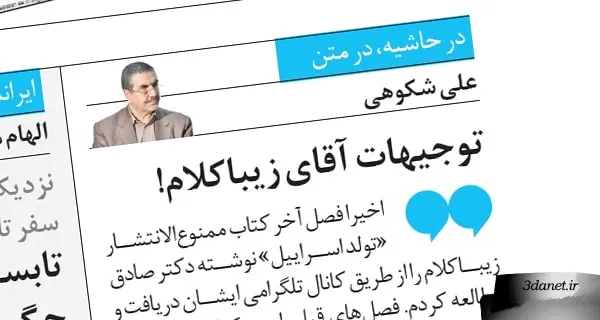
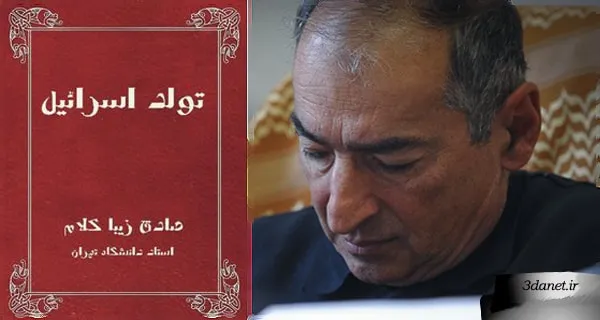
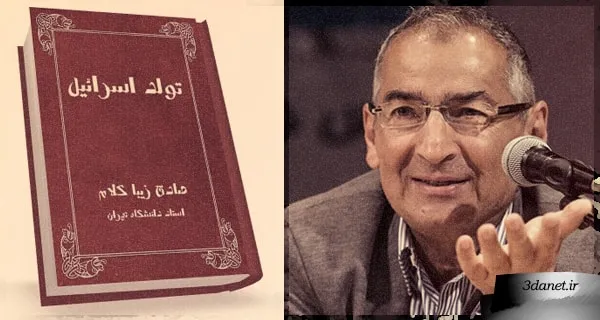
I recently received and read the final chapter of the banned book "The Birth of Israel" by Dr. Sadegh Zibakalam through his Telegram channel. I had seen the earlier chapters of this book as well, but to grasp its conclusion, I had to read it with greater reflection in order to better understand Zibakalam's differing perspective on the establishment of the State of Israel in the land of Palestine. Of course, I do not wish to critique his overall view on this matter for now—that must be addressed in its proper place—but rather, I merely want to delve into a specific issue that is inconsistent with Mr. Zibakalam's liberal approach and, I believe, ensnares him in a contradiction.
In a section of his writing, Zibakalam poses the question: "Why is research on the Holocaust not permitted in the West, and to be more precise, in many European countries, and why have individuals who researched the Holocaust and denied its occurrence been punished? Is there no freedom in the West? Why, in the West and in a liberal democratic system where research and theorizing on any subject, from the denial of God Almighty to the most sacred religious and moral beliefs, is unproblematic, is it not possible to research the Holocaust, and why is there a legal prohibition against it?" He immediately provides a concise answer to this question in this manner: "The root of the laws and regulations enacted against the examination of the Holocaust in a number of European countries lies, in fact, in the issue of anti-Semitism, or in the anti-Jewish and racist nature of Holocaust deniers. In other words, the reason for opposing Holocaust denial and criminalizing it is, in truth, due to the racist and anti-Jewish nature of the Holocaust deniers."
After this general answer, Zibakalam presents all his evidence for the definitive occurrence of the Holocaust, but he claims that the hatred of Europeans for Jews was so profound that even with the revelation of the Holocaust's crimes, that animosity did not transform into friendship and affection, because "the malice, animosity, hatred, and antagonism against Jews were so deep-rooted that even the Holocaust did not bring some anti-Semites to their senses." In Zibakalam's view, within Europe itself, "after the initial sympathy, the Holocaust, or more accurately, the tragedy of the Holocaust, gradually faded from memory, and the same millennia-old feelings of hatred for Jews resurfaced for many anti-Semites." According to him, anti-Semites turned to Holocaust denial in order to cope more easily with this great massacre and to continue their hatred and enmity toward Jews with a clear conscience.
Zibakalam then poses the question of what lesson should be learned from it so that such a crime is never repeated, and in his opinion, answering this question required accepting the reality that the Holocaust had occurred. According to Zibakalam, "it was very regrettable that, due to a handful of biased, short-sighted, sick, flawed, and racist anti-Jewish thoughts and ideas, the possibility of learning from that horrific historical tragedy was being lost." From his perspective, it was for this reason that such laws were passed in Germany and other European countries so that "Holocaust denial would be considered a racist act." Zibakalam defends this because he holds a definite presupposition that "Holocaust deniers were, in reality, anti-Jewish individuals who had cloaked their racist sentiments and hatred of Jewry in a magnificent, demagogic, and misleading guise of 'impartial scientific research.'"
Mr. Zibakalam's method of justification and reasoning is very interesting and contrary to the approach that most liberals resort to. A liberal usually prioritizes freedom over truth and does not place any truth in a position where, in the name of defending it, the freedom of others can be restricted. They consider freedom a one-way process that must not negate itself, and therefore, it is meaningless for a liberal to deem the critique of the Holocaust impermissible and even a crime on the grounds that the Holocaust is a definitive truth.
Worse still, Zibakalam labels all opponents of the Holocaust as "demagogic and biased anti-Semites" and accords no dignity to independent research and inquiry. Can one really not imagine that some people, without holding racist views and purely from the standpoint of an impartial researcher, might investigate the Holocaust and arrive at different conclusions? Another point is: would Mr. Zibakalam allow the same logic to be applied in Islamic countries, including Iran, so that a set of historical issues become sacrosanct, any scientific research and examination of them is prohibited on similar grounds, and authors writing about them are branded criminals in advance? By Mr. Zibakalam's logic, is there any problem with considering the criminality of America and Israel, the treason of Reza Shah, the red line of nuclear energy, and similar matters as absolute truths, such that anyone who challenges them is a criminal deserving of legal prosecution? Couldn't this very reasoning of Mr. Zibakalam be carved out for these instances as well and place them beyond the realm of critique and scrutiny? I am not personally a Holocaust denier, and I believe Europe must compensate for it because it was the perpetrator of the Holocaust. I do not at all accept that Muslims in Palestine should have paid the price for those crimes, and I also protest against Israel's current anti-Palestinian Holocaust. At the same time, Zibakalam has not remained faithful to his own liberal principles in this matter, and it is interesting that he has resorted to justifying the West and its contradictory behavior in an affair where Zionists are involved, and not necessarily Jews. The influence of Israel, the Jewish Agency, and their affiliated organizations in Europe is so strong and powerful that they can pass laws of this kind and prosecute their critics.
.
.
Mr. Zibakalam's Justifications
Author: Mohsen Shokouhi
Source: Etemad Newspaper - Dated 5 October 2016
.
.

Discussion0 comments
No comments yet; let yours be the first voice.